Reverse chain rule introduction
TL;DR
The reverse chain rule allows us to find the integral of a function by identifying its composition and applying a simple formula.
Transcript
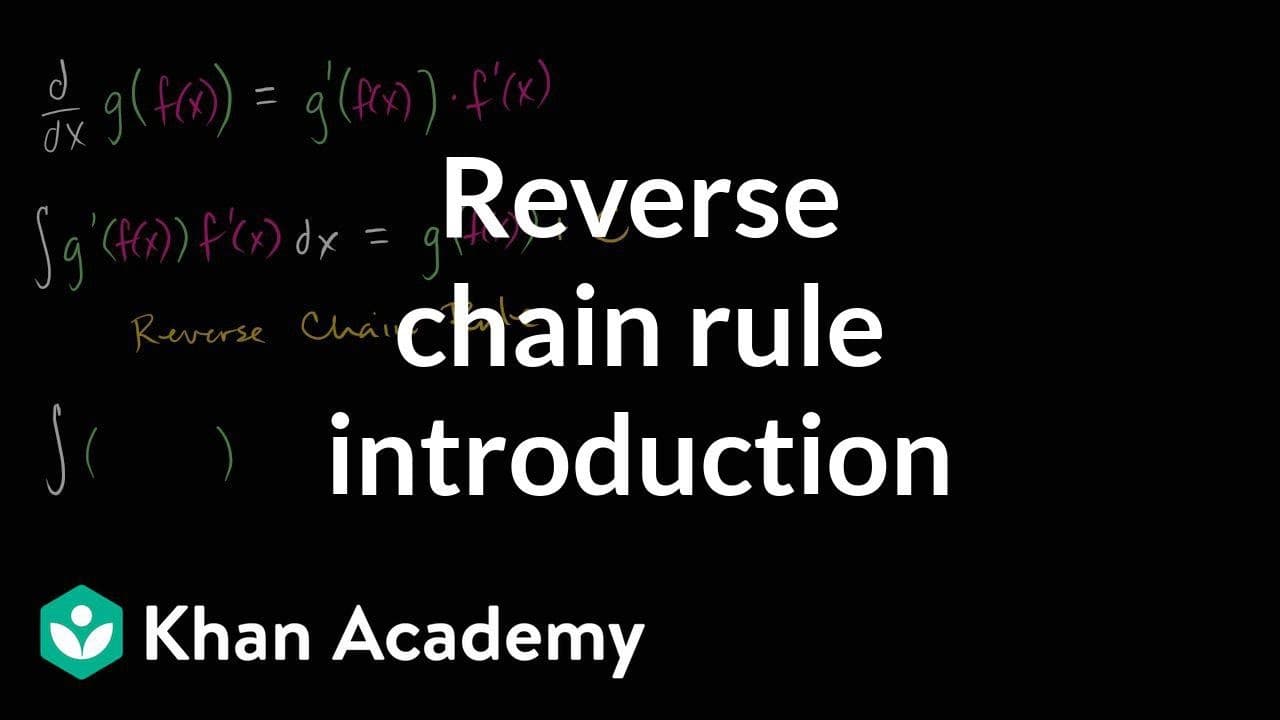
- [Voiceover] Hopefully we all remember our good friend the chain rule from differential calculus that tells us that if I were to take the derivative with respect to x of g of f of x, g of, let me write those parentheses a little bit closer, g of f of x, g of f of x, that this is just going to be equal to the derivative of g with respect to f of x,... Read More
Key Insights
- 📏 The reverse chain rule is a powerful tool that simplifies the process of finding indefinite integrals.
- ⚾ It is based on the concept of composition of functions and the derivatives of those functions.
- 🍽️ By identifying the inner and outer functions and their derivatives, we can apply the reverse chain rule to find the indefinite integral.
- 🥘 The reverse chain rule is essentially a shortcut for u-substitution, allowing us to solve integrals more quickly and efficiently.
- 📏 It is important to understand the chain rule in differential calculus before attempting to use the reverse chain rule.
- 📏 The reverse chain rule can be applied to functions that follow a specific pattern, where the composition of functions can be easily identified.
Install to Summarize YouTube Videos and Get Transcripts
Explore YouTube Video Summarizer or Get YouTube Transcript Extractor
Questions & Answers
Q: What is the reverse chain rule?
The reverse chain rule is a technique that allows us to find the integral of a function by identifying its composition and using a simple formula. It is the reverse of the chain rule used in differential calculus.
Q: How does the reverse chain rule relate to u-substitution?
The reverse chain rule is essentially a shortcut for u-substitution. Instead of explicitly substituting variables, we apply the reverse chain rule to find the integral in terms of the original function.
Q: Why is the reverse chain rule useful?
The reverse chain rule allows us to solve integrals more quickly by bypassing the need for explicit substitution. It simplifies the process of finding indefinite integrals of composite functions.
Q: Are there any limitations to the reverse chain rule?
The reverse chain rule is applicable to functions that follow a specific pattern. It may not work for all types of functions, especially those that do not exhibit clear composition.
Summary & Key Takeaways
-
The reverse chain rule states that if we have the derivative of a composition of functions, we can find the integral of that expression by reversing the chain rule.
-
By identifying the inner and outer functions and their derivatives, we can apply the reverse chain rule to find the indefinite integral.
-
The reverse chain rule is essentially a shortcut for u-substitution, allowing us to solve integrals more quickly.
Read in Other Languages (beta)
Share This Summary 📚
Summarize YouTube Videos and Get Video Transcripts with 1-Click
Try YouTube Summary with ChatGPT & Claude or YouTube Transcript Generator
Explore More Summaries from Khan Academy 📚



Summarize YouTube Videos and Get Video Transcripts with 1-Click
Try YouTube Summary with ChatGPT & Claude or YouTube Transcript Generator