Example of hypotheses for paired and two-sample t tests | AP Statistics | Khan Academy
TL;DR
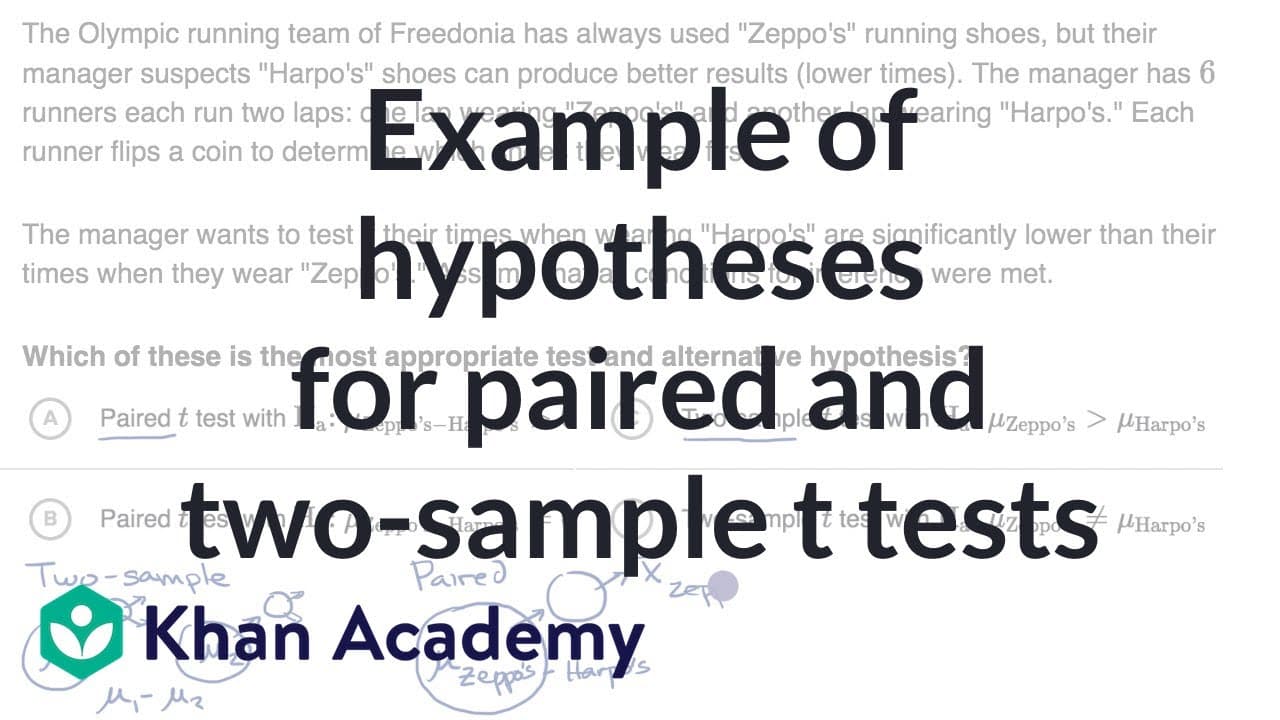
The manager of an Olympic running team wants to determine if Harpo's shoes produce significantly lower times than Zeppo's shoes, conducting a paired T-test.
Transcript
- [Instructor] The Olympic running team of Freedonia has always used Zeppo's running shoes, but their manager suspects Harpo's shoes can produce better results, which would be lower times. The manager has six runners each run two laps. One lap wearing Zeppo's and another lap wearing Harpo's. Each runner flips a coin to determine which shoes they we... Read More
Key Insights
- ⏳ The manager wants to test if Harpo's shoes result in significantly lower times than Zeppo's shoes.
- 🏃 The study involves paired measurements within the same group of runners, making it suitable for a paired T-test.
- ⌛ The null hypothesis assumes no difference in mean times between the two shoe types, while the alternative hypothesis suggests a greater mean difference.
- 😩 The analysis of the study focuses on the mean difference between wearing Zeppo's and Harpo's shoes.
- ⏳ The manager's goal is to gather evidence suggesting that Harpo's shoes yield lower times compared to Zeppo's shoes.
- 👻 The paired T-test allows for a direct comparison between the two shoe conditions and accounts for individual differences in performance.
- 🦖 The results of the paired T-test will determine if there is statistical evidence for the manager's belief that Harpo's shoes can produce better results.
Install to Summarize YouTube Videos and Get Transcripts
Explore YouTube Video Summarizer or Get YouTube Transcript Extractor
Questions & Answers
Q: What is the difference between a two-sample T-test and a paired T-test?
A two-sample T-test compares the means of two independent samples from different populations, while a paired T-test compares the means within the same population by pairing observations.
Q: What is the null hypothesis in this shoe comparison study?
The null hypothesis is that there is no difference in mean times between wearing Zeppo's and Harpo's shoes, meaning the mean difference is equal to zero.
Q: What is the alternative hypothesis in this study?
The alternative hypothesis is that the mean difference between wearing Zeppo's and Harpo's shoes is greater than zero, indicating that Harpo's shoes result in significantly lower times.
Q: How is the mean difference calculated in a paired T-test?
In a paired T-test, the mean difference is calculated by subtracting the measurement with Zeppo's shoes from the measurement with Harpo's shoes for each individual in the sample. The mean of these differences is then calculated.
Summary & Key Takeaways
-
The manager of the Olympic running team suspects that Harpo's running shoes may result in lower times than Zeppo's shoes.
-
To test this hypothesis, the manager has six runners each run two laps, one wearing Zeppo's shoes and the other wearing Harpo's shoes.
-
A paired T-test is appropriate for this scenario, as it compares the mean difference between Zeppo's and Harpo's shoes within the same group of runners.
Read in Other Languages (beta)
Share This Summary 📚
Summarize YouTube Videos and Get Video Transcripts with 1-Click
Try YouTube Summary with ChatGPT & Claude or YouTube Transcript Generator
Explore More Summaries from Khan Academy 📚



Summarize YouTube Videos and Get Video Transcripts with 1-Click
Try YouTube Summary with ChatGPT & Claude or YouTube Transcript Generator