How to Understand Backpropagation in Neural Networks
TL;DR
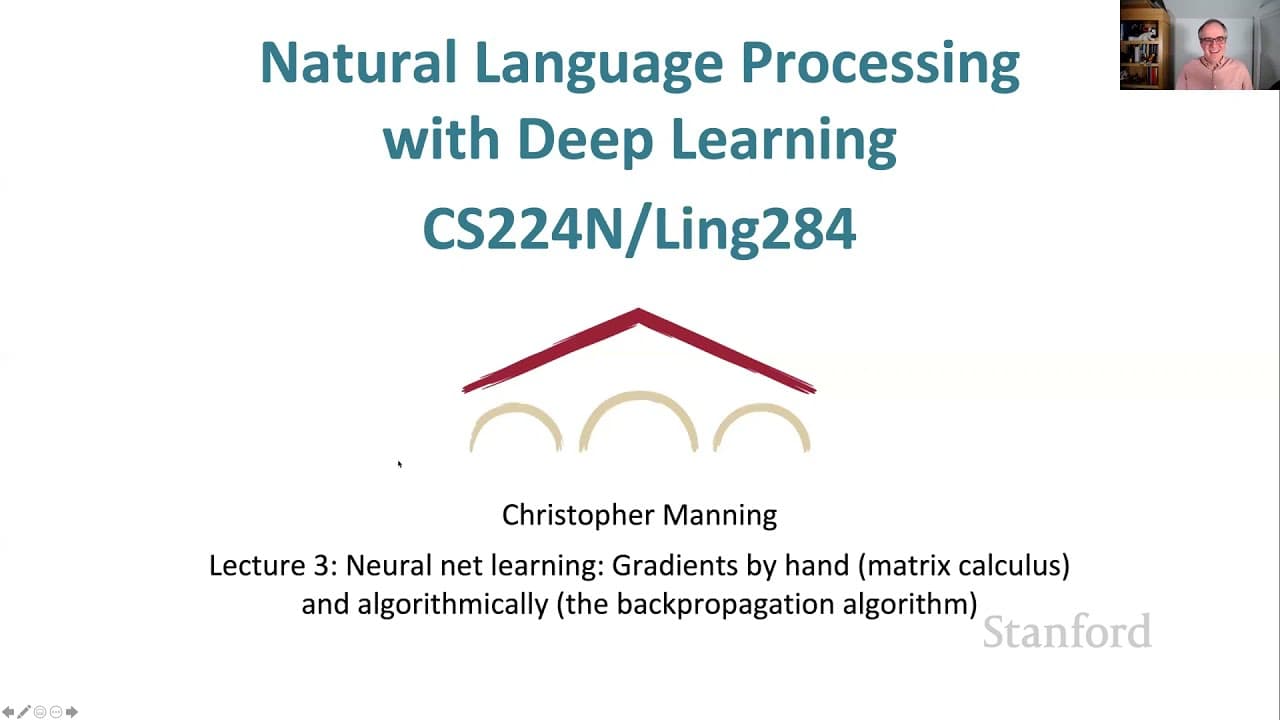
Backpropagation is the key algorithm used for training neural networks, enabling efficient gradient computation. This lecture details the mathematical foundations of backpropagation and how it applies to tasks like named entity recognition, highlighting the significance of the computation graph in optimizing the learning process.
Transcript
hi everyone i'll get started okay so we're now i'm back for the second week of cs224n um on natural language processing with deep learning okay so um for today's lecture what we're going to be looking at is all the math details of doing neural net learning first of all looking at how we can work out by hand um gradients for training neural networks... Read More
Key Insights
- 🚂 The back propagation algorithm is crucial for training neural networks by computing the gradients of the parameters.
- 🎭 The computation graph and topological sort are used to perform forward and backward propagation efficiently.
- 🔁 Efforts are made to avoid repeated computation and optimize the training process.
- 📏 The chain rule is applied in back propagation to calculate gradients by multiplying local and upstream gradients.
Install to Summarize YouTube Videos and Get Transcripts
Explore YouTube Video Summarizer or Get YouTube Transcript Extractor
Questions & Answers
Q: What is the purpose of the back propagation algorithm?
The back propagation algorithm allows us to calculate the gradients of the parameters in a neural network, which is crucial for training the network. It enables us to update the weights of the model based on the computed gradients, improving the accuracy and performance of the network.
Q: Why is it important to avoid repeated computation in back propagation?
Repeated computation can significantly slow down the training process. By reusing derivatives of higher layers, we can save computational resources and ensure efficient training. The back propagation algorithm aims to minimize repeated computation and optimize the overall training process.
Q: How does the chain rule play a role in back propagation?
The chain rule is the fundamental principle used in back propagation. It allows us to calculate the gradients of each layer in a neural network by multiplying the local gradient with the upstream gradient. This technique enables efficient computation of the derivatives required for updating the parameters.
Q: Why is the shape convention important in back propagation?
The shape convention ensures consistency in the dimensions of gradients and parameters for efficient gradient updates. By reshaping the gradients to match the shape of the parameters, we can perform element-wise operations and update the parameters accordingly. It allows for proper implementation of stochastic gradient descent.
Summary & Key Takeaways
-
The lecture focuses on the math details of neural network learning, specifically the process of computing gradients by hand and using the back propagation algorithm.
-
The content introduces a simple neural network task of named entity recognition and explains how the algorithm is applied to train the network.
-
The lecture discusses the computation graph and the process of forward propagation and back propagation to calculate the gradients of the parameters.
-
The importance of efficient computation and the use of matrix calculus in neural networks is highlighted.
Read in Other Languages (beta)
Share This Summary 📚
Summarize YouTube Videos and Get Video Transcripts with 1-Click
Try YouTube Summary with ChatGPT & Claude or YouTube Transcript Generator
Explore More Summaries from Stanford Online 📚


Summarize YouTube Videos and Get Video Transcripts with 1-Click
Try YouTube Summary with ChatGPT & Claude or YouTube Transcript Generator