What Are the ACID Properties in Database Transactions?
TL;DR
The ACID properties in database transactions ensure reliability and accuracy: Atomicity guarantees all operations succeed or none do; Consistency ensures data remains valid; Integrity maintains accurate data across operations; and Durability guarantees that completed transactions survive system failures. Transaction managers are crucial in maintaining these properties throughout the processing of transactions.
Transcript
click the Bell icon to get latest videos from Akira other friends today we will discuss about the transaction in a database management system or actually the movement of data from one department or a file on another table or revelation in that file so we will talk about the acid properties that is Artemis City consistency integrity and durability o... Read More
Key Insights
- ❓ Transactions in database management systems involve the movement of data through a series of operations.
- ❓ The ACID properties (Atomicity, Consistency, Integrity, and Durability) are crucial for maintaining the reliability and accuracy of transactions.
- 🖐️ Transaction managers play a vital role in maintaining the ACID properties and ensuring the proper execution of transactions.
Install to Summarize YouTube Videos and Get Transcripts
Explore YouTube Video Summarizer or Get YouTube Transcript Extractor
Questions & Answers
Q: What is a transaction in a database management system?
A transaction is a collection of similar operations that are needed to perform a single logical operation in a database management system. It involves the movement of data from one department or file to another.
Q: What are the ACID properties of a transaction?
The ACID properties are Atomicity, Consistency, Integrity, and Durability. Atomicity means that all operations in a transaction must be performed without interruption or not done at all. Consistency ensures that the data resulting from a transaction is in a consistent state. Integrity involves maintaining the integrity of data across the system. Durability ensures that the results of a transaction are permanent and can be accessed in the future without errors.
Q: How does a transaction manager maintain the ACID properties?
A transaction manager, in a database management system, is responsible for maintaining the ACID properties. It ensures atomicity by ensuring that all operations in a transaction are performed or not performed together. Consistency is maintained by ensuring that the data resulting from a transaction is in a consistent state. Integrity is maintained by updating all relevant data when one piece of data is modified. Durability is ensured by making the results of a transaction permanent and accessible in the future.
Q: Can you provide an example of a transaction management issue?
One example is the problem of concurrency control. If multiple accounts try to update a shared account simultaneously, without proper synchronization, it can result in inconsistent or incorrect outcomes. For example, if two accounts try to transfer money to a third account at the same time, the amounts credited may be different, leading to an inaccurate transaction.
Summary & Key Takeaways
-
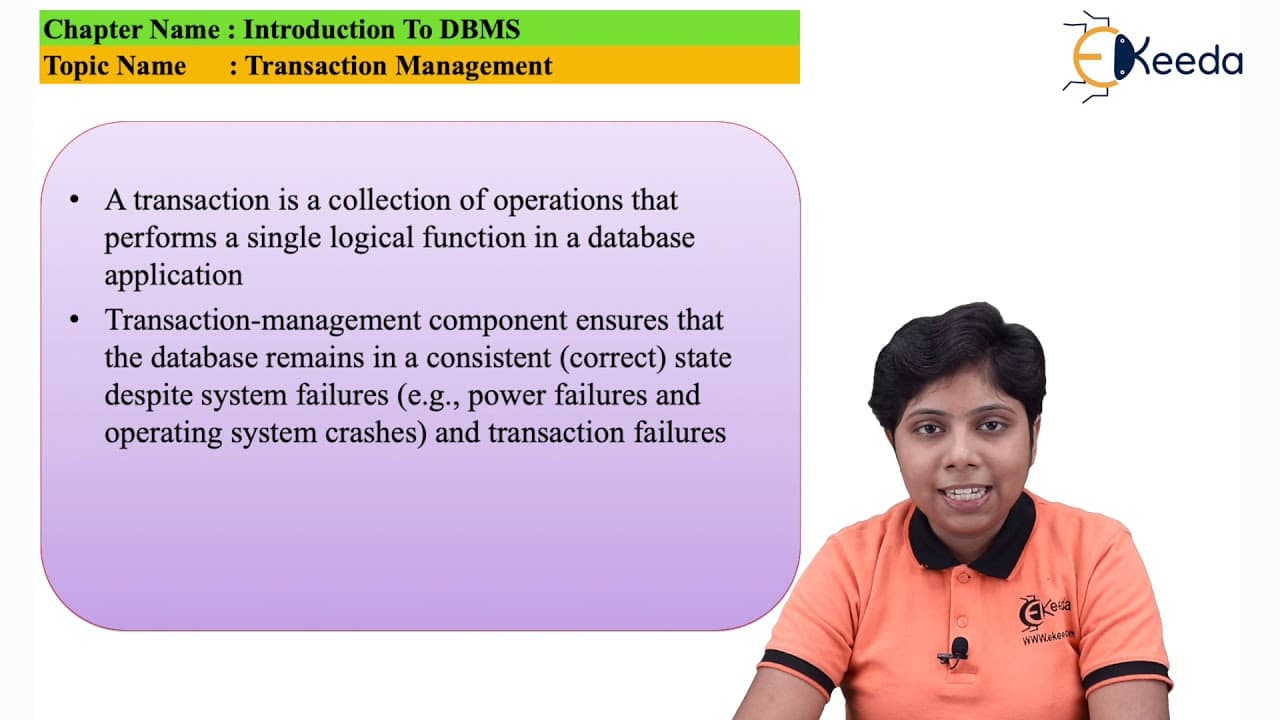
The video discusses the concept of transactions in a database management system, which involves the movement of data from one department or file to another through a series of operations.
-
Transactions are collections of similar operations that are needed to complete a single logical operation.
-
The video explains the ACID properties of transactions: Atomicity, Consistency, Integrity, and Durability, and highlights the importance of maintaining these properties.
Read in Other Languages (beta)
Share This Summary 📚
Summarize YouTube Videos and Get Video Transcripts with 1-Click
Try YouTube Summary with ChatGPT & Claude or YouTube Transcript Generator
Explore More Summaries from Ekeeda 📚






Summarize YouTube Videos and Get Video Transcripts with 1-Click
Try YouTube Summary with ChatGPT & Claude or YouTube Transcript Generator