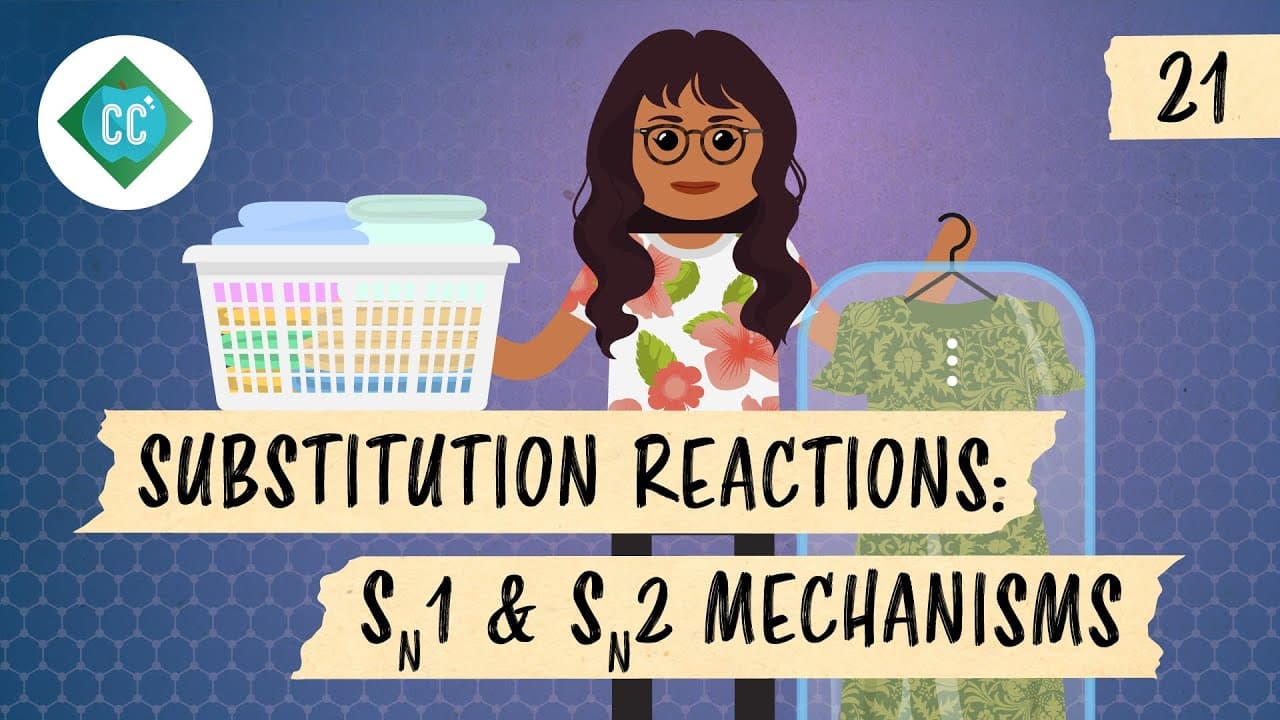
Substitution Reactions - SN1 and SN2 Mechanisms: Crash Course Organic Chemistry #21
TL;DR
Substitution reactions, known as SN1 and SN2 mechanisms, are determined by the structure of the substrate, the nucleophile involved, and the solvent used.
Transcript
You can review content from Crash Course Organic Chemistry with the Crash Course app, available now for Android and iOS devices. Hi! I’m Deboki Chakravarti and welcome to Crash Course Organic Chemistry! And to my home. Where we’re filming now because of the pandemic. When your fancy clothes say "DRY CLEAN ONLY," maybe you just… never wash them. Whe... Read More
Key Insights
- 🚱 Dry cleaning uses a non-water liquid, tetrachloroethylene, to wash clothes, but spills of this chemical can harm the environment.
- 🗑️ Soil bacteria have enzymes that can remove harmful compounds from waste products through SN2 reactions.
- 👥 SN1 and SN2 reactions are determined by the structure of the substrate, the leaving group, the nucleophile, and the solvent used.
- 🫀 Nucleophile strength is influenced by atom size and polarizability.
- 🐻❄️ Weak nucleophiles, polar protic solvents, and acidic conditions favor SN1 mechanisms.
- 😐 Strong nucleophiles, polar aprotic solvents, and neutral/basic conditions favor SN2 mechanisms.
- 😒 Primary carbon substrates use SN2, secondary carbon substrates can use SN1 or SN2, and tertiary carbon substrates use exclusively SN1.
Install to Summarize YouTube Videos and Get Transcripts
Explore YouTube Video Summarizer or Get YouTube Transcript Extractor
Questions & Answers
Q: What is the difference between dry cleaning and regular washing?
Dry cleaning uses a liquid other than water, such as tetrachloroethylene, to remove dirt from clothes. Regular washing involves the use of water and detergent.
Q: How do soil bacteria help with waste remediation?
Soil bacteria have enzymes that can remove harmful compounds from waste products through SN2 reactions. These compounds are then processed and can be reused in manufacturing.
Q: Why is tetrachloroethylene a challenging compound for bioremediation?
Tetrachloroethylene has a double bond that prevents it from undergoing SN2 reactions, making it difficult for bacteria to break it down and remove halogens.
Q: How do leaving groups affect substitution reactions?
Good leaving groups, such as weak bases with strong conjugate acids, are more likely to participate in substitution reactions. Poor leaving groups, such as strong bases, are less likely to be replaced by nucleophiles.
Summary & Key Takeaways
-
Dry cleaning uses a liquid, such as tetrachloroethylene, to wash away dirt from clothes, but spills of this chemical can be harmful to the environment.
-
Industrial plants use soil bacteria to clean up waste products by utilizing an enzyme that removes harmful compounds and replaces them with alcohols.
-
SN1 and SN2 reactions are substitution reactions that depend on the structure of the substrate, the leaving group, the nucleophile, and the solvent used.
Read in Other Languages (beta)
Share This Summary 📚
Summarize YouTube Videos and Get Video Transcripts with 1-Click
Try YouTube Summary with ChatGPT & Claude or YouTube Transcript Generator
Explore More Summaries from CrashCourse 📚



Summarize YouTube Videos and Get Video Transcripts with 1-Click
Try YouTube Summary with ChatGPT & Claude or YouTube Transcript Generator