Understand Calculus in 35 Minutes
TL;DR
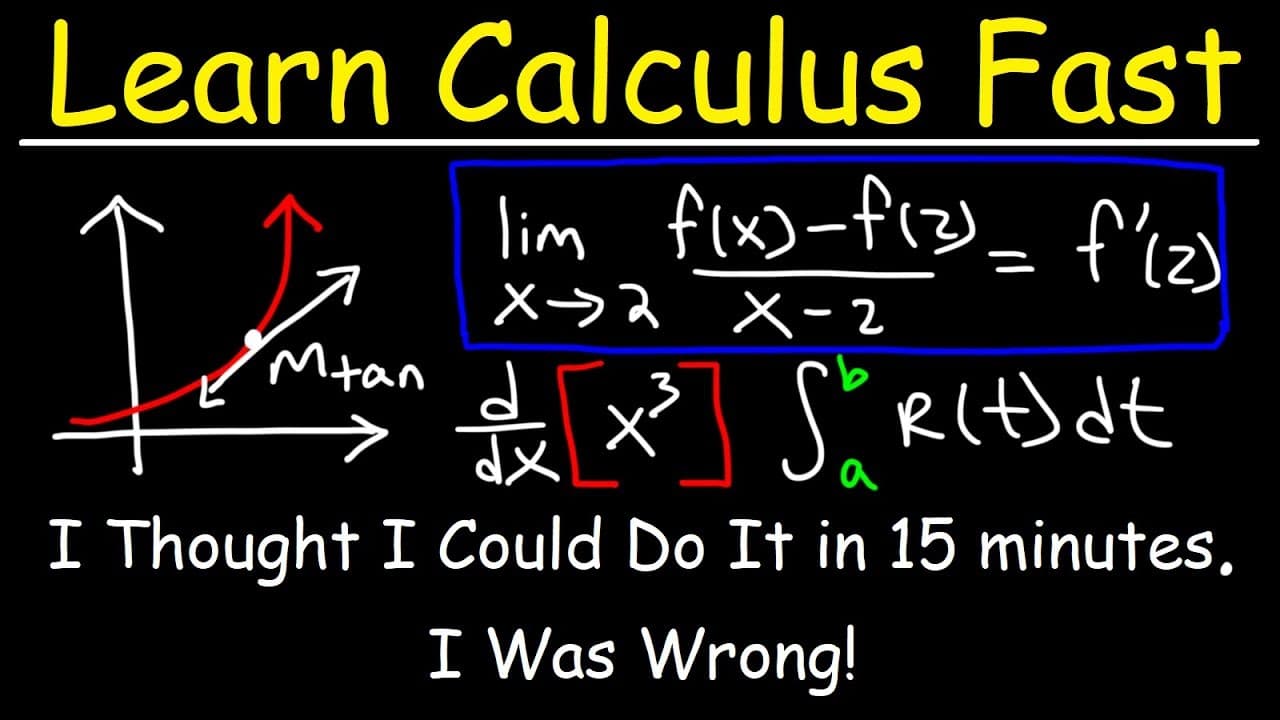
Learn about limits, derivatives, and integration, which are essential concepts in calculus, and how they relate to evaluating functions, calculating rates of change, and finding the area under a curve.
Transcript
in this video i'm going to attempt to teach the fundamentals of calculus in a very short time so there's three areas of calculus that you want to be familiar with the first one is limits now limits help you to evaluate a function let's say if we want to evaluate f when x is equal to 2 but for some reason a function is undefined or we just can't do ... Read More
Key Insights
- ☺️ Limits allow us to evaluate functions and understand their behavior as x approaches specific values.
- 🫥 Derivatives provide the slope of tangent lines, representing rates of change in functions.
- ⌛ Integration helps find the area under curves and determines the accumulation of quantities over time.
- 📏 Calculating derivatives and integrals involves applying mathematical rules and formulas, such as the power rule.
- 🫥 Approximating the slope of the tangent line using the slope of the secant line can provide a good estimate.
- 😥 Definite integrals allow for a precise calculation of the net change or accumulated quantity between two points.
- 💁 These fundamental concepts form the basis of calculus and are essential for solving complex problems in mathematics and science.
Install to Summarize YouTube Videos and Get Transcripts
Explore YouTube Video Summarizer or Get YouTube Transcript Extractor
Questions & Answers
Q: What are limits used for in calculus?
Limits help evaluate functions as x approaches a specific value, providing insights into what happens to the function in that scenario. They are especially useful when functions are undefined or when exact calculations cannot be made.
Q: How can derivatives be calculated using the power rule?
The power rule states that the derivative of a variable raised to a constant is obtained by multiplying the constant by the variable raised to (constant - 1) power. This rule allows for the calculation of the slope of the tangent line, indicating the rate of change at a particular point on a function.
Q: What is the relationship between derivatives and tangent lines?
Derivatives provide the slope of the tangent line to a curve at a specific point. This slope represents the instantaneous rate of change or the rate at which the function's value changes per unit of time.
Q: How does integration relate to finding the area under a curve?
Integration is the opposite process of differentiation and is used to find the anti-derivative or calculate the accumulation of a quantity over time. In the context of calculus, it helps determine the area under a curve by multiplying the function's values by the corresponding x-values.
Summary & Key Takeaways
-
Limits allow you to evaluate a function as x approaches a certain value, which is useful when the function is undefined or challenging to calculate.
-
Derivatives are functions that give you the slope of an original function at a specific value, helping you determine rates of change.
-
Integration is the opposite of differentiation and allows you to calculate how much something accumulates over time, as well as find the area under the curve.
Read in Other Languages (beta)
Share This Summary 📚
Summarize YouTube Videos and Get Video Transcripts with 1-Click
Try YouTube Summary with ChatGPT & Claude or YouTube Transcript Generator
Explore More Summaries from The Organic Chemistry Tutor 📚




Summarize YouTube Videos and Get Video Transcripts with 1-Click
Try YouTube Summary with ChatGPT & Claude or YouTube Transcript Generator