X-Values For Which SUM(cos^n(x)/2^n) Converges
TL;DR
Explains converging infinite series using the geometric series formula with cosine functions, concluding that the series converges for all x values.
Transcript
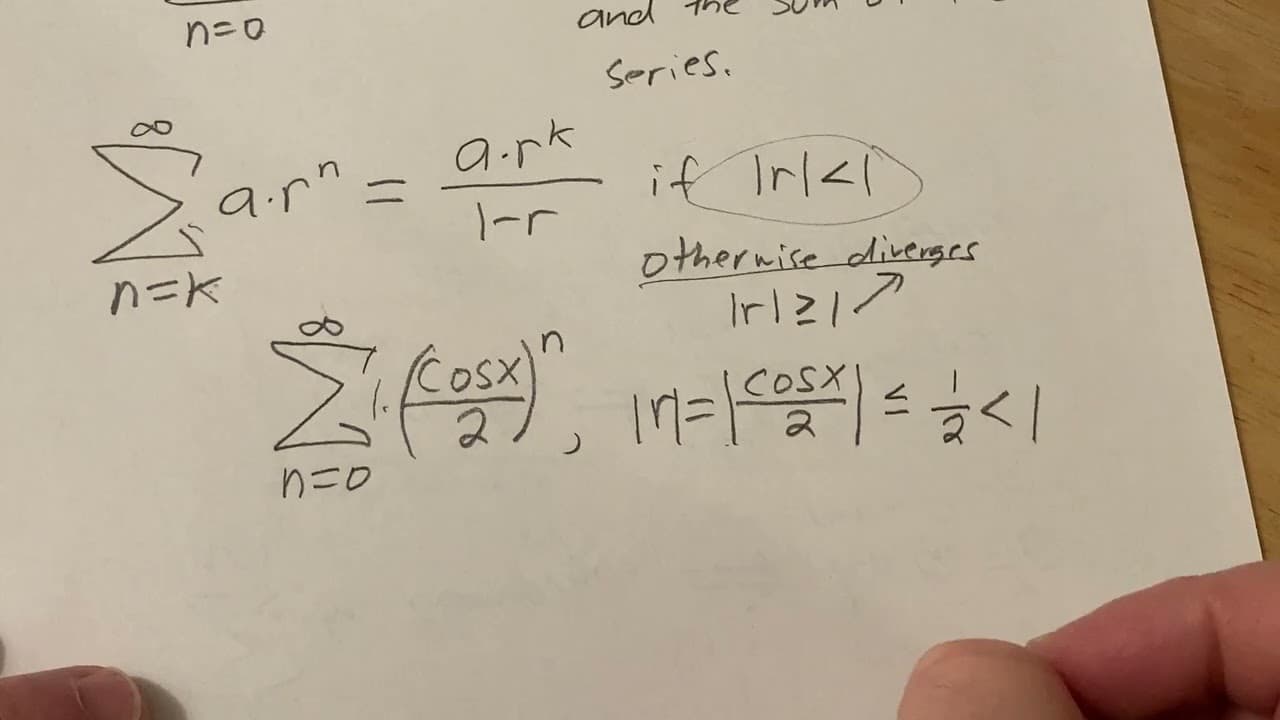
hi in this video we're going to be doing a series problem so we have this infinite series it goes from 0 to infinity and it's cosine of x to the nth power over 2 to the nth power and the question wants us to find the values of x for which this series converges and it also wants us to find the sum of the series so we're going to be using a geometric... Read More
Key Insights
- ❓ Geometric series formula is pivotal in determining whether series converge or diverge.
- ❓ Absolute value comparisons ensure the validity of the series convergence conditions.
- 🍹 The sum of an infinite series can be calculated using the geometric series formula efficiently.
Install to Summarize YouTube Videos and Get Transcripts
Explore YouTube Video Summarizer or Get YouTube Transcript Extractor
Questions & Answers
Q: What is the condition for a geometric series to converge?
A geometric series converges when the absolute value of the common ratio 'r' is less than 1. Otherwise, it diverges due to the expanding growth of terms.
Q: How is the sum of an infinite series calculated using the geometric series formula?
The sum is derived by dividing the first term by 1 minus the common ratio 'r', providing a simplified expression that converges for suitable 'r' values.
Q: Why does the infinite series involving cosine of x over 2 converge for all x values?
The series convergence is guaranteed as the absolute value of cosine(x/2) is always less than 1, satisfying the conditions of the geometric series convergence test.
Q: How does the video's approach demonstrate the convergence of the given series?
By carefully examining the series and applying the geometric series formula, it becomes evident that the series converges for any real number 'x'.
Summary & Key Takeaways
-
The video discusses an infinite series involving cosine functions raised to the nth power over 2 to the nth power.
-
By applying the geometric series formula, the series is shown to converge for all x values.
-
The sum of the series is found to be 2/(2-cos(x)), applicable for all real numbers x.
Read in Other Languages (beta)
Share This Summary 📚
Summarize YouTube Videos and Get Video Transcripts with 1-Click
Try YouTube Summary with ChatGPT & Claude or YouTube Transcript Generator
Explore More Summaries from The Math Sorcerer 📚


Summarize YouTube Videos and Get Video Transcripts with 1-Click
Try YouTube Summary with ChatGPT & Claude or YouTube Transcript Generator