What Is the Monroe Doctrine and Its Impact?
TL;DR
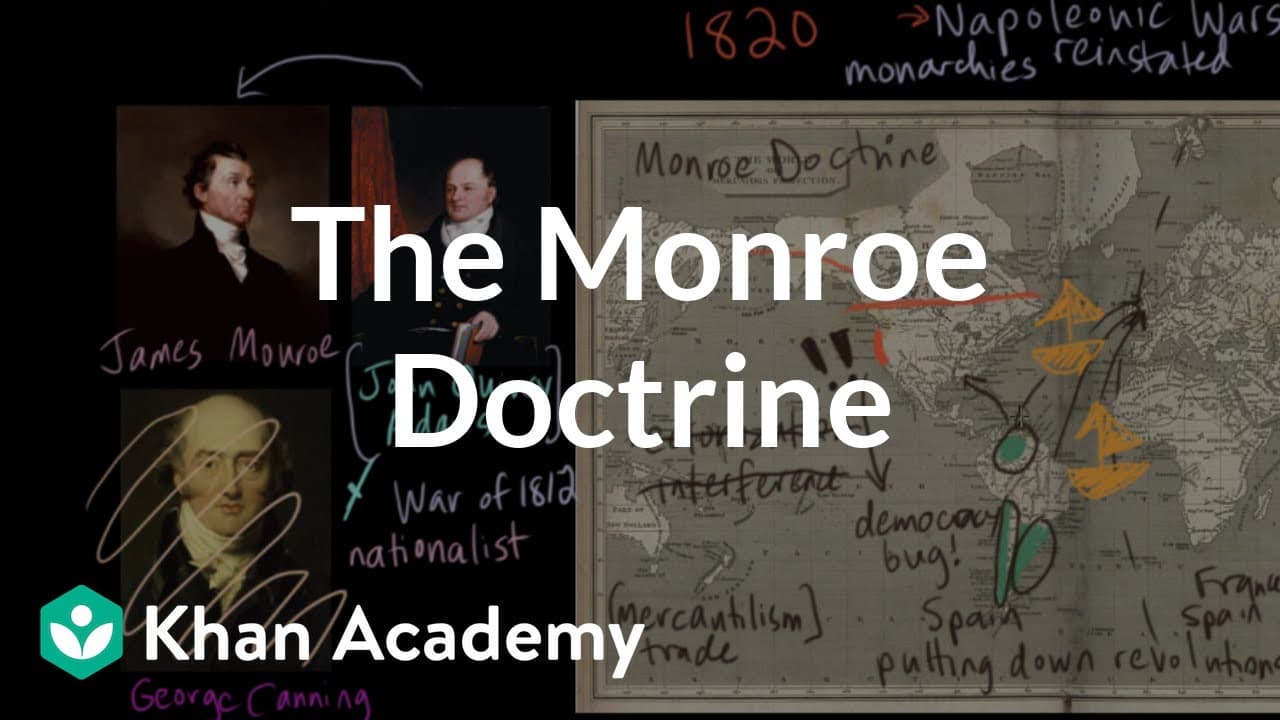
The Monroe Doctrine, proclaimed by President James Monroe in 1823, declared that European powers should refrain from colonizing or interfering in the Americas. Despite the U.S. being a minor power at the time, the doctrine became a cornerstone of American foreign policy, justifying Manifest Destiny and influencing later leaders as they sought to establish the U.S. as a dominant force in the Western Hemisphere.
Transcript
- On December 2, 1823, U.S. President James Monroe was giving his annual State of the Union Address to Congress when he threw in a couple of remarks about the United States' relationship with the powers of Europe. He said, "The American continents, "by the free and independent condition "which they have assumed and maintained, "are henceforth not t... Read More
Key Insights
- 🌍 The Monroe Doctrine was a bold declaration by President James Monroe in 1823, asserting that Europe should stay out of the Americas and no further colonization or interference would be tolerated.
- 🇺🇸 The United States, seen as a minor power at the time, had limited means to enforce the doctrine, relying on the British Navy's support as a proxy.
- 🌍 The Monroe Doctrine became a cornerstone of American foreign policy, serving as a justification for Manifest Destiny and shaping future presidents' approaches to international relations.
- 🇺🇸 The proclamation demonstrated a combination of American nationalism and isolationism, emphasizing the United States' desire for independence and non-involvement in European affairs.
- 🌎 Mercantilism played a role in the development of the Monroe Doctrine, as British and American interests were driven by the prospect of gaining access to new markets in the newly independent nations of South America.
- 🌎 The Monroe Doctrine became increasingly significant in the 20th century as the United States emerged as a world power and expanded its influence in the Americas.
- 🌍 The doctrine drew a clear distinction between the old world of Europe and the new world of the Americas, establishing a strong barrier between the two realms.
Install to Summarize YouTube Videos and Get Transcripts
Explore YouTube Video Summarizer or Get YouTube Transcript Extractor
Questions & Answers
Q: Why did President James Monroe proclaim the Monroe Doctrine?
Monroe was concerned about the possibility of European powers interfering in the Americas and encroaching on American interests. He wanted to protect the independence of the newly formed republics in South America and prevent any further colonization.
Q: How did European powers respond to the Monroe Doctrine?
European powers, considering the United States a minor power, did not challenge the Monroe Doctrine. They saw the British Navy as the enforcer of the doctrine, which aimed to protect the neutrality and independence of South America.
Q: How did the Monroe Doctrine shape American foreign policy?
The Monroe Doctrine became a key aspect of American foreign policy throughout the 19th and 20th centuries. It justified Manifest Destiny and symbolized America's intention to become a world power. It also reflected American isolationism, emphasizing non-involvement in European affairs.
Q: What role did mercantilism play in the development of the Monroe Doctrine?
Mercantilism, the economic system in which colonies existed to enrich the mother country, influenced the British and American support for the newly independent nations in South America. With these nations breaking away from Spain, their markets opened up to British and American trade, leading to reluctance in seeing them being returned to colonial status.
Summary & Key Takeaways
-
In 1823, President James Monroe proclaimed the Monroe Doctrine, stating that Europe should not colonize or interfere in the Americas.
-
Despite the United States being a minor power at the time, European powers did not challenge the Monroe Doctrine.
-
The Monroe Doctrine became a key facet of American foreign policy, justifying Manifest Destiny and influencing future presidents such as Teddy Roosevelt and Franklin Delano Roosevelt.
Read in Other Languages (beta)
Share This Summary 📚
Summarize YouTube Videos and Get Video Transcripts with 1-Click
Try YouTube Summary with ChatGPT & Claude or YouTube Transcript Generator
Explore More Summaries from Khan Academy 📚



Summarize YouTube Videos and Get Video Transcripts with 1-Click
Try YouTube Summary with ChatGPT & Claude or YouTube Transcript Generator