Don't blindly follow programming advice on tech social media
TL;DR
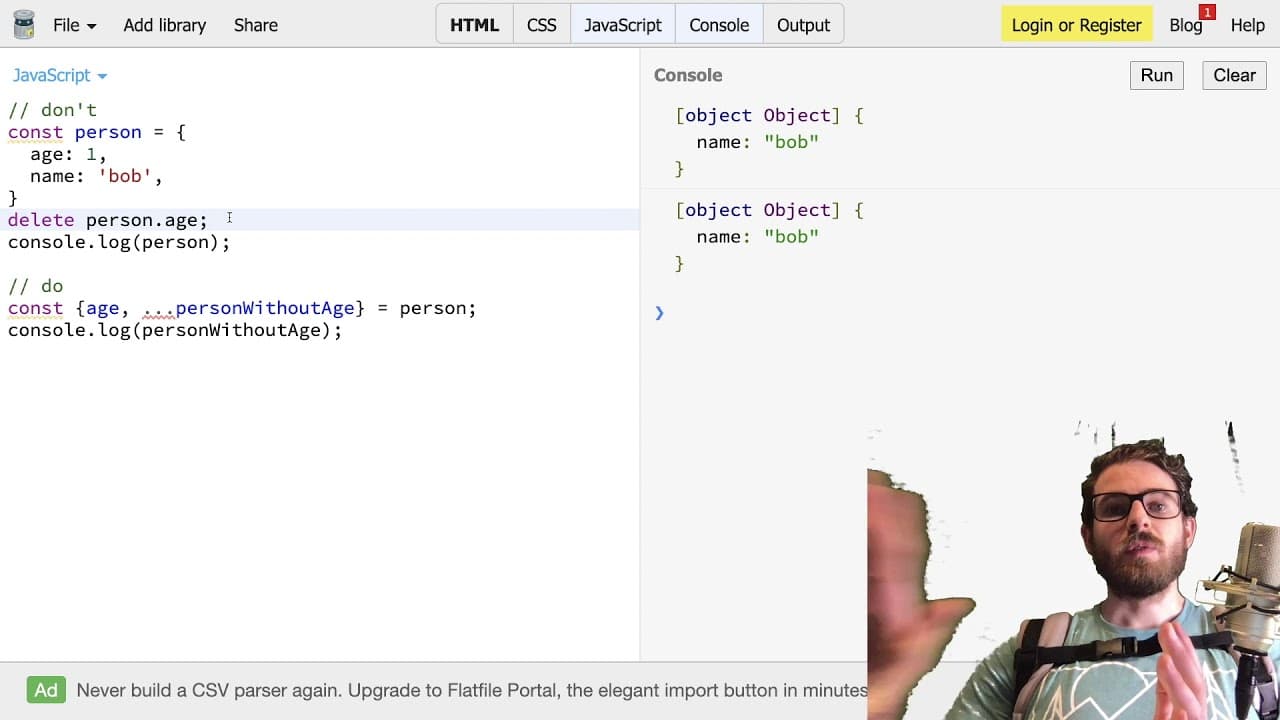
Don't blindly follow programming advice without understanding the reasoning behind it.
Transcript
how is it going everyone i hope you guys are having a great day so in this video i just wanted to kind of talk about something that kind of irritated me if you're not familiar with the tech scene on twitter it's just a it's a scene that you should probably be part of if you want to get little tips and tricks about programming or web development and... Read More
Key Insights
- 🔉 Critical thinking is essential when consuming coding advice shared on social media, as not all tips are based on sound practices.
- 😒 The direct use of the delete keyword in JavaScript can lead to potential bugs due to unintended property mutations and should be approached cautiously.
- 👨💻 Utilizing object utility libraries like Lodash can simplify the manipulation of objects without direct mutation, promoting cleaner code practices.
- 🥺 The importance of maintaining object integrity in programming cannot be overstated, as changes to shared objects can lead to complex debugging scenarios.
- 👨💻 Function size recommendations should take into account practical experience rather than arbitrary limits to avoid oversimplifying complex code structures.
- 📈 A deeper understanding of coding practices empowers developers to make informed choices rather than following trends or popularity metrics.
- 👾 Engaging with community feedback and providing reasoning can enhance the quality of advice shared in tech spaces like Twitter and YouTube.
Install to Summarize YouTube Videos and Get Transcripts
Explore YouTube Video Summarizer or Get YouTube Transcript Extractor
Questions & Answers
Q: Why is it risky to blindly follow programming advice on platforms like Twitter?
Blindly following programming advice can lead to misunderstanding and poor practices. Many influencers may not provide context or reasoning, which can result in adopting methods that are flawed or unsuitable for a specific project. A comprehensive understanding is crucial to ensure code quality and maintainability.
Q: Can you explain the issue with using the delete keyword in JavaScript?
The delete keyword removes properties from JavaScript objects, which can lead to unexpected bugs if those objects are passed around in your code. If a property is deleted in one function, other functions relying on that property may fail. It's important to manage object mutations carefully to maintain the integrity of the data throughout the application.
Q: What alternative solution does the speaker recommend instead of using the delete keyword?
The speaker suggests using libraries like Lodash, which offer utility functions such as omit, to create shallow copies of objects without certain properties. This helps to avoid direct mutations while maintaining a clear and manageable codebase, thus reducing bugs related to data integrity.
Q: What are the pros and cons of splitting large functions into smaller ones?
Dividing large functions into smaller ones can enhance readability and simplify testing, allowing better code organization. However, this can introduce complexity, requiring developers to navigate between multiple functions, which may obscure the overall logic and make comprehension more difficult, particularly in larger systems.
Q: What approach should beginners take when encountering programming advice online?
Beginners should engage critically with programming advice by questioning the rationale behind it. Instead of accepting statements at face value, they should seek explanations, research the concepts, and understand broader implications, as this leads to a stronger foundation in their programming knowledge.
Q: How can developers assess the quality of advice found online?
Developers should look for advice backed by clear reasoning, examples, and proven experience. Engaging with multiple sources, cross-referencing with documentation, and checking community feedback can also help evaluate the reliability of the advice and avoid blindly following less informed recommendations.
Summary & Key Takeaways
-
The speaker emphasizes the importance of understanding the reasoning behind programming advice shared on social media, particularly Twitter, to avoid misinformation.
-
A criticism is presented against popular programming tips that lack explanations, highlighting a specific example where the advice to avoid the delete keyword in JavaScript was given without justification.
-
The speaker advocates for more thoughtful engagement with coding practices, encouraging programmers to question advice and understand the pros and cons before implementation.
Read in Other Languages (beta)
Share This Summary 📚
Summarize YouTube Videos and Get Video Transcripts with 1-Click
Try YouTube Summary with ChatGPT & Claude or YouTube Transcript Generator
Explore More Summaries from Web Dev Cody 📚

Summarize YouTube Videos and Get Video Transcripts with 1-Click
Try YouTube Summary with ChatGPT & Claude or YouTube Transcript Generator