How to Design a Relational Database Effectively
TL;DR
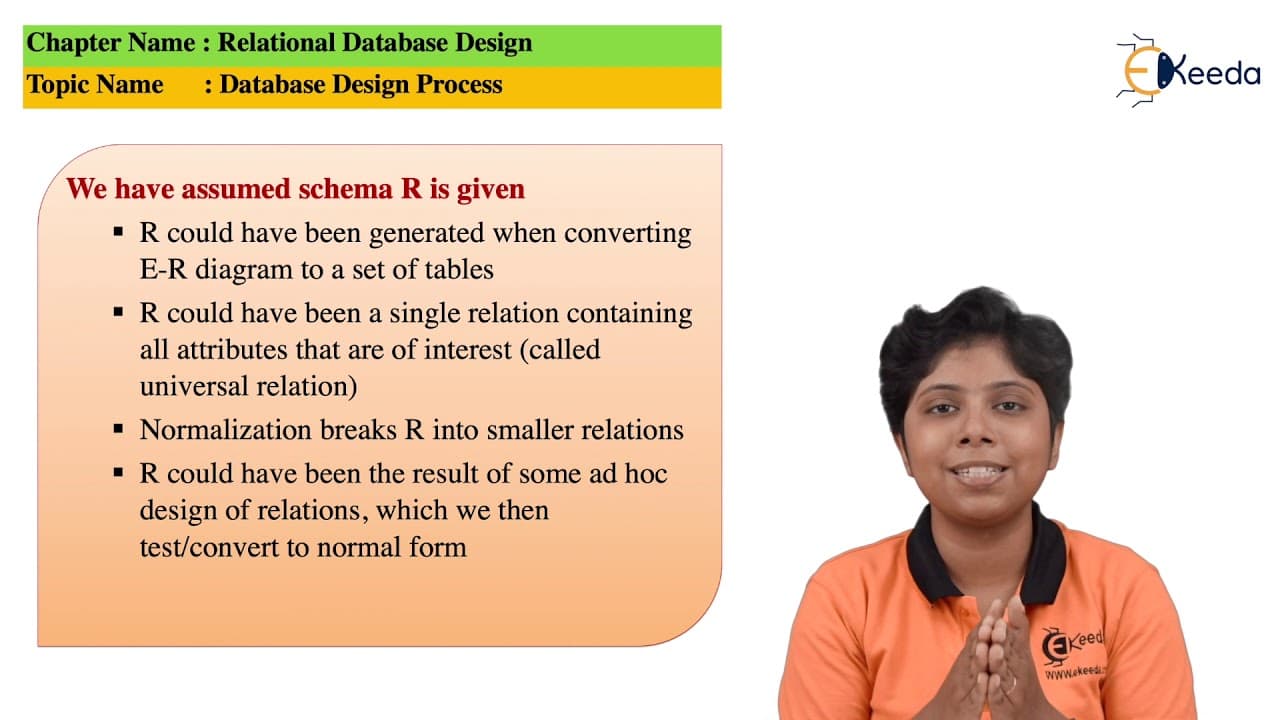
To design a relational database effectively, prioritize normalization to reduce data redundancy and enhance integrity. Utilize the Entity-Relationship (ER) model for clear representation of entities, attributes, and relationships. Carefully name attributes to maintain clarity, and consider denormalization only when necessary for design purposes, while always aiming to select the best design alternative for the organization's specific needs.
Transcript
click the bell icon to get latest videos from akira hello friends today we will discuss about the database design process while having all the normalization ear model in our mind so that we can name it properly we can use the de normalization and solve other issues les is temporal data or in the ear model to the conversation of relational schema we... Read More
Key Insights
- 🎨 Normalization is essential in database design to reduce redundancy and improve data integrity and retrieval efficiency.
- 🆘 The ER model helps in deriving a normalized relational schema by properly modeling entities, attributes, and relationships.
- 📛 Distinct and coherent attribute names ensure clarity and accuracy in data interpretation.
- 😄 Denormalization is sometimes used in designing to combine decomposed relations for ease of analysis, although it introduces redundant information.
- 👋 Choosing the best design alternative requires considering the specific needs and demands of the enterprise.
- 😵 Cross tabs are useful for statistical analysis but not suitable for database design.
- 🎨 Sparse databases, where most attributes have empty values, should be avoided in database design.
Install to Summarize YouTube Videos and Get Transcripts
Explore YouTube Video Summarizer or Get YouTube Transcript Extractor
Questions & Answers
Q: What is normalization in the database design process?
Normalization is the process of organizing data in a database to reduce redundancy and dependency issues. It involves decomposing a relation into smaller, more manageable relations to ensure data integrity and efficient retrieval.
Q: How does the ER model help in normalization?
The ER model allows for the proper modeling of entities, attributes, and relationships. It helps in identifying and specifying entity sets, attributes associated with them, and relationships between them, which can be used to derive a normalized relational schema.
Q: Why is it important to have coherent and distinct attribute names?
Coherent and distinct attribute names help in clearly identifying the role and meaning of each attribute within a relation or database. It avoids confusion and ensures accurate interpretation of the data.
Q: When is denormalization used in the database design process?
Denormalization is used when there is a specific need to combine decomposed relations into a single relation for designing purposes. It allows designers to easily comprehend and analyze data relationships without the need for frequent referencing, although it introduces redundant information.
Summary & Key Takeaways
-
The video explains the importance of normalization in database design and how it helps in achieving a decomposed relation that can efficiently fetch data.
-
It discusses how the entity relationship (ER) model can be used to normalize data and handle non-binary relationships.
-
The video also covers the process of naming attributes and relationships in a database, emphasizing the need for coherent and distinct names.
-
It explains the concept of denormalization and when it may be used for designing purposes.
-
Lastly, the video highlights the importance of choosing the best design from the alternative options, considering the specific needs of the enterprise.
Read in Other Languages (beta)
Share This Summary 📚
Summarize YouTube Videos and Get Video Transcripts with 1-Click
Try YouTube Summary with ChatGPT & Claude or YouTube Transcript Generator
Explore More Summaries from Ekeeda 📚





Summarize YouTube Videos and Get Video Transcripts with 1-Click
Try YouTube Summary with ChatGPT & Claude or YouTube Transcript Generator