Impedance
TL;DR
This video explains the concept of impedance and how to derive the i-v equations for resistors, inductors, and capacitors when the input is a sinusoid.
Transcript
- [Voiceover] Now we're gonna talk about the idea of impedance. This is a really important idea in electronics and it's something that comes from the study of AC analysis. And AC analysis is where we limit ourselves to inputs to our circuits that look like sinusoids, cosines or sines. And of all the signals that we could possibly have in the entire... Read More
Key Insights
- 🥳 Impedance is a fundamental concept in electronics, representing the ratio of voltage to current in a circuit.
- 🥰 The i-v equations for resistors, inductors, and capacitors can be derived when the input is a sinusoid, using complex exponential notation.
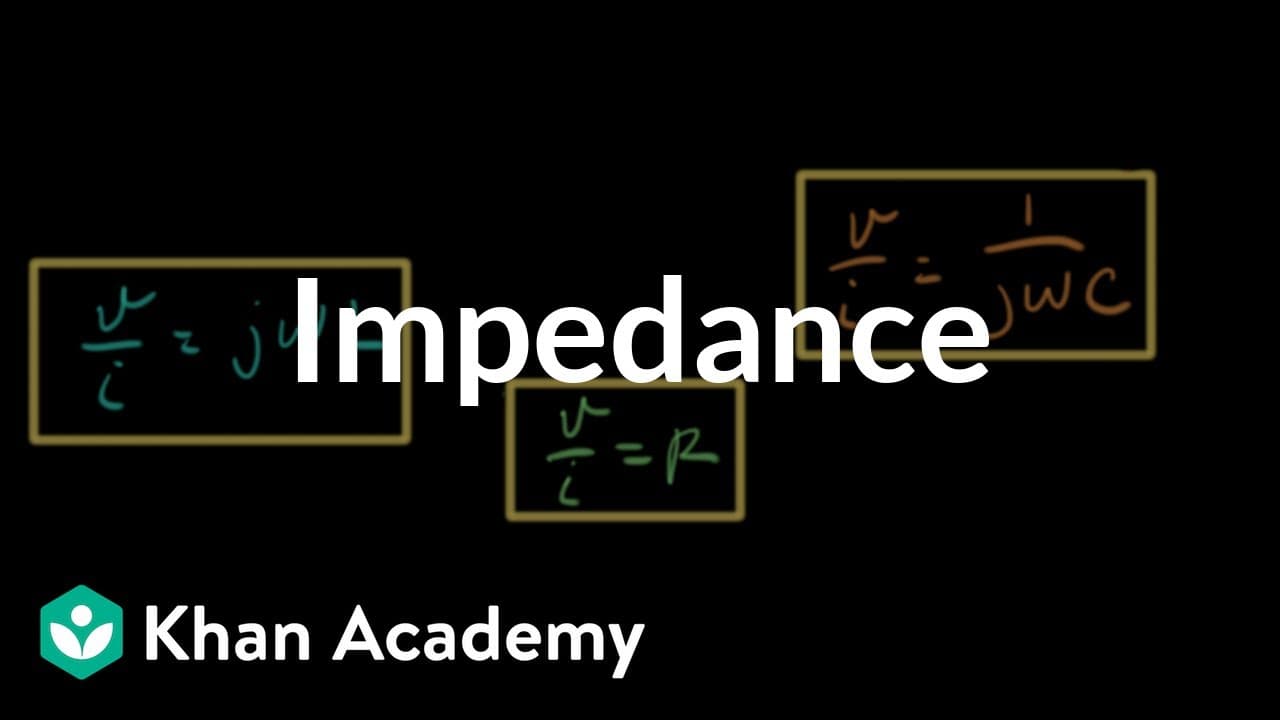
- 🍧 Impedance differs for each passive component, with resistors having a constant impedance equal to their resistance, inductors having a frequency-dependent impedance (j omega L), and capacitors having a frequency-dependent impedance (1 / (j omega C)).
Install to Summarize YouTube Videos and Get Transcripts
Explore YouTube Video Summarizer or Get YouTube Transcript Extractor
Questions & Answers
Q: What is impedance in electronics?
Impedance is the general concept of the ratio of voltage to current in a circuit, encompassing the values of components and the effect of frequency on the voltage-current relationship.
Q: What are the i-v equations for resistors, inductors, and capacitors with sinusoidal inputs?
The i-v equation for a resistor is v = i * R, for an inductor it is v = j omega L * i, and for a capacitor it is v = 1 / (j omega C) * i.
Q: How does the impedance of a resistor, inductor, and capacitor differ?
The impedance of a resistor is equal to its resistance, the impedance of an inductor is j omega L, and the impedance of a capacitor is 1 / (j omega C).
Q: How does frequency affect the impedance of inductors and capacitors?
The impedance of inductors and capacitors is frequency-dependent. For inductors, the impedance increases with frequency (j omega L), while for capacitors, the impedance decreases with frequency (1 / (j omega C)).
Summary & Key Takeaways
-
The video introduces the concept of impedance in electronics, which is the ratio of voltage to current in a circuit.
-
The i-v equations for resistors, inductors, and capacitors are derived when the input is a sinusoid.
-
The impedance for resistors is equal to the resistance, for inductors it is equal to j omega L, and for capacitors it is equal to 1 / j omega C.
Read in Other Languages (beta)
Share This Summary 📚
Summarize YouTube Videos and Get Video Transcripts with 1-Click
Try YouTube Summary with ChatGPT & Claude or YouTube Transcript Generator
Explore More Summaries from Khan Academy 📚



Summarize YouTube Videos and Get Video Transcripts with 1-Click
Try YouTube Summary with ChatGPT & Claude or YouTube Transcript Generator