Power Amplifier Performance Parameters - Amplifier Design - RF Design
TL;DR
This video lecture discusses the performance parameters of power amplifiers, including efficiency, distortion, 1 dB compression point, dynamic range, and the difference between S-parameters and load-pull controls.
Transcript
hello friends in this video lecture we are going to discuss about the performance parameters of our amplifier to average dc power wrong by the circuit is given as eta equal to t 0 ac divided by p in dc it has a problem of that it does not consider rf input power so other one efficiency is used for the better measurement of amplifier efficiency is p... Read More
Key Insights
- ✊ Efficiency of power amplifiers is measured using power-added efficiency, which considers both RF input power and DC power.
- ✊ Distortion occurs in power amplifiers at high power levels due to their non-linear behavior.
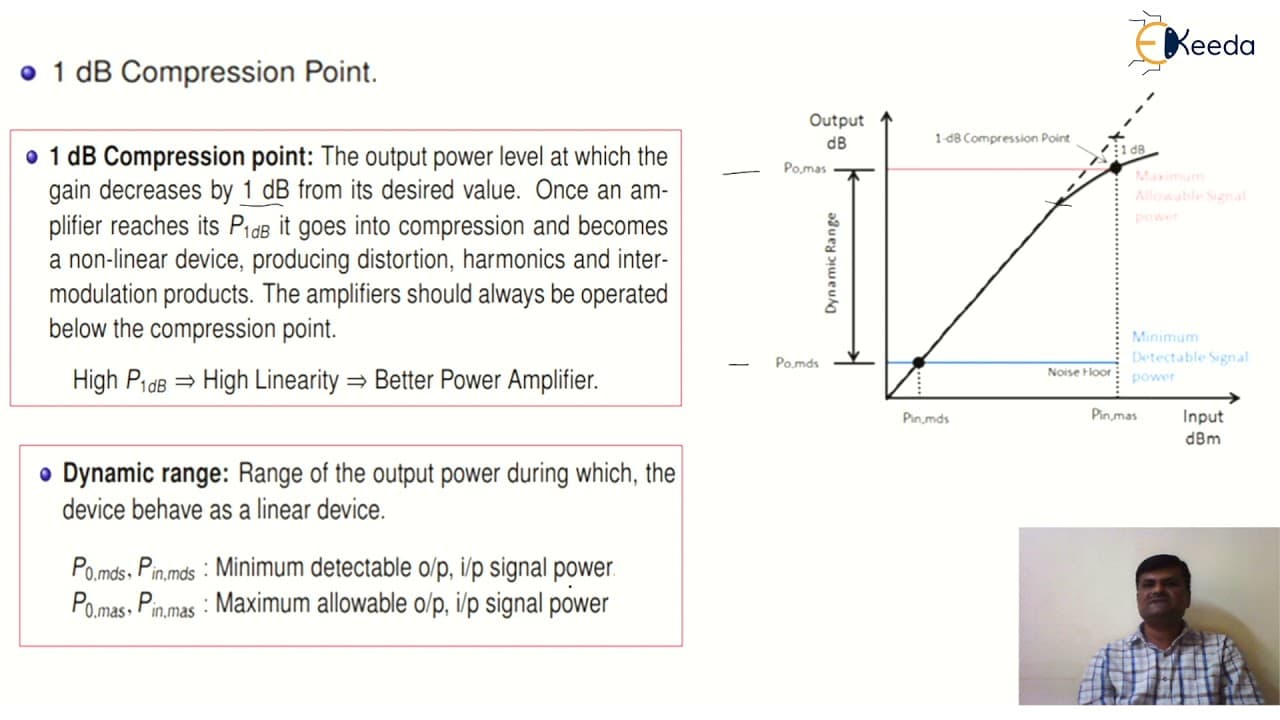
- ☺️ The 1 dB compression point is important in power amplifier design as it determines the threshold for non-linear behavior and distortion.
- 🧡 The dynamic range represents the range of output power within which the power amplifier behaves linearly.
- 📡 Scattering parameters (S-parameters) are suitable for small signal linear devices, while load-pull controls are used for characterizing large power signals.
- ✊ S-parameters are used for designing small signal power amplifiers, while load-pull controls are used for designing high-power amplifiers.
- ✋ S-parameters do not measure higher-order effects such as distortion, which load-pull controls can capture.
Install to Summarize YouTube Videos and Get Transcripts
Explore YouTube Video Summarizer or Get YouTube Transcript Extractor
Questions & Answers
Q: How is amplifier efficiency calculated?
Amplifier efficiency can be calculated using the power-added efficiency formula, which divides the output RF power by the input RF power. It provides a better measurement of amplifier efficiency compared to just considering DC power.
Q: What is distortion in power amplifiers?
Distortion refers to changes in the output signal waveform compared to the input waveform. In power amplifiers, non-linear behavior causes distortion in terms of phase and amplitude.
Q: What is the significance of the 1 dB compression point?
The 1 dB compression point is the point at which the amplifier's gain decreases by 1 dB. Operating above this point leads to non-linear behavior, distortion, and the production of harmonics and intermodulation products.
Q: How is the dynamic range calculated?
The dynamic range is calculated between the minimum detectable input power and the maximum allowable input power. It represents the range of output power during which the power amplifier behaves linearly.
Summary & Key Takeaways
-
The video explains the calculation of amplifier efficiency using power-added efficiency, which takes into account both RF input power and DC power.
-
Distortion occurs in power amplifiers at high power levels due to non-linear behavior, resulting in changes in the output signal in terms of phase and amplitude.
-
The 1 dB compression point is a critical parameter for power amplifier design, as it determines the point at which the gain decreases by 1 dB, causing distortion and non-linear behavior.
-
The dynamic range is the range of output power in which the power amplifier behaves linearly, and it is calculated between the minimum detectable and maximum allowable input power.
Read in Other Languages (beta)
Share This Summary 📚
Summarize YouTube Videos and Get Video Transcripts with 1-Click
Try YouTube Summary with ChatGPT & Claude or YouTube Transcript Generator
Explore More Summaries from Ekeeda 📚




Summarize YouTube Videos and Get Video Transcripts with 1-Click
Try YouTube Summary with ChatGPT & Claude or YouTube Transcript Generator