What Is Six Sigma and How Did It Evolve?
TL;DR
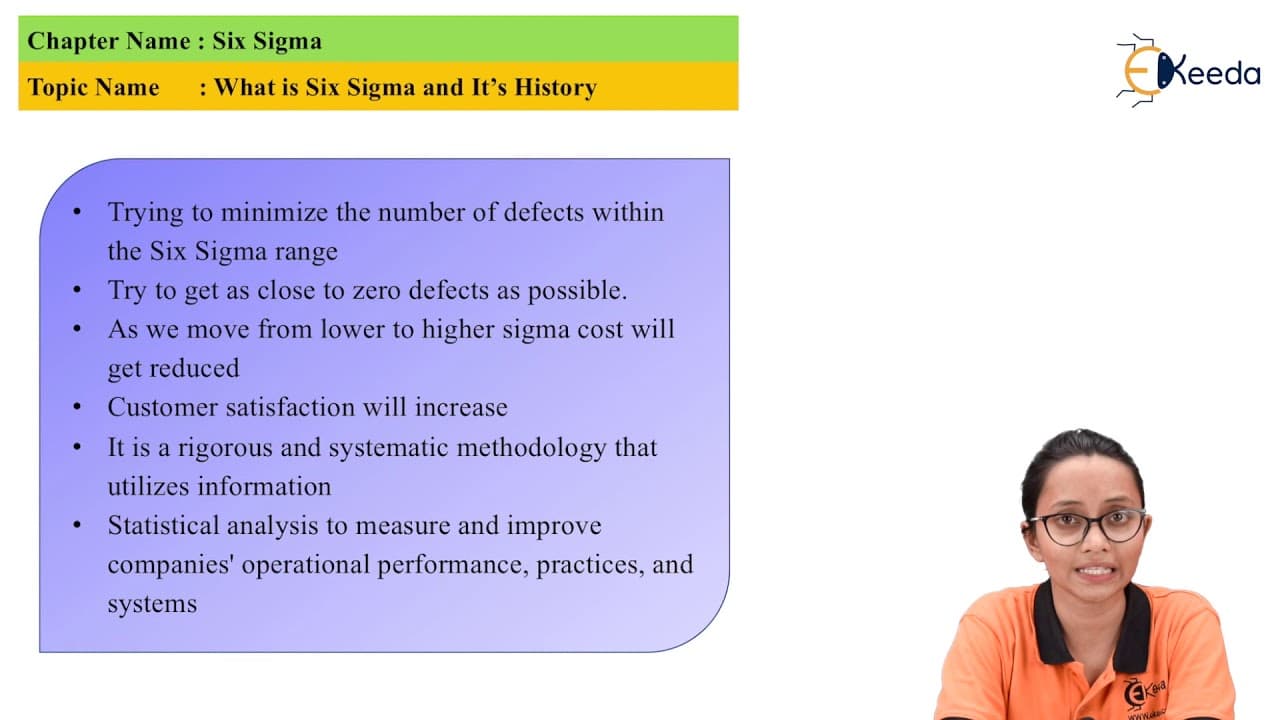
Six Sigma is a data-driven methodology aimed at improving business processes by minimizing defects and variability. Developed by Motorola in 1987, it gained prominence through General Electric's adoption, focusing on achieving near-zero defects to enhance customer satisfaction and operational efficiency.
Transcript
hello guys in this video we are going to study about Six Sigma and its history Six Sigma is the tool used for improving the capability of the business process it is a discipline statistical based data-driven approach and continuous improvement methodology for eliminating defects in a product process or service Six Sigma was developed memo company b... Read More
Key Insights
- 👨💼 Six Sigma is a discipline and methodology for improving business processes and reducing defects.
- ❓ It was developed by Motorola in 1987 and later popularized by General Electric.
- 🛄 Six Sigma aims to improve quality, increase customer satisfaction, and reduce costs.
- 🎭 The Sigma capability measures how well a process performs and determines the cost of poor quality.
- 🥅 Zero defects and minimizing variability are the goals of Six Sigma.
- 💁 It utilizes statistical analysis and information to drive improvements in operational performance.
- ❓ Six Sigma is used in various sectors of the industry.
Install to Summarize YouTube Videos and Get Transcripts
Explore YouTube Video Summarizer or Get YouTube Transcript Extractor
Questions & Answers
Q: How did Six Sigma gain popularity?
Six Sigma gained popularity when Jack Mills made it the central focus of his business strategy at General Electric in 1995. Today, it is widely used in different sectors of industry.
Q: What is the significance of the Sigma capability?
Sigma capability, indicated by the Sigma value, measures how well a process is performing. As the Sigma capability increases, the cost of poor quality decreases, while profitability, productivity, and customer satisfaction increase.
Q: What is the goal of Six Sigma?
The goal of Six Sigma is to minimize defects within the Six Sigma range, striving towards zero defects. It aims to improve the quality of output by identifying and removing the causes of defects and minimizing variability in processes.
Q: How is Six Sigma performance measured?
Six Sigma performance is measured using the defect rate per million opportunities. A higher Sigma level indicates better quality, with the ideal being Six Sigma (3.5 defects per million opportunities).
Summary & Key Takeaways
-
Six Sigma is a statistical-based methodology used to improve business processes by eliminating defects in products, processes, or services.
-
It was developed by Motorola using the knowledge of quality gurus like Taguchi, Ishikawa, and Deming.
-
Motorola officially launched its Six Sigma program in 1987 and became known as a quality leader, winning awards and certifying experts in the field.
Read in Other Languages (beta)
Share This Summary 📚
Summarize YouTube Videos and Get Video Transcripts with 1-Click
Try YouTube Summary with ChatGPT & Claude or YouTube Transcript Generator
Explore More Summaries from Ekeeda 📚






Summarize YouTube Videos and Get Video Transcripts with 1-Click
Try YouTube Summary with ChatGPT & Claude or YouTube Transcript Generator