What Are the Core Principles of Hinduism?
TL;DR
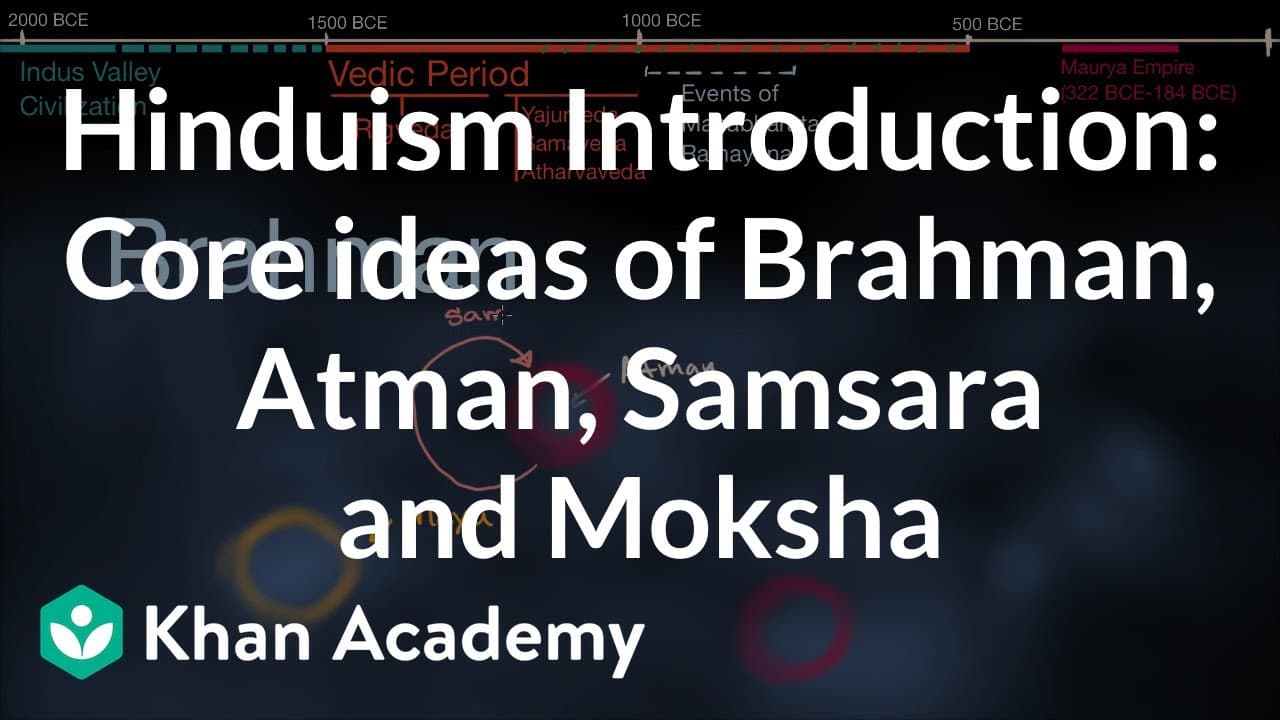
Hinduism is one of the world's oldest religions, rooted in the ancient Indus Valley civilization, and centers on crucial concepts like Brahman (the ultimate reality), Atman (the inner self), and the cycle of Samsara (reincarnation). Its core beliefs also involve Karma (action and its consequences) and Dharma (rightful duty), with the ultimate goal being Moksha, or liberation from this cycle.
Transcript
- [Instructor] We're now going to talk about Hinduism which is one of the largest religions on Earth, practiced by over a billion people. And, it's interesting for several reasons. First, it is considered to be one of the oldest religions that is still practiced. Some historians would place the origins of Hinduism at 5,000 years into the past. It h... Read More
Key Insights
- 🥶 Hinduism is one of the oldest religions still practiced, with origins in the ancient Indus Valley civilization and the Vedic Period.
- 👯 The name "Hinduism" comes from the word "Sindhu" and refers to people beyond the Indus River.
- 🚨 Hinduism is a combination of various cultures and traditions that merged over thousands of years around the Indian subcontinent.
- 💯 The core beliefs of Hinduism revolve around concepts such as Brahman, Atman, Maya, Samsara, Karma, and Dharma.
- 🥳 Hinduism emphasizes the goal of attaining Moksha, which is liberation from the cycle of birth and rebirth and realizing the unity of Atman and Brahman.
- ❓ The Upanishads, a subset of the Vedas, are significant texts in representing the spiritual and philosophical aspects of Hinduism.
- 🧑🏫 Hinduism recognizes the interconnectedness of all beings and teaches non-discrimination and the acceptance of all as part of the same reality.
Install to Summarize YouTube Videos and Get Transcripts
Explore YouTube Video Summarizer or Get YouTube Transcript Extractor
Questions & Answers
Q: How old is Hinduism and what are its origins?
Hinduism is believed to be 5,000 years old and has origins in the practices of the Indus Valley civilization and the Vedic Period.
Q: What is the meaning behind the term "Hinduism"?
"Hinduism" comes from the Persian word "Hindus," which was a version of the Sanskrit word "Sindhu," referring to people beyond the Indus River.
Q: What are the core beliefs of Hinduism?
Hinduism revolves around the concepts of Brahman (the true reality), Atman (the inner self), Maya (the illusion of separateness), Samsara (the cycle of birth and rebirth), Karma (action and consequences), and Dharma (the rightful role and duty).
Q: What is the goal of Hinduism?
The goal of Hinduism is to attain Moksha, which is liberation from the cycle of birth and rebirth and to realize the oneness of Atman and Brahman.
Summary & Key Takeaways
-
Hinduism is considered one of the oldest religions, dating back 5,000 years to the Indus Valley civilization and the Vedic Period.
-
The name Hinduism comes from the Sanskrit word "Sindhu" which was pronounced as "Hindus" by the Persians, referring to people beyond the Indus River.
-
The core beliefs of Hinduism revolve around the concepts of Brahman (the true reality), Atman (the inner self), Maya (the illusion of separateness), Samsara (the cycle of birth and rebirth), Karma (action and consequences), and Dharma (the rightful role and duty).
Read in Other Languages (beta)
Share This Summary 📚
Summarize YouTube Videos and Get Video Transcripts with 1-Click
Try YouTube Summary with ChatGPT & Claude or YouTube Transcript Generator
Explore More Summaries from Khan Academy 📚



Summarize YouTube Videos and Get Video Transcripts with 1-Click
Try YouTube Summary with ChatGPT & Claude or YouTube Transcript Generator