Verifying Trigonometric Identities With Double Angle Formulas
TL;DR
This content provides detailed explanations and examples on how to verify identities using double angle formulas.
Transcript
now let's work on some verifying the identity problems with double angle formulas so show that sine plus cosine squared is equal to sine two theta plus one now the first thing we need to do in this example is write this expression twice sine theta plus cosine theta squared is sine plus cosine times sine plus cosine sine times sine is sine squared a... Read More
Key Insights
- 🔺 Double angle formulas allow for the simplification of trigonometric expressions by breaking down angles into smaller components.
- 😑 Verifying trigonometric identities involves substituting double angle formulas and manipulating expressions using trigonometric identities.
- 😑 Dividing both the numerator and denominator by cos^2(theta) can simplify trigonometric expressions.
Install to Summarize YouTube Videos and Get Transcripts
Explore YouTube Video Summarizer or Get YouTube Transcript Extractor
Questions & Answers
Q: How can double angle formulas be used to verify trigonometric identities?
Double angle formulas allow us to simplify trigonometric expressions by breaking down the angle into smaller components. By substituting the double angle formulas and manipulating the expressions using trigonometric identities, we can verify the identities.
Q: What is the process of verifying the identity sin(theta) + cos(theta)^2 = sin(2theta) + 1?
We start by writing the expression twice to simplify it further. Then, using the double angle formula sin(2theta) = 2sin(theta)cos(theta), we can substitute and simplify the expression. Finally, by observing that sin^2(theta) + cos^2(theta) = 1 and rearranging the terms, we can verify the identity.
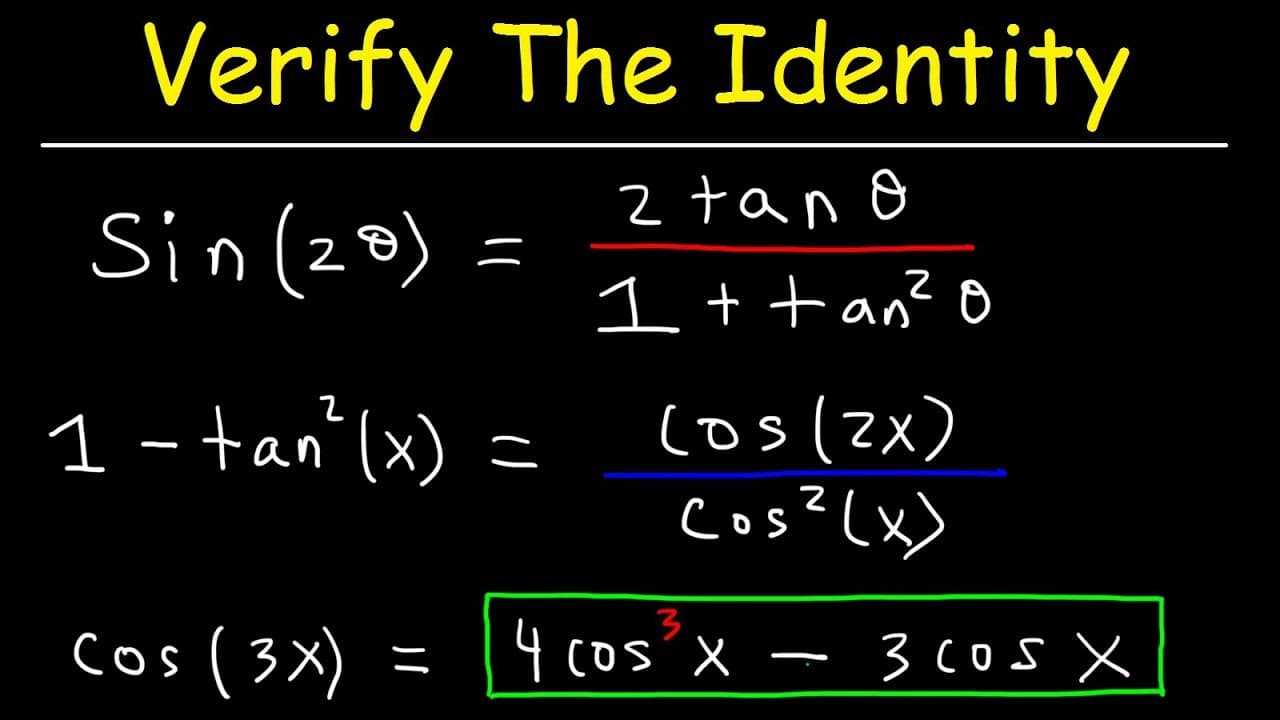
Q: How do we verify the identity sin(2theta) = 2tan(theta) / (1 + tan^2(theta))?
We begin by converting sin(2theta) to 2sin(theta)cos(theta) using the double angle formula. Then, we simplify the expression by dividing both the numerator and denominator by cos^2(theta) to obtain 2sin(theta) / cos(theta). After applying the quotient identity sin(theta) / cos(theta) = tan(theta), we can verify the identity.
Q: How can the identity 1 - tan^2(theta) = cos(2theta) / cos^2(theta) be proven?
By substituting cos(2theta) = 1 - 2sin^2(theta) and rearranging terms, we can rewrite the expression as (1 - 2sin^2(theta)) / cos^2(theta). Then, we use the Pythagorean identity sin^2(theta) + cos^2(theta) = 1 to simplify the expression to (cos^2(theta)) / cos^2(theta) = 1. Thus, the identity is verified.
Summary & Key Takeaways
-
The content explains how to verify the identity sine(theta) + cosine(theta)^2 = sine(2theta) + 1 by using double angle formulas and simplifying the expression.
-
The process of verifying the identity sine(2theta) = 2tan(theta) / (1 + tan^2(theta)) is demonstrated using the double angle formula and trigonometric identities.
-
The identity 1 - tan^2(theta) = cos(2theta) / cos^2(theta) is proven by manipulating the expression using the double angle formula and trigonometric identities.
-
The steps of verifying the identity cos(4x) = 8cos^4(x) - 8cos^2(x) + 1 are shown by using the double angle formula, simplifying the expression, and combining like terms.
Read in Other Languages (beta)
Share This Summary 📚
Summarize YouTube Videos and Get Video Transcripts with 1-Click
Try YouTube Summary with ChatGPT & Claude or YouTube Transcript Generator
Explore More Summaries from The Organic Chemistry Tutor 📚




Summarize YouTube Videos and Get Video Transcripts with 1-Click
Try YouTube Summary with ChatGPT & Claude or YouTube Transcript Generator