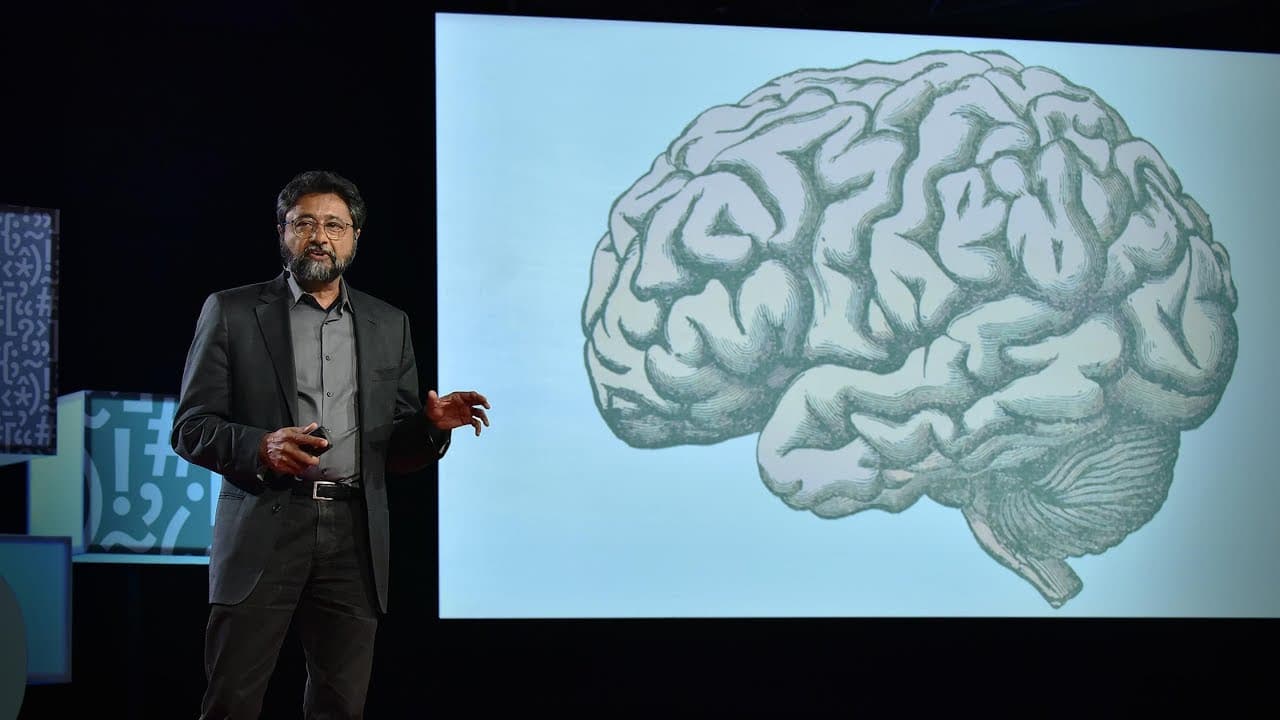
How your brain decides what is beautiful | Anjan Chatterjee
TL;DR
Sir Francis Galton, a brilliant polymath, presents a surprising finding about beauty in a talk to the anthropologic institute in Great Britain and Ireland.
Transcript
It's 1878. Sir Francis Galton gives a remarkable talk. He's speaking to the anthropologic institute of Great Britain and Ireland. Known for his pioneering work in human intelligence, Galton is a brilliant polymath. He's an explorer, an anthropologist, a sociologist, a psychologist and a statistician. He's also a eugenist. In this talk, he presents ... Read More
Key Insights
- 🧠 Galton's composite portraits of criminals turned out to be beautiful, raising questions about the nature of beauty and why certain features excite us.
- ♀️ Beauty in faces is subjective, but there are basic parameters that contribute to attractiveness, such as averageness, symmetry, and the effects of hormones.
- 🌍 Averageness in faces represents the central tendencies of a group and is considered more attractive because it indicates genetic diversity and adaptability.
- ⚖️ Symmetric faces are generally seen as more attractive than asymmetric ones, as asymmetries can be associated with developmental abnormalities or infections.
- ⚙️ Hormones like estrogen and testosterone shape features that are regarded as attractive, with estrogen signaling fertility and testosterone producing typically masculine features.
- ♂️ Testosterone-infused features may be an indicator of fitness, invoking the handicap principle where only especially fit organisms can afford to divert resources to maintain extravagant appendages.
- 🧬 Preferences for specific physical features can be arbitrary for individuals, but if they are heritable and associated with a reproductive advantage, they can become universal for a group over time.
- 🧠 Attractive faces activate parts of our visual cortex and pleasure centers in the brain, indicating that beauty engages both our visual processing and our experience of pleasure.
- ⚖️ Beauty is often associated with goodness in our brains, leading to biases where attractive people are seen as more intelligent, trustworthy, and deserving of advantages, while those with minor disfigurements are perceived as less competent.
Install to Summarize YouTube Videos and Get Transcripts
Explore YouTube Video Summarizer or Get YouTube Transcript Extractor
Questions & Answers
Q: What new technique did Sir Francis Galton present in his talk?
Sir Francis Galton presented a new technique in which he could combine photographs to produce composite portraits. This technique could be used to characterize different types of people.
Q: What surprising finding did Galton make with his composite portraits?
To Galton's surprise, when he combined photographs of violent criminals to create composite portraits, the resulting image was beautiful. This surprising finding raised questions about the nature of beauty.
Q: What are some basic parameters that contribute to facial attractiveness?
Several basic parameters contribute to what makes a face attractive. These include averaging, symmetry, and the effects of hormones.
Q: Why are average faces typically more attractive than individual faces?
Galton's finding that composite or average faces are typically more attractive than individual faces has been replicated many times. Average faces represent the central tendencies of a group, suggesting that people with mixed features have greater genetic diversity and adaptability to the environment.
Q: What role does symmetry play in facial attractiveness?
People generally find symmetric faces more attractive than asymmetric ones. Symmetry is also an indicator of health, as developmental abnormalities and parasitic infections often lead to asymmetries.
Q: How do hormones influence facial attractiveness?
Estrogen and testosterone play important roles in shaping features that we find attractive. Estrogen produces features that signal fertility, such as large eyes, full lips, narrow chins, and high cheekbones. Testosterone produces features typically associated with masculinity, such as heavier brows, thinner cheeks, and bigger jaws.
Q: How does the brain respond to beauty?
Attractive faces activate parts of our visual cortex that are tuned to processing faces, as well as areas associated with reward and pleasure. Our brains automatically respond to beauty, even when we're not consciously thinking about it. There is also a reflexive association between beauty and goodness within the brain.
Q: What biases and stereotypes exist regarding facial attractiveness?
People with minor facial anomalies and disfigurements are often regarded as less good, less kind, less intelligent, less competent, and less hardworking. This is likely due to a "disfigured is bad" stereotype that is perpetuated by images in popular media. Understanding these implicit biases is important to promote fair treatment based on behavior, rather than appearance.
Summary & Key Takeaways
-
Sir Francis Galton presents a new technique to combine photographs and produce composite portraits, hoping to discover the face of criminality but instead producing beautiful portraits.
-
The factors that contribute to facial attractiveness are averaging, symmetry, and the effects of hormones, such as estrogen and testosterone.
-
Attractive faces activate parts of the visual cortex and pleasure centers in the brain, and our brains automatically respond to beauty, associating it with goodness. Attractive people receive advantages in life, while those with facial anomalies or disfigurements are often seen as less good, less intelligent, and less competent.
Read in Other Languages (beta)
Share This Summary 📚
Summarize YouTube Videos and Get Video Transcripts with 1-Click
Try YouTube Summary with ChatGPT & Claude or YouTube Transcript Generator
Explore More Summaries from TED 📚





Summarize YouTube Videos and Get Video Transcripts with 1-Click
Try YouTube Summary with ChatGPT & Claude or YouTube Transcript Generator