What Are the Seven Basic Quality Tools in Quality Engineering?
TL;DR
The seven basic quality tools introduced by Dr. Ishikawa are check sheets, histograms, pareto charts, cause and effect diagrams, scatter diagrams, control charts, and flow charts. These tools aid in problem-solving and process improvement by organizing data, analyzing variations, and prioritizing quality issues.
Transcript
hello students today's topic is classification of quality tools so there are seven basic quality tools which can assist an organization for problem solving and process improvement so these quality tools will assist the organization to solve the problems and to organize the process properly and for improvement of the process so the first person who ... Read More
Key Insights
- 💹 Dr. Ishikawa introduced seven quality tools - check sheets, histograms, pareto charts, cause and effect diagrams, scatter diagrams, control charts, and flow charts.
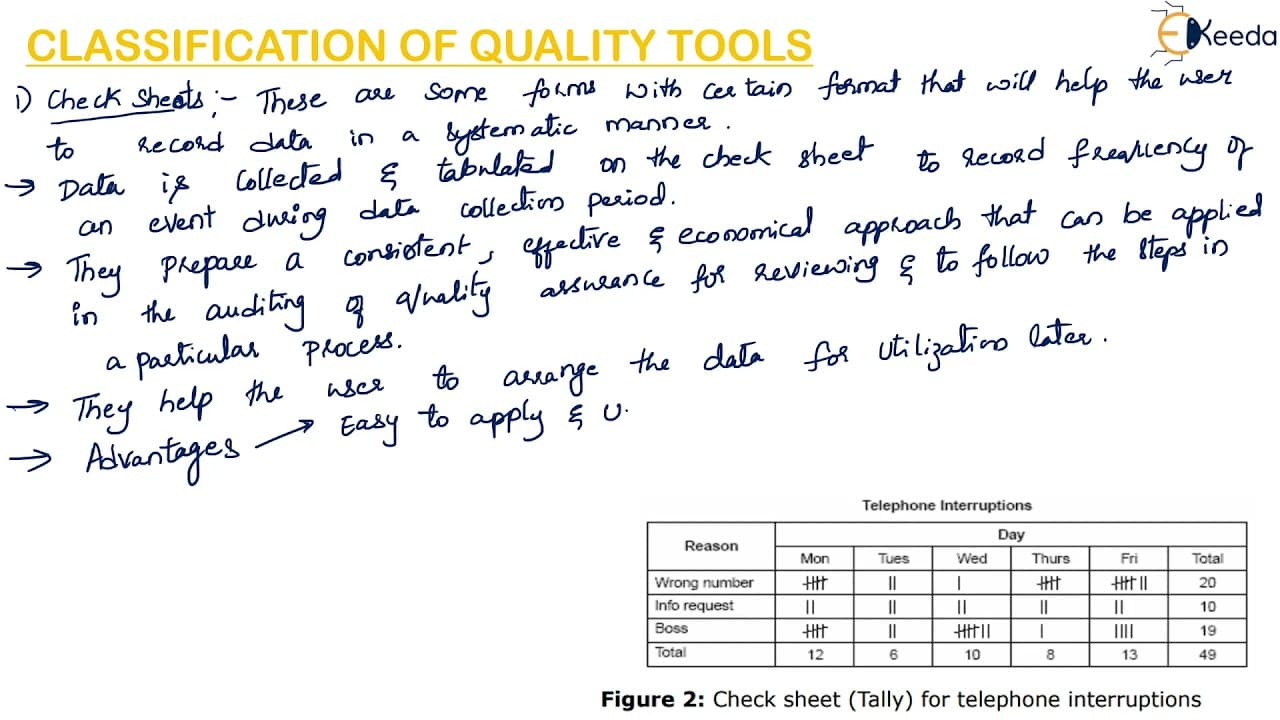
- 🪈 Check sheets help record and analyze the frequency of specific events during data collection.
- ❓ Histograms visualize the frequency distribution of observed values of a variable.
- 🪈 Pareto charts prioritize quality problems or causes in descending order of importance.
- ⚾ Cause and effect diagrams, also known as fishbone diagrams, help identify quality problems based on their degree of importance.
- ❎ Scatter diagrams assess the relationship, whether positive or negative, between two quality variables.
- 🦻 Flow charts represent the sequence of steps in a process, aiding in problem-solving and improving overall quality.
Install to Summarize YouTube Videos and Get Transcripts
Explore YouTube Video Summarizer or Get YouTube Transcript Extractor
Questions & Answers
Q: Who introduced the seven basic quality tools?
Dr. Ishikawa introduced the seven basic quality tools in 1968 for problem solving and process improvement in organizations.
Q: How are check sheets used for data collection?
Check sheets are simple forms that help users record data systematically, allowing them to tabulate the frequency of specific events during data collection periods.
Q: What is the purpose of a pareto chart?
Pareto charts, a type of histogram, prioritize and visualize quality problems, conditions, or their causes in descending order of importance.
Q: How does a control chart help in quality control?
Control charts monitor processes and check if they are within upper and lower control limits, helping to identify variations and maintain statistical control.
Summary & Key Takeaways
-
Dr. Ishikawa introduced seven basic quality tools: check sheets, histograms, pareto charts, cause and effect diagrams, scatter diagrams, control charts, and flow charts.
-
Check sheets are used to systematically record data and analyze the frequency of specific events during data collection periods.
-
Histograms visualize the frequency distribution of observed values of a variable, helping to analyze variation within a process.
Read in Other Languages (beta)
Share This Summary 📚
Summarize YouTube Videos and Get Video Transcripts with 1-Click
Try YouTube Summary with ChatGPT & Claude or YouTube Transcript Generator
Explore More Summaries from Ekeeda 📚




Summarize YouTube Videos and Get Video Transcripts with 1-Click
Try YouTube Summary with ChatGPT & Claude or YouTube Transcript Generator