What Is Gerrymandering and How Does It Work?
TL;DR
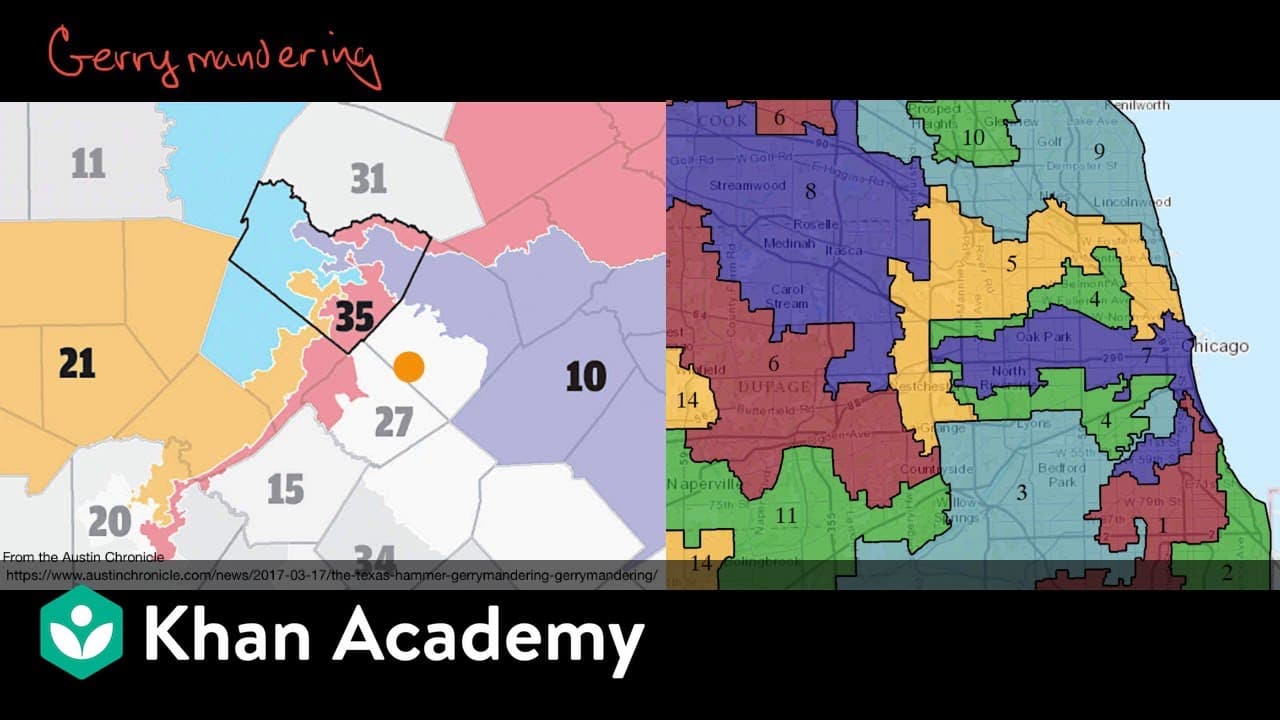
Gerrymandering is the practice of redrawing congressional district boundaries to favor a specific political party. This manipulation can dilute votes or protect incumbents, often using advanced algorithms to achieve desired outcomes. Originating from an 1812 salamander-shaped district in Massachusetts, gerrymandering significantly impacts voter representation.
Transcript
- [Instructor] What we see here are two maps of congressional districts. On the left we see some congressional districts in and around Austin, Texas. This black line shows us Travis County where Austin, Texas is. And on this right map we see the congressional districts in and around Chicago, Illinois. What I'd like you to do is pause this video and... Read More
Key Insights
- 🥳 Gerrymandering involves manipulating district shapes to benefit a political party.
- 🉐 Incumbent protection, vote dilution, and competitive advantage are common objectives of gerrymandering.
- 🥅 Sophisticated computer algorithms are used to create district boundaries that achieve specific political goals.
- 👳 Gerrymandering can affect urban and rural areas differently, depending on political leanings.
- ⚾ Different states undergo redistricting every 10 years based on the U.S. Census results.
- 🙈 Gerrymandering can provoke controversy and criticism, as it can be seen as undermining democratic principles.
- 🍉 The term "gerrymandering" originated from a salamander-shaped district in Massachusetts in 1812.
Install to Summarize YouTube Videos and Get Transcripts
Explore YouTube Video Summarizer or Get YouTube Transcript Extractor
Questions & Answers
Q: What is gerrymandering, and why is it done?
Gerrymandering is redrawing congressional district lines to favor one political party. It is done primarily to gain a political advantage by diluting opposition votes or protecting incumbents.
Q: How did the term "gerrymandering" originate?
The term "gerrymandering" comes from Elbridge Gerry, the governor of Massachusetts in 1812. Gerry signed a bill that created a salamander-shaped district, combining his name with "salamander" to create the term.
Q: What are some implications of gerrymandering?
Gerrymandering can lead to unequal representation and undermine the democratic process. It can favor one political party over another, dilute the power of certain voter groups, and even change the composition of an incumbent's district.
Q: How can computer algorithms be used in gerrymandering?
Sophisticated computer algorithms can be used to stretch or manipulate district boundaries to achieve specific political objectives. This process allows for more precise manipulation of district shapes and populations.
Summary & Key Takeaways
-
Gerrymandering is the act of shaping congressional districts to favor one political party over another.
-
District shapes can be manipulated through sophisticated computer algorithms to achieve various political objectives.
-
Gerrymandering can benefit incumbents, dilute votes, or force incumbents to compete against each other.
Read in Other Languages (beta)
Share This Summary 📚
Summarize YouTube Videos and Get Video Transcripts with 1-Click
Try YouTube Summary with ChatGPT & Claude or YouTube Transcript Generator
Explore More Summaries from Khan Academy 📚



Summarize YouTube Videos and Get Video Transcripts with 1-Click
Try YouTube Summary with ChatGPT & Claude or YouTube Transcript Generator