States of matter follow-up | States of matter and intermolecular forces | Chemistry | Khan Academy
TL;DR
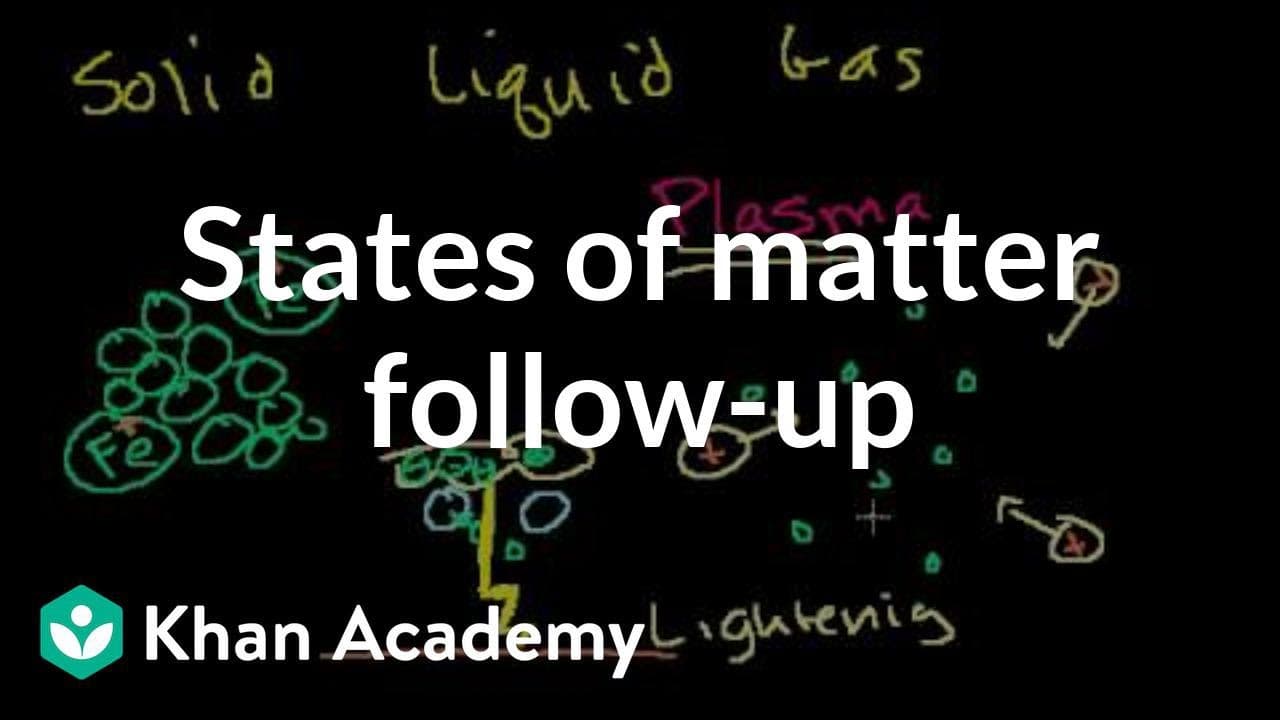
Plasma is a unique state of matter with properties of both gases and conductors, and it is the most common state of matter in the universe.
Transcript
In the last video we touched on the three states of matter that are really most familiar to our everyday experience. The solid, the liquid, and the gas. And I kind of hinted that there is a fourth state, which I don't cover, because it's usually not the domain of an introductory chemistry course. But a little bit of a discussion ensued on the messa... Read More
Key Insights
- 🫢 Plasma is a unique state of matter with properties of both gases and conductors.
- 🫢 It is formed when gases are subjected to a strong electromagnetic field that causes electrons to disassociate from atoms.
- 🫢 Plasma can conduct electricity and take the shape of its container like a gas.
- 🫢 Plasma is the most common state of matter in the universe, while solids, liquids, and gases are more commonly encountered in everyday life.
- 🤩 Lightning and stars are examples of natural phenomena where plasma can be found.
- 🫀 Hydrogen bonds are attractions between partially positive hydrogen atoms and partially negative atoms like nitrogen, fluorine, and oxygen.
Install to Summarize YouTube Videos and Get Transcripts
Explore YouTube Video Summarizer or Get YouTube Transcript Extractor
Questions & Answers
Q: Why is plasma considered the fourth state of matter?
Plasma is distinct from solids, liquids, and gases because it has properties of both gases and conductors. It behaves like a gas but also exhibits conductivity.
Q: What happens when electrons are bumped off in a plasma?
When electrons are bumped off in a plasma, the otherwise neutral atoms become positively charged. This allows for the conduction of electricity, as the free electrons are able to move.
Q: Where can plasma be found?
Plasma can be found in various natural phenomena, such as lightning. It also exists in stars, where extremely strong electromagnetic fields and high pressure result in the dissociation of electrons.
Q: What are hydrogen bonds and how do they form?
Hydrogen bonds are attractions between a partially positive hydrogen atom and a partially negative atom, such as nitrogen, fluorine, or oxygen. Electronegative atoms like nitrogen, fluorine, and oxygen tend to form hydrogen bonds.
Summary & Key Takeaways
-
Plasma is considered the fourth state of matter and has properties of both gases and conductors.
-
It is formed when gases are subjected to a strong electromagnetic field, causing electrons to disassociate from atoms.
-
Plasma can take the shape of its container like a gas and is capable of conducting electricity.
Read in Other Languages (beta)
Share This Summary 📚
Summarize YouTube Videos and Get Video Transcripts with 1-Click
Try YouTube Summary with ChatGPT & Claude or YouTube Transcript Generator
Explore More Summaries from Khan Academy 📚



Summarize YouTube Videos and Get Video Transcripts with 1-Click
Try YouTube Summary with ChatGPT & Claude or YouTube Transcript Generator