What Are Affixes and How Do They Change Word Meaning?
TL;DR
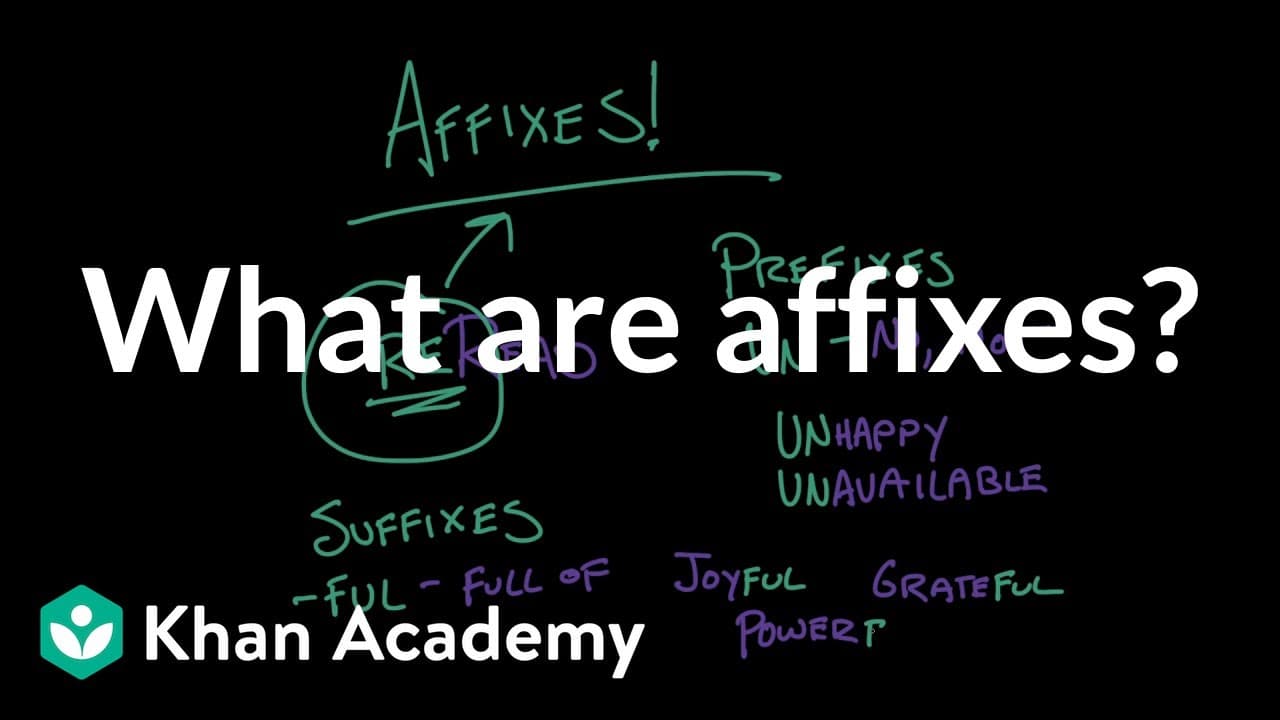
Affixes are parts of words that modify their meaning, either as prefixes at the beginning or suffixes at the end. For example, the prefix 'un-' negates a word (unhappy) while the suffix '-ful' indicates a state (joyful). Understanding affixes enhances vocabulary and allows for the creation of new words in English.
Transcript
- [Instructor] Hello readers. Today we're going to talk about things called affixes. One of the things that I love about the English language is how flexible its words can be. You can take little word parts and stick them together to make new words. If I read something once, I've read it. If I read it again, now I've reread it. That little re thing... Read More
Key Insights
- 🔑 Affixes are word parts that can be added to English words to modify their meaning.
- 🔑 Prefixes come before the root word and can change the word's negativity, repetition, or reversal.
- ❤️🩹 Suffixes come at the end of a word and can impact its degrees, qualities, or states of being.
- 👾 Exploring affixes through games and creating new words can strengthen understanding and knowledge of their usage.
- 😑 Affixes offer flexibility in the English language, enabling the creation of a wide range of words and expressions.
- ❓ Learning and understanding affixes enhances vocabulary and language comprehension.
- ❓ Prefixes like "re-", "dis-", and "mis-" indicate repetition, negation, and error, respectively.
Install to Summarize YouTube Videos and Get Transcripts
Explore YouTube Video Summarizer or Get YouTube Transcript Extractor
Questions & Answers
Q: What are affixes in the English language?
Affixes in the English language are word parts that can be added to existing words to alter their meaning. They can be either prefixes at the beginning or suffixes at the end of words.
Q: How do prefixes change the meaning of words?
Prefixes, such as "un-", "re-", or "dis-", change the meaning of words by indicating negation, repetition, or reversal. For example, "unhappy" means not happy, "redo" means to do again, and "disobey" means to not obey.
Q: What do suffixes indicate in the English language?
Suffixes in the English language indicate various aspects such as degrees, qualities, or states of being. For instance, the suffix "-ful" means full of, "-ly" indicates a way of doing something, and "-ness" signifies a state of being.
Q: How can affixes be used to create new words?
Affixes can be combined with existing words to create new words and expand vocabulary. By adding prefixes or suffixes, the meaning of the original word can be modified to convey a different concept or idea.
Summary & Key Takeaways
-
Affixes in the English language are word parts that can be added to existing words to change their meaning.
-
Prefixes are affixes that come at the beginning of words, such as "un-", which means no or not.
-
Suffixes are affixes that come at the end of words, such as "-ful", which means full of.
Read in Other Languages (beta)
Share This Summary 📚
Summarize YouTube Videos and Get Video Transcripts with 1-Click
Try YouTube Summary with ChatGPT & Claude or YouTube Transcript Generator
Explore More Summaries from Khan Academy 📚



Summarize YouTube Videos and Get Video Transcripts with 1-Click
Try YouTube Summary with ChatGPT & Claude or YouTube Transcript Generator