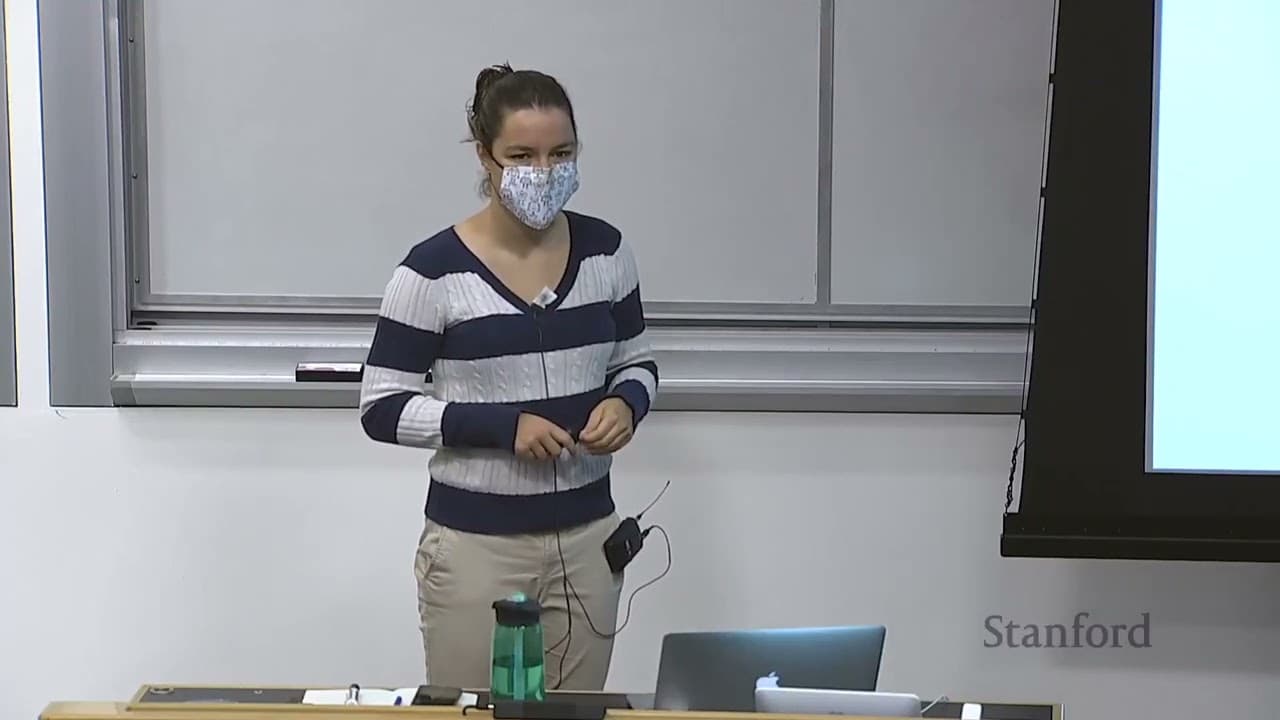
Stanford CS330: Deep Multi-task & Meta Learning I 2021 I Lecture 10
TL;DR
Model-based RL uses models to optimize actions and can be applied to multitask learning, especially in high-dimensional spaces.
Transcript
today we'll be talking about model based RL for multitask learning and so far we've talked all the oral that we've talked about is model free and so we'll be talking about a different class of approaches that you leverage models so um some Logistics we sent out the mid-quarter survey this is to kind of supplement the high resolution feedback that w... Read More
Key Insights
- 😒 Model-based RL uses models to optimize actions, providing an alternative to model-free RL.
- ⚾ Multitask learning can be effectively addressed using model-based RL, where tasks share aspects of the environment but vary in rewards.
- 👾 Learning a latent space and modeling in that space can improve efficiency and enable planning in high-dimensional spaces.
- ✋ Model-based RL can be used for tasks involving image observations or other high-dimensional inputs.
- 😵 Planning methods, such as random shooting or cross-entropy optimization, can be applied in model-based RL.
- 🥺 Learning a latent space may lead to representation collapse, where the model ignores important aspects of the input data.
- ⚾ Model-based RL can be highly efficient and effective in learning complex skills from image observations.
Install to Summarize YouTube Videos and Get Transcripts
Explore YouTube Video Summarizer or Get YouTube Transcript Extractor
Questions & Answers
Q: What is the difference between model-based RL and model-free RL?
Model-based RL uses models to optimize actions, while model-free RL does not. Model-based RL leverages predictions from the model to plan actions, while model-free RL directly updates the policy or value function.
Q: How does model-based RL handle multitask learning?
Model-based RL can be applied to multitask learning by using different reward functions for different tasks, while keeping the state space, action space, and dynamics shared across tasks. This allows for efficient learning and planning for multiple tasks.
Q: How can model-based RL be applied to high-dimensional spaces, like image observations?
In high-dimensional spaces, model-based RL can learn a lower-dimensional latent space using autoencoders or other methods. Planning and optimization is then performed in this latent space, which reduces the complexity and improves efficiency.
Q: What are the advantages of using model-based RL for multitask learning?
Model-based RL is sample-efficient and can learn complex skills efficiently. It also allows for the optimization of actions in high-dimensional spaces, making it suitable for tasks involving image observations or other high-dimensional inputs.
Summary & Key Takeaways
-
Model-based RL leverages models to optimize actions, in contrast to model-free RL approaches.
-
In multitask learning, tasks share similarities in state space, action space, and dynamics, but vary in reward functions.
-
Model-based RL can be used in high-dimensional spaces, such as learning from image observations.
Read in Other Languages (beta)
Share This Summary 📚
Summarize YouTube Videos and Get Video Transcripts with 1-Click
Try YouTube Summary with ChatGPT & Claude or YouTube Transcript Generator
Explore More Summaries from Stanford Online 📚

Summarize YouTube Videos and Get Video Transcripts with 1-Click
Try YouTube Summary with ChatGPT & Claude or YouTube Transcript Generator