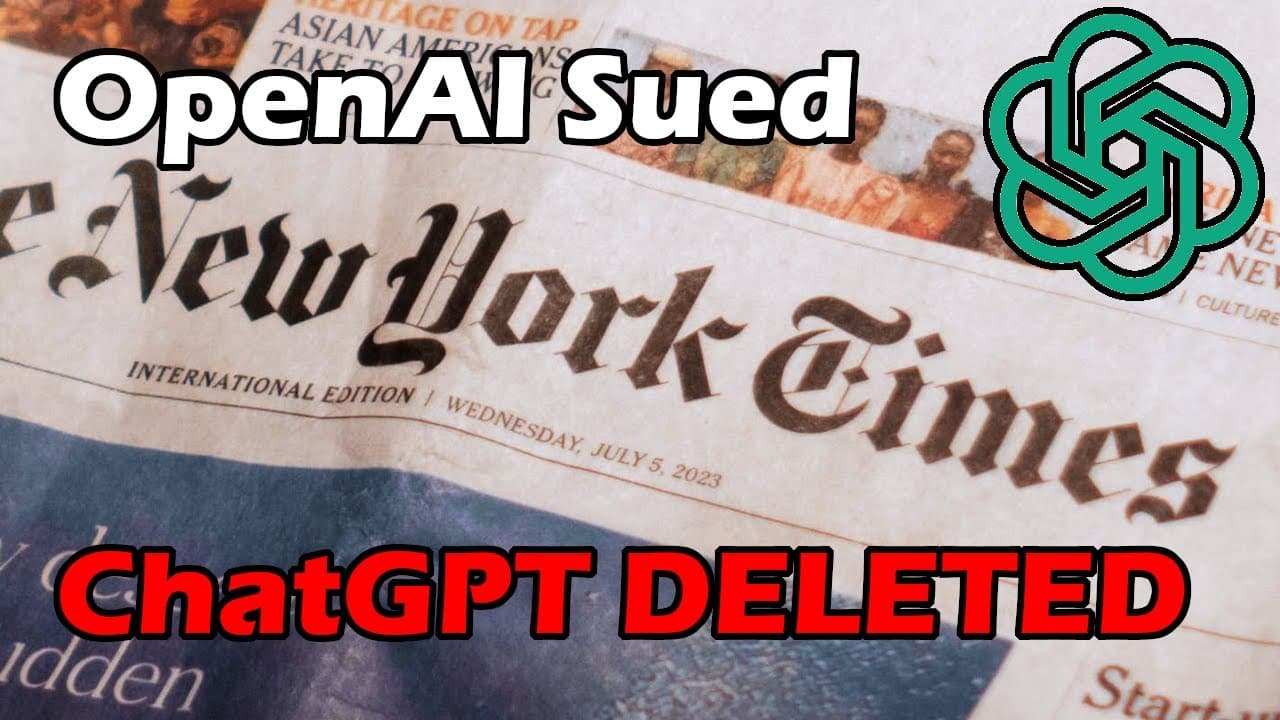
OpenAI sued by NYT! New York Times demands that ChatGPT be DELETED! The end of GPT? Probably not...
TL;DR
OpenAI and Microsoft face a lawsuit from New York Times over copyright infringement and damages, challenging the use of generative AI models like GPT.
Transcript
New York Times has sued open Ai and Microsoft for copyright infringement now you've probably seen this and heard this in the news cycle and they are suing for literally billions of dollars in Damages and they also want open Ai and Microsoft to delete chat GPT and GPT uh like all their training data sets so that's pretty severe and it is somewhat hy... Read More
Key Insights
- 😀 Lawsuits against generative AI entities often face challenges due to the novelty of AI technology and lack of precedent in copyright law.
- ❓ The legal battle highlights the tension between established entities and disruptive technologies seeking to transform industries.
- ©️ Transparency in data sourcing for AI models may become more important to avoid copyright infringement issues.
- 🤗 Open-source data sets and models could offer a solution to legal challenges faced by proprietary AI entities.
- 👮 The lawsuit underscores the need for clarity in copyright laws surrounding AI technologies.
- 💼 Uncovering the source of data used in AI models is crucial to determine liability in copyright infringement cases.
- 🔉 Legal battles between traditional media and AI entities reflect broader tensions between innovation and existing structures.
Install to Summarize YouTube Videos and Get Transcripts
Explore YouTube Video Summarizer or Get YouTube Transcript Extractor
Questions & Answers
Q: Why is New York Times suing OpenAI and Microsoft?
New York Times alleges copyright infringement, claiming AI models like GPT reproduce articles verbatim without permission, seeking damages and data deletion.
Q: How have past lawsuits against generative AI entities fared?
Previous cases show initial strong claims often get dismissed by judges due to lack of established precedent regarding AI and copyright laws.
Q: What challenges do lawsuits against generative AI entities face?
The novelty of AI technology and difficulty in proving harm or infringement complicates legal proceedings and establishing liability.
Q: How might this lawsuit impact the future of open-source data and models?
The lawsuit could spur more transparency in data sourcing for AI models, possibly leading to a shift towards open-source approaches to avoid legal issues.
Summary & Key Takeaways
-
New York Times sues OpenAI and Microsoft for copyright infringement, seeking billions in damages and deletion of training data.
-
Past lawsuits against generative AI often see initial strong claims that eventually get tossed out by judges.
-
Lack of precedent for generative AI in copyright law poses challenges in establishing infringement and harm.
Read in Other Languages (beta)
Share This Summary 📚
Summarize YouTube Videos and Get Video Transcripts with 1-Click
Try YouTube Summary with ChatGPT & Claude or YouTube Transcript Generator
Explore More Summaries from David Shapiro 📚


Summarize YouTube Videos and Get Video Transcripts with 1-Click
Try YouTube Summary with ChatGPT & Claude or YouTube Transcript Generator