Profit maximization worked example Free Response Question | Microeconomics | Khan Academy
TL;DR
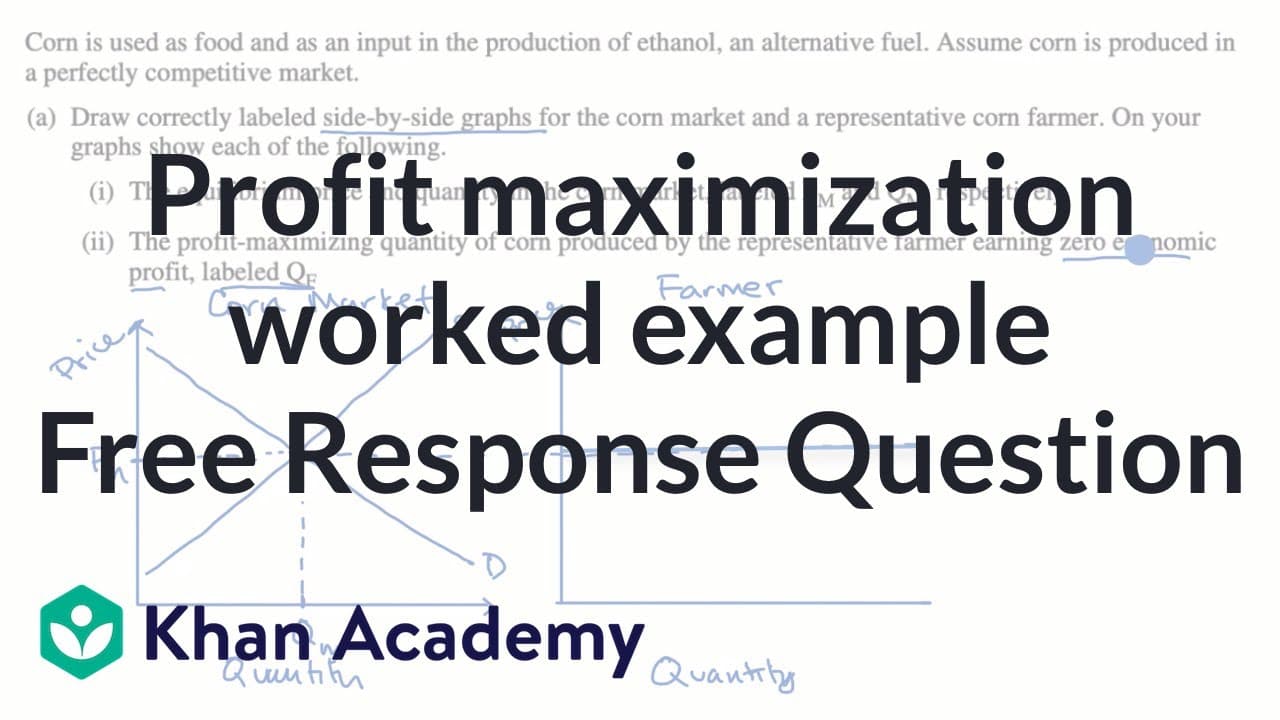
This video explains how to draw side-by-side graphs for the corn market and a representative corn farmer, showing the equilibrium price and quantity in the market, as well as the profit-maximizing quantity for the farmer.
Transcript
- [Instructor] We're told corn is used as food and as an input in the production of ethanol, an alternative fuel. Assume corn is produced in a perfectly competitive market. Draw correctly labeled side-by-side graphs for the corn market and a representative corn farmer. On your graphs show each of the following: The equilibrium price and quantity in... Read More
Key Insights
- 😋 Corn is used both as a food product and as an input in the production of ethanol, an alternative fuel.
- 🧑🌾 In a perfectly competitive market, the farmer is a price taker and must accept the market price for corn.
- 🧑🌾 The profit-maximizing quantity for the farmer occurs where the marginal cost intersects the marginal revenue (market price) and results in zero economic profit.
- 🇨🇷 The average total cost curve intersects the market price at the profit-maximizing quantity to ensure no economic profit is made.
- 🧑🌾 Drawing side-by-side graphs helps visualize the equilibrium price and quantity in the corn market, as well as the profit-maximizing quantity for the farmer.
- 🧑🌾 The concept of zero economic profit means the farmer covers all costs but does not earn any additional profit.
- 🧑🌾 Beyond the profit-maximizing quantity, each additional unit of corn produced by the farmer results in a loss.
Install to Summarize YouTube Videos and Get Transcripts
Explore YouTube Video Summarizer or Get YouTube Transcript Extractor
Questions & Answers
Q: What is the purpose of drawing side-by-side graphs for the corn market and a representative farmer?
Drawing these graphs allows us to visualize the equilibrium price and quantity in the market, as well as the profit-maximizing quantity for the farmer, helping us understand the dynamics of the corn market.
Q: Why is the farmer considered a price taker in a perfectly competitive market?
The farmer is a price taker because they have no control over the market price and must accept it as determined by the forces of supply and demand.
Q: How is the profit-maximizing quantity of corn determined for the representative farmer?
The profit-maximizing quantity occurs where the marginal cost curve intersects the marginal revenue (which, in this case, is the market price). It is also the quantity at which the farmer earns zero economic profit.
Q: Why does the average total cost curve intersect the market price at the profit-maximizing quantity?
Zero economic profit requires the price to be equal to the average total cost. Therefore, the average total cost curve intersects the market price to ensure the farmer covers all costs without making a profit.
Summary & Key Takeaways
-
This video discusses the concept of corn production in a perfectly competitive market and its use as food and an input in ethanol production.
-
It guides viewers on how to create correctly labeled side-by-side graphs for the corn market and a representative corn farmer, showcasing the equilibrium price and quantity in the market, as well as the profit-maximizing quantity for the farmer.
-
The video emphasizes that the farmer acts as a price taker, meaning they must accept the market price for corn, leading to zero economic profit at the profit-maximizing quantity.
Read in Other Languages (beta)
Share This Summary 📚
Summarize YouTube Videos and Get Video Transcripts with 1-Click
Try YouTube Summary with ChatGPT & Claude or YouTube Transcript Generator
Explore More Summaries from Khan Academy 📚



Summarize YouTube Videos and Get Video Transcripts with 1-Click
Try YouTube Summary with ChatGPT & Claude or YouTube Transcript Generator