Leetcode 1717. Maximum Score From Removing Substrings
TL;DR
This content discusses strategies to maximize points by removing substrings from a given string.
Transcript
hey there everyone welcome back to lead coding in this video we will be solving the question number two of lead good by weekly contest 43 so let us go through the problem statement we are given a string s and we are given two integers x and y we can perform the following operations any number of times we can remove av and gain x number of points so... Read More
Key Insights
- 😥 Understanding the differences in point values for substring removals is essential for developing an effective strategy.
- 🥺 A greedy approach is often advantageous in optimization problems, where immediate gains can lead to better overall outcomes.
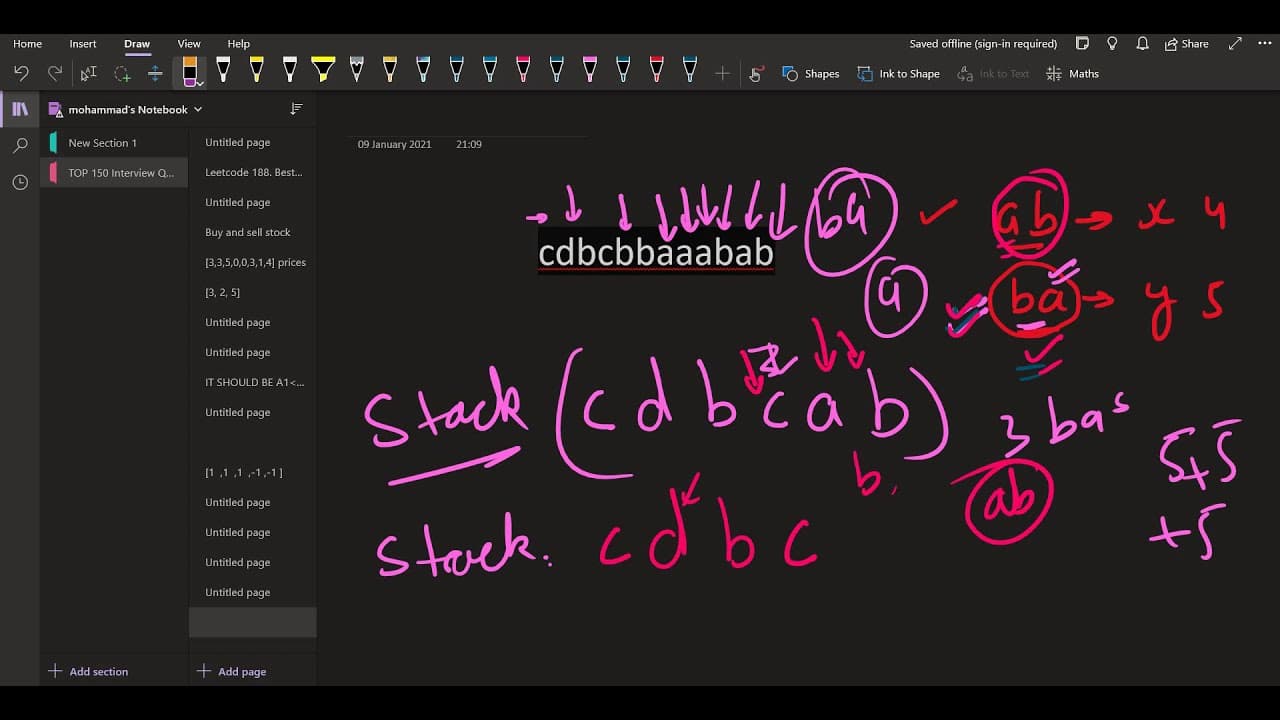
- 😒 The use of a stack proves to be a powerful tool for managing character states during substring evaluations, facilitating efficient removals.
- 💯 Priority should be given to operations that yield higher scores to maximize total points accumulated through various removals.
- 😚 Possible removal conflicts must be handled thoughtfully to avoid losing potential points from subsequent operations.
- 👣 Keeping track of the stack's state enables quick decisions on whether to remove substrings or continue adding characters.
- 🥺 Computational complexity must be carefully considered, as naive implementations can lead to inefficiencies, emphasizing the need for optimized data structures.
Install to Summarize YouTube Videos and Get Transcripts
Explore YouTube Video Summarizer or Get YouTube Transcript Extractor
Questions & Answers
Q: What is the main challenge presented in the coding problem?
The main challenge is to maximize the points gained by removing specific substrings ("ab" and "ba") from a given string. Each removal operation provides a different number of points, with the objective being to choose the optimal sequence of removals to achieve the highest possible score.
Q: How do you decide which substring to remove first?
The decision of which substring to remove first is based on the points associated with each removal. If removing "ba" yields more points than removing "ab," then "ba" should be prioritized. The goal is to apply a greedy strategy to maximize total points gained.
Q: What role does the stack structure play in solving the problem?
The stack structure aids in efficiently tracking characters as they are processed, allowing for quick removals of valid substrings when conditions are met. By maintaining this structure, the algorithm can dynamically assess possible removals and update the score as it traverses the string.
Q: What are the time complexity considerations mentioned in the video?
The presenter mentions that the algorithm could result in a worst-case time complexity of O(n^2), primarily due to concatenation operations as substrings are removed. However, by efficiently using a stack for removals, the operations can be optimized, leading to improved performance.
Q: How does the video suggest handling characters that might cause conflict when removing substrings?
The video suggests that when removing a "ba," it may disturb the potential removal of an "ab." However, this is acceptable since any disturbance will only affect at most one "ab." Therefore, prioritizing "ba" due to its higher point value is justified in the greedy strategy.
Q: What coding approach is recommended for implementing the solution?
The recommended coding approach involves using a vector or string as a stack to manage character additions and removals. The algorithm checks the current character against the top of the stack, allowing for efficient point calculations and substring removals based on the established point values.
Q: Why is it important to analyze multiple removal strategies in the problem?
Analyzing multiple removal strategies is crucial because different sequences of operations can lead to vastly different total points. By evaluating various paths and their implications, it is possible to identify the most rewarding sequence of operations, ensuring that the maximum score is achieved.
Summary & Key Takeaways
-
The video focuses on solving a specific problem from a coding contest involving a string and two types of operations that can yield points.
-
Viewers learn a greedy strategy for removing substrings that maximizes points gained, prioritizing one type of removal over another based on their respective point values.
-
The presenter also discusses using a stack-like structure in coding for efficient substring removal and point calculation, demonstrating the approach with a practical example.
Read in Other Languages (beta)
Share This Summary 📚
Summarize YouTube Videos and Get Video Transcripts with 1-Click
Try YouTube Summary with ChatGPT & Claude or YouTube Transcript Generator
Explore More Summaries from Fraz 📚

Summarize YouTube Videos and Get Video Transcripts with 1-Click
Try YouTube Summary with ChatGPT & Claude or YouTube Transcript Generator