Finding Fourier coefficients for square wave
TL;DR
Learn how to use Fourier series to represent a square wave as an infinite sum of weighted sines and cosines.
Transcript
- [Voiceover] So this could very well be an exciting video because we start with this idea of a Fourier series that we could take a periodic function and represent it as an infinite sum of weighted cosines and sines and we use that idea to say, "Well can we find formulas "for those coefficients?" And we were able to do that using the powers of calc... Read More
Key Insights
- 👻 Fourier series allows us to represent complex periodic functions using simpler trigonometric functions.
- 🍉 The coefficients for the cosine terms are zero for the given square wave, while the sine terms have non-zero coefficients for odd values of n.
- 🥡 Calculating the coefficients involves taking definite integrals of the function over the period.
Install to Summarize YouTube Videos and Get Transcripts
Explore YouTube Video Summarizer or Get YouTube Transcript Extractor
Questions & Answers
Q: What is a Fourier series?
A Fourier series is a representation of a periodic function as an infinite sum of weighted sines and cosines.
Q: How are the coefficients for the Fourier series calculated?
The coefficients, a-sub-n and b-sub-n, can be calculated by taking definite integrals of the function over the period and using trigonometric identities to simplify the expressions.
Q: Why are the coefficients for the cosine terms zero?
For the specific square wave example, the function is always zero for the cosine terms, resulting in zero coefficients.
Q: What is the significance of the b-sub-n coefficients being non-zero only for odd values of n?
The non-zero b-sub-n coefficients indicate that the square wave can be approximated using odd harmonics, which correspond to higher frequency components in the Fourier series.
Summary & Key Takeaways
-
The video explains the concept of Fourier series and how it can be used to represent a periodic function as a sum of sines and cosines.
-
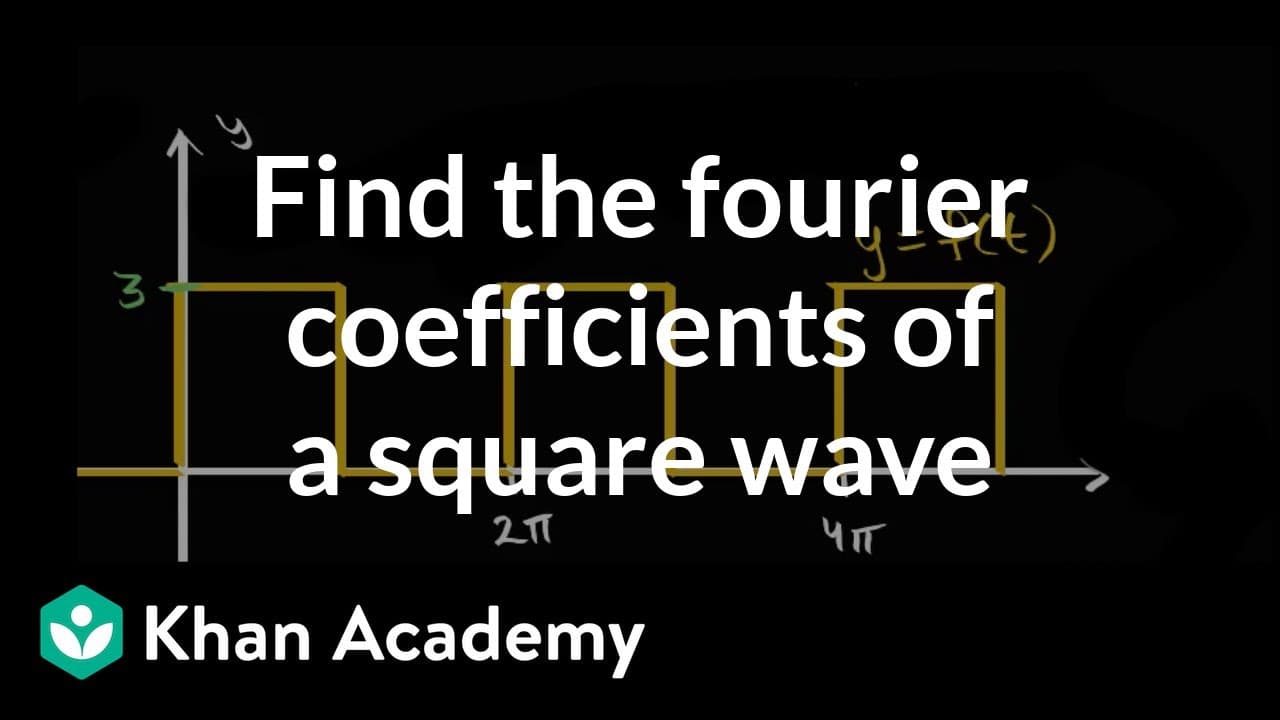
The specific example used is a square wave with a period of 2π, and the video demonstrates how to calculate the coefficients for the series.
-
The coefficients for the cosine terms (a-sub-n) are found to be zero for all values of n, while the coefficients for the sine terms (b-sub-n) are non-zero only when n is odd.
-
The Fourier expansion for the square wave is given by a-sub-zero = 3/2, b-sub-1 = 6/π * sin(t), b-sub-3 = 2/π * sin(3t), b-sub-5 = 6/5π * sin(5t), and so on.
Read in Other Languages (beta)
Share This Summary 📚
Summarize YouTube Videos and Get Video Transcripts with 1-Click
Try YouTube Summary with ChatGPT & Claude or YouTube Transcript Generator
Explore More Summaries from Khan Academy 📚



Summarize YouTube Videos and Get Video Transcripts with 1-Click
Try YouTube Summary with ChatGPT & Claude or YouTube Transcript Generator