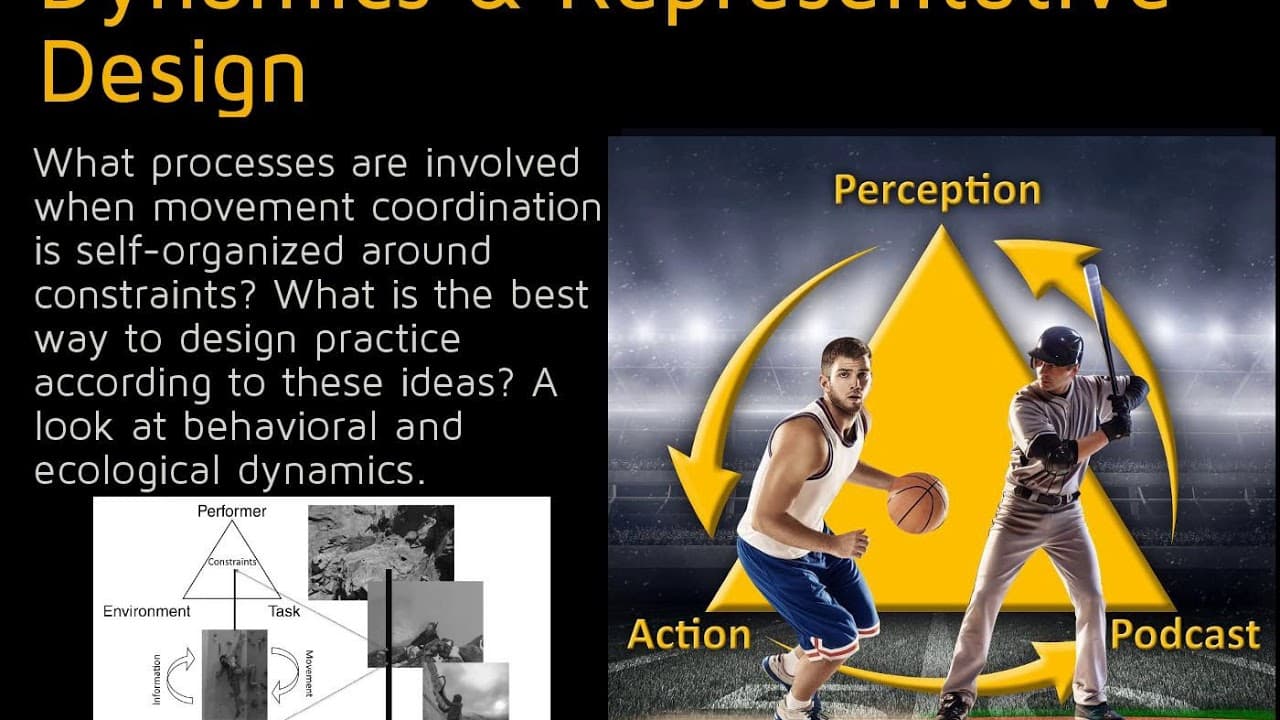
88 – The Constraints-Led Approach to Coaching II: Dynamics & Representative Design
TL;DR
Explores dynamics and design in constraints-led coaching.
Transcript
today on the perception and action podcast the second episode in my series on the constraints light approach to coaching looking at the theoretical underpinnings provided by behavioral and ecological dynamics and the issue of representative design so it's time for a call to action hi everyone this is Rob gray from Arizona State University in percep... Read More
Key Insights
- The constraints-led approach (CLA) emphasizes self-organization in movement, focusing on how performers adapt to constraints through dynamics.
- Coordination in CLA involves the perception-action cycle, where perception and action are interdependent and influence each other.
- Behavioral dynamics models treat the performer and environment as coupled systems, focusing on how they mutually influence each other.
- Ecological dynamics expands on behavioral dynamics by incorporating affordances, emphasizing the role of action capabilities in perception.
- Representative design in practice involves maintaining the functional coupling between perception and action to ensure skill transfer.
- Degeneracy in movement allows athletes to adapt their skills to various constraints, enhancing flexibility and adaptability.
- Ecological dynamics suggests that skill acquisition involves education of attention and intention, improving perceptual attunement and goal understanding.
- Practical coaching tips include understanding information sources, maintaining perception-action coupling, and studying movement variability in elite performers.
Install to Summarize YouTube Videos and Get Transcripts
Explore YouTube Video Summarizer or Get YouTube Transcript Extractor
Questions & Answers
Q: What is the constraints-led approach to coaching?
The constraints-led approach (CLA) to coaching is a methodology that focuses on how performers self-organize their movements around environmental and task constraints. It emphasizes the importance of the perception-action cycle, where perception and action are interdependent and influence each other, leading to the development of effective movement solutions through the interaction of various constraints.
Q: How do behavioral dynamics models explain coordination?
Behavioral dynamics models explain coordination by treating the performer and the environment as coupled dynamical systems. These models emphasize the mutual influence between the performer and environment, where movement solutions emerge from the interaction of mechanical forces and perceptual information. This approach allows for predicting future states, diagnosing past states, and understanding the organization of behavior without attributing it to an internal controller.
Q: What role do affordances play in ecological dynamics?
In ecological dynamics, affordances play a crucial role by linking perception and action capabilities. This approach suggests that performers perceive action-specifying information sources that are scaled based on their action capabilities, such as body dimensions and maximal turning rates. Affordances allow performers to tailor their movement patterns to suit their individual constraints, leading to self-organized and emergent behavior that adapts to changing environmental conditions.
Q: What is representative design in practice?
Representative design in practice involves creating training environments that closely mimic the informational and action demands of competition. It ensures that the functional coupling between perception and action is maintained, allowing for effective skill transfer. This design principle emphasizes retaining specifying information and ensuring action fidelity, so that practice drills elicit similar movement patterns to those used in actual performance settings.
Q: How does degeneracy contribute to skill development?
Degeneracy contributes to skill development by allowing performers to achieve functionally equivalent actions through different structural components of movement. This flexibility enables athletes to adapt their skills to various constraints and environmental changes, enhancing their ability to perform under diverse conditions. By harnessing degeneracy, athletes can develop robust and adaptable movement solutions that improve overall performance and resilience.
Q: What is the education of attention and intention in ecological dynamics?
In ecological dynamics, the education of attention involves attuning performers to specifying information that supports coordination and adaptability. The education of intention focuses on helping performers understand the affordances they aim to achieve in different situations. Together, these processes enhance the performer's ability to perceive relevant information and adapt their actions to achieve intended goals, facilitating effective skill acquisition and performance.
Q: Why is maintaining perception-action coupling important in practice?
Maintaining perception-action coupling in practice is important because it ensures that movement solutions emerge from the interaction between perceptual information and action dynamics. This coupling is crucial for developing skills that transfer effectively to competition settings, as it allows performers to adapt their actions based on real-time changes in the environment. By preserving this coupling, coaches can create practice environments that foster realistic and adaptable skill development.
Q: How can coaches benefit from studying movement variability in elite performers?
Coaches can benefit from studying movement variability in elite performers by gaining insights into the diverse ways athletes achieve successful outcomes. By examining the differences in movement solutions among skilled performers, coaches can identify alternative strategies and techniques that may enhance skill development. Understanding movement variability also highlights the importance of individual constraints and encourages coaches to design practice environments that accommodate diverse movement patterns.
Summary & Key Takeaways
-
The podcast discusses the constraints-led approach to coaching, focusing on how coordination emerges through self-organization around environmental and task constraints. It highlights the importance of the perception-action cycle in shaping movement solutions and explores the role of behavioral and ecological dynamics in understanding skill acquisition.
-
Behavioral dynamics models treat performers and environments as coupled dynamical systems, emphasizing the mutual influence between them. The ecological dynamics approach adds the concept of affordances, highlighting how action capabilities influence perception and coordination. Representative design in practice is critical for ensuring skill transfer.
-
Practical implications for coaches include understanding the information sources athletes use, maintaining the coupling between perception and action, and recognizing individual differences in movement solutions. The podcast emphasizes the importance of adaptability and flexibility in skill development, encouraging coaches to study movement variability in elite performers.
Read in Other Languages (beta)
Share This Summary 📚
Summarize YouTube Videos and Get Video Transcripts with 1-Click
Try YouTube Summary with ChatGPT & Claude or YouTube Transcript Generator
Explore More Summaries from Rob Gray 📚
Summarize YouTube Videos and Get Video Transcripts with 1-Click
Try YouTube Summary with ChatGPT & Claude or YouTube Transcript Generator