What Is Rotational Motion and How Does It Work?
TL;DR
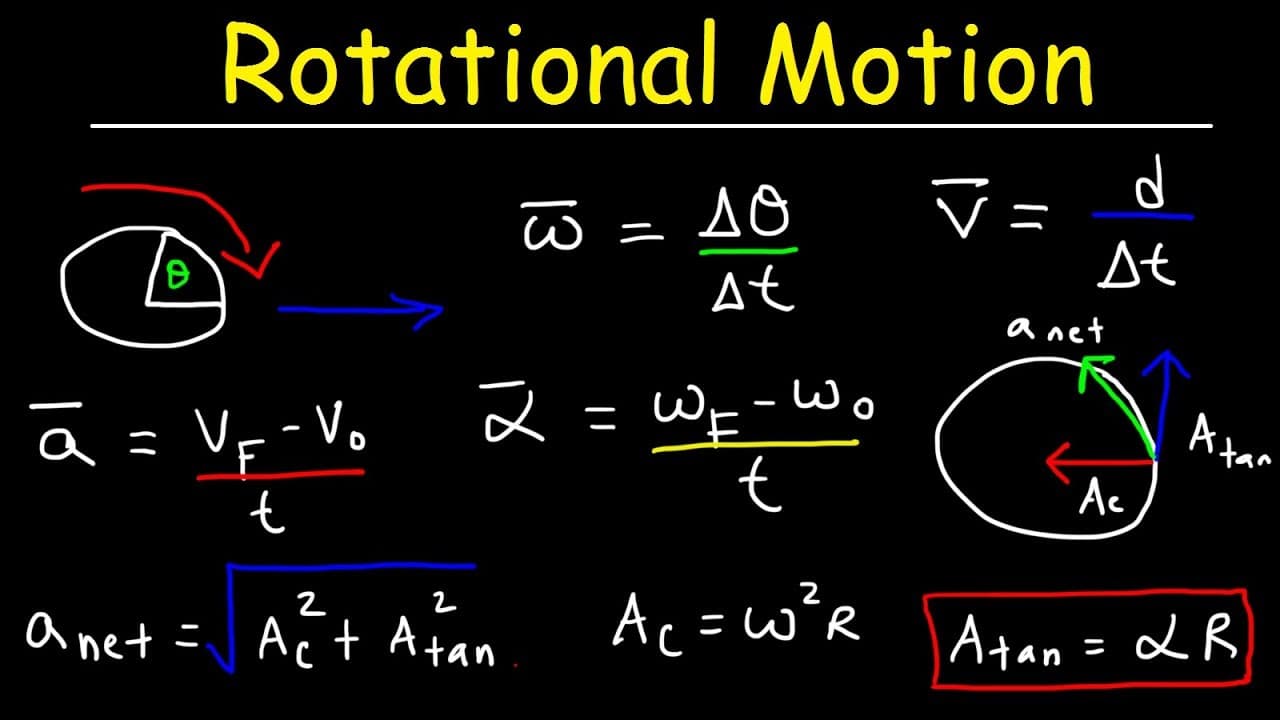
Rotational motion describes objects spinning or rotating around a fixed point. Key concepts include angular position and displacement measured in radians, angular velocity for spinning speed, and the relationship between linear and angular velocities given by the equation v = ω * r. Understanding these principles is essential for analyzing motion in circular paths.
Transcript
in this video we're going to talk about rotational motion so what exactly is rotational motion from the word you can describe that it's any object that can rotate or spin so that's rotational motion it's different from linear motion where an object simply moves forward linear motion and translational motion basically means the same thing now so wha... Read More
Key Insights
- ❓ Rotational motion refers to objects rotating or spinning, distinct from linear motion.
- 📐 Angular position and angular displacement are measured in radians.
- ⏩ Angular velocity measures how fast an object is spinning, while linear velocity measures how fast it is moving forward.
- 🥰 The equation v = ω * r relates linear velocity and angular velocity.
- 🏍️ The period is the time it takes to complete one cycle, while frequency is the number of cycles per second.
- 👻 The equation ω = 2πf allows for calculating angular velocity using frequency.
- 😥 Centripetal acceleration points towards the center of the circle and is ω^2 * r.
Install to Summarize YouTube Videos and Get Transcripts
Explore YouTube Video Summarizer or Get YouTube Transcript Extractor
Questions & Answers
Q: What is the difference between rotational motion and linear motion?
Rotational motion involves objects rotating or spinning, while linear motion refers to an object simply moving forward in a straight line.
Q: What are the terms used in rotational motion?
Terms in rotational motion include angular position, angular displacement, angular velocity, and angular acceleration.
Q: What is the unit for angular displacement?
The standard unit for angular displacement is radians, although degrees can also be used.
Q: How does angular velocity differ from linear velocity?
Angular velocity measures how fast an object is spinning on a circle, while linear velocity measures how fast it is moving forward.
Q: How are linear velocity and angular velocity related?
The equation relating linear velocity and angular velocity is v = ω * r, where v is linear velocity, ω is angular velocity, and r is the radius of the circle.
Q: What is the period and frequency in rotational motion?
The period is the time it takes to complete one cycle, while the frequency is the number of cycles per second. The unit for period is seconds, while the unit for frequency is hertz.
Q: How can angular velocity be calculated using frequency?
The equation for calculating angular velocity using frequency is ω = 2πf, where ω is angular velocity and f is frequency.
Q: What are centripetal and tangential accelerations?
Centripetal acceleration points towards the center of the circle and is ω^2 * r, while tangential acceleration is equal to the angular acceleration times the radius.
Summary & Key Takeaways
-
Rotational motion involves objects rotating or spinning, distinct from linear motion or translational motion.
-
Terms in rotational motion include angular position and angular displacement, measured in radians.
-
Angular velocity measures how fast an object is spinning, while linear velocity measures how fast it is moving forward.
-
Angular acceleration relates to the change in angular velocity, while linear acceleration relates to the change in velocity.
Read in Other Languages (beta)
Share This Summary 📚
Summarize YouTube Videos and Get Video Transcripts with 1-Click
Try YouTube Summary with ChatGPT & Claude or YouTube Transcript Generator
Explore More Summaries from The Organic Chemistry Tutor 📚




Summarize YouTube Videos and Get Video Transcripts with 1-Click
Try YouTube Summary with ChatGPT & Claude or YouTube Transcript Generator