What Conditions Must Be Met for T-Intervals?
TL;DR
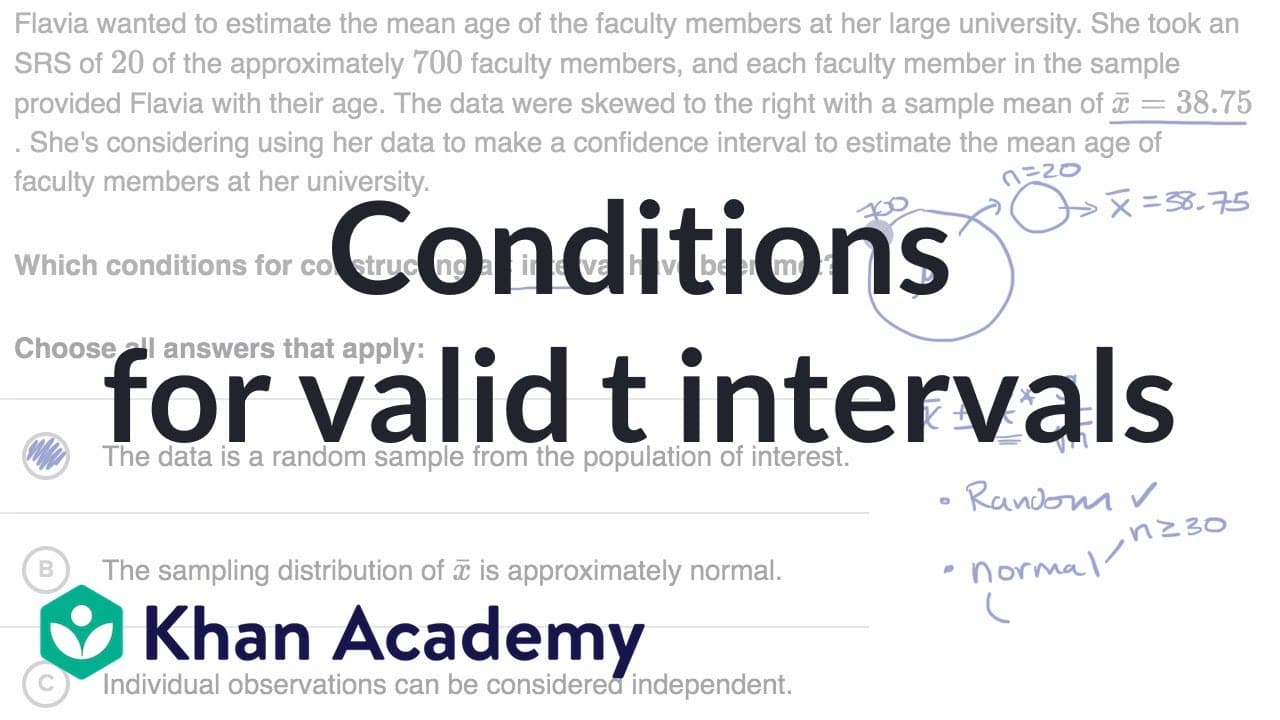
To construct a t interval effectively, three conditions must be met: random sampling, a normal distribution of the sample means, and independent observations. While Flavia's sample of 20 faculty members satisfies the random sampling and independence criteria, the right-skewed data indicates a failure to meet the normality requirement, suggesting caution in using the t interval for her mean age estimation.
Transcript
- [Instructor] Flavia wanted to estimate the mean age of the faculty members at her large university. She took an SRS, or simple random sample, of 20 of the approximately 700 faculty members, and each faculty member in the sample provided Flavia with their age. The data were skewed to the right with a sample mean of 38.75. She's considering using h... Read More
Key Insights
- 🛄 Flavia's study aims to estimate the mean age of faculty members at her university using a sample of 20.
- 🗯️ The data collected from the sample is skewed to the right, indicating a non-normal distribution.
- 😃 A t interval is used when the population standard deviation is not known, but the sample standard deviation can be calculated.
- 👷 The conditions for constructing a t interval include random sampling, a normal condition (either a larger sample size or a roughly symmetric distribution), and independent observations (either sampling with replacement or a small sample size relative to the population).
- 🗯️ Flavia's study meets the conditions of random sampling and independent observations, but not the normal condition due to the right skewness of the data.
- 🥶 The right skewness suggests that there are faculty members much older than the sample mean but unlikely to be much younger.
Install to Summarize YouTube Videos and Get Transcripts
Explore YouTube Video Summarizer or Get YouTube Transcript Extractor
Questions & Answers
Q: How did Flavia select her sample for estimating the mean age of faculty members?
Flavia selected a simple random sample of 20 faculty members out of approximately 700.
Q: Why does Flavia want to construct a t interval?
Flavia wants to construct a t interval to estimate the mean age of faculty members at her university using the sample data she collected.
Q: What are the conditions for constructing a t interval?
The conditions for constructing a t interval include having a random sample, a normal condition (either a sample size greater than or equal to 30 or a roughly normal or approximately symmetric distribution of the original data), and independent observations (sampling with replacement or a sample size that is less than or equal to 10% of the population size).
Q: Which conditions for constructing a t interval have been met in Flavia's study?
Flavia's study meets the condition of having a random sample and independent observations but does not meet the normal condition due to the right skewness of the data.
Summary & Key Takeaways
-
Flavia took a simple random sample of 20 faculty members out of approximately 700 to estimate the mean age of faculty members at her university.
-
The sample data were skewed to the right, with a sample mean age of 38.75.
-
She wants to construct a t interval to estimate the population mean age, but needs to determine if the conditions for constructing a t interval have been met.
Read in Other Languages (beta)
Share This Summary 📚
Summarize YouTube Videos and Get Video Transcripts with 1-Click
Try YouTube Summary with ChatGPT & Claude or YouTube Transcript Generator
Explore More Summaries from Khan Academy 📚



Summarize YouTube Videos and Get Video Transcripts with 1-Click
Try YouTube Summary with ChatGPT & Claude or YouTube Transcript Generator