What is Multi-task and Meta Reinforcement Learning?
TL;DR
Multi-task reinforcement learning uses a unified approach to tackle various tasks simultaneously, enhancing decision-making processes in dynamic environments. It builds on the principles of reinforcement learning, leveraging task identifiers to model multiple objectives within a single Markov Decision Process (MDP). This method opens opportunities for applications in fields like robotics and autonomous systems, optimizing learning outcomes across diverse scenarios.
Transcript
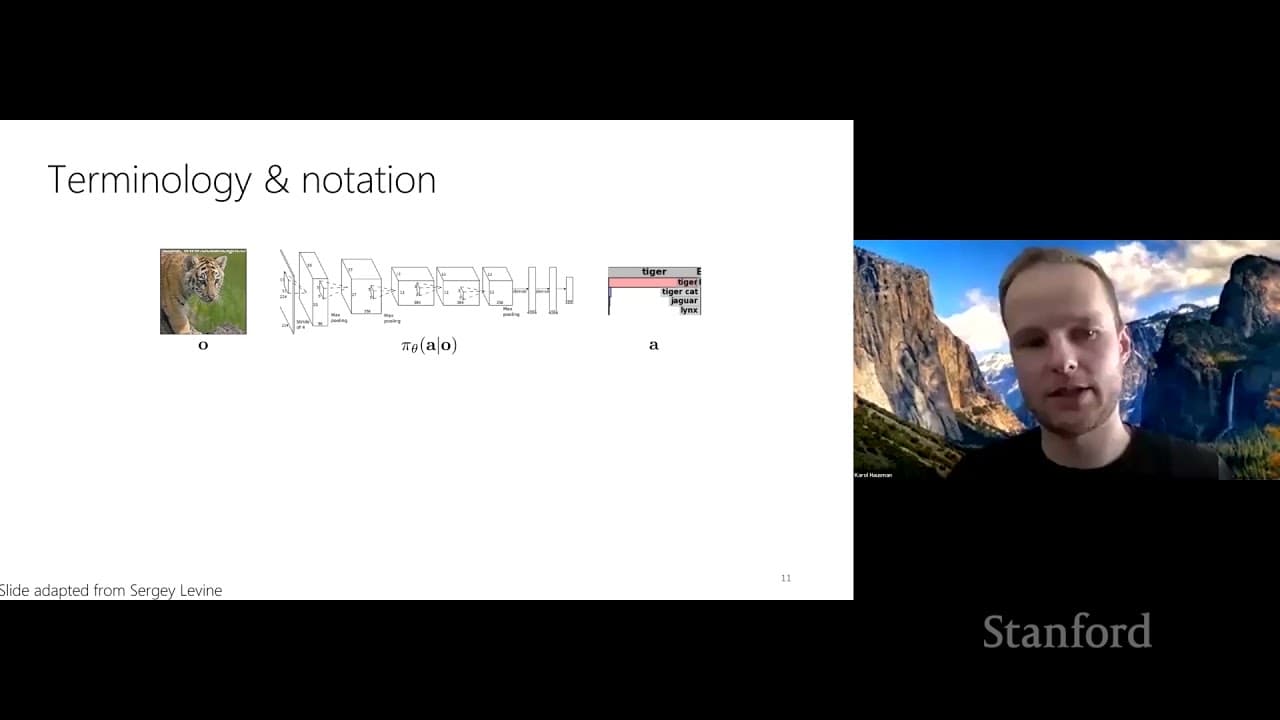
so far in the course we've talked about multitask learning and meta learning for supervised learning uh and now we're going to start talking about reinforcement learning which introduces a number of really interesting challenges and and also opportunities to do better when you're trying to learn multiple tasks and i learn across tasks uh and the fi... Read More
Key Insights
- 🎰 Reinforcement learning enables machines to learn through trial and error and make optimal decisions in dynamic environments.
- 💄 The Markov Decision Process (MDP) provides a framework for modeling sequential decision-making problems in reinforcement learning.
- 👻 Multitask reinforcement learning extends reinforcement learning to multiple tasks, allowing for the simultaneous learning of different objectives.
- 👻 Incorporating task identifiers into the state allows for the representation of multiple tasks as a single MDP.
Install to Summarize YouTube Videos and Get Transcripts
Explore YouTube Video Summarizer or Get YouTube Transcript Extractor
Questions & Answers
Q: What is reinforcement learning and why is it important?
Reinforcement learning is a machine learning technique that focuses on learning through sequential decision making. It is important because it allows machines to learn how to make optimal decisions in complex and dynamic environments.
Q: How does reinforcement learning differ from other machine learning approaches?
Unlike supervised learning, where the model is trained on labeled data, and unsupervised learning, where the model identifies patterns in unlabeled data, reinforcement learning requires interaction with the environment to learn through trial and error. It learns from feedback in the form of rewards or punishments.
Q: What is the Markov Decision Process (MDP)?
The MDP is a mathematical framework used to model sequential decision-making problems in reinforcement learning. It consists of a set of states, a set of actions, transition dynamics that define the probability of transitioning from one state to another based on an action, and a reward function that assigns a scalar value to each state-action pair.
Q: How does multitask reinforcement learning work?
Multitask reinforcement learning extends the concept of reinforcement learning to multiple tasks. Each task has its own reward function, but the transition dynamics and state space remain the same. By incorporating a task identifier into the state, the MDP can represent multiple tasks as a single MDP.
Q: How can reinforcement learning be applied in robotics?
Reinforcement learning can be applied in robotics to teach robots how to make decisions based on their observations of the environment. It allows them to learn how to interact with their surroundings and perform complex tasks such as object recognition, grasping, and autonomous navigation.
Q: What are the challenges and limitations of reinforcement learning?
Some challenges and limitations of reinforcement learning include high variance gradients, the requirement for large amounts of training data, the need for exploration to discover optimal policies, and the difficulty of dealing with partially observable environments.
Q: How does goal-conditioned reinforcement learning differ from multitask reinforcement learning?
Goal-conditioned reinforcement learning is a specific type of multitask reinforcement learning where the task identifier represents a desired goal state. The agent learns to take actions that lead to the achievement of the goal state, allowing for more fine-grained control over the learning process.
Summary & Key Takeaways
-
The content introduces the concept of reinforcement learning and highlights its challenges and opportunities for learning across multiple tasks.
-
The lecturer shares their background and fascination with deep reinforcement learning, as well as its application to robotics.
-
The importance of sequential decision making and its relevance to intelligence is discussed.
-
The Markov Decision Process (MDP), state space, action space, transition dynamics, and reward functions are explained in the context of reinforcement learning.
-
The content also explores multitask reinforcement learning and the addition of a task identifier to the state, allowing for the modeling of multiple tasks as a single MDP.
Read in Other Languages (beta)
Share This Summary 📚
Summarize YouTube Videos and Get Video Transcripts with 1-Click
Try YouTube Summary with ChatGPT & Claude or YouTube Transcript Generator
Explore More Summaries from Stanford Online 📚

Summarize YouTube Videos and Get Video Transcripts with 1-Click
Try YouTube Summary with ChatGPT & Claude or YouTube Transcript Generator