Products
Features
YouTube Video Summarizer
Summarize YouTube videos
Web & PDF Highlighter
Highlight web pages & PDFs
Chat with PDF
Ask any PDF questions with AI
Ask AI Clone
Chat with your highlights & memories
Audio Transcriber
Transcribe audio files to text
Glasp Reader
Read and highlight articles
Kindle Highlight Export
Export your Kindle highlights
Idea Hatch
Hatch ideas from your highlights
Integrations
Obsidian Plugin
Notion Integration
Pocket Integration
Instapaper Integration
Medium Integration
Readwise Integration
Snipd Integration
Hypothesis Integration
Apps & Extensions
Chrome Extension
Safari Extension
Edge Add-ons
Firefox Add-ons
iOS App
Android App
Discover
Discover
Ideas
Discover new ideas and insights
Articles
Curated articles and insights
Books
Book recommendations by great minds
Posts
Essays and notes from readers
Quotes
Inspiring quotes collection
Videos
Curated videos and summaries
Explore Glasp
Glasp Newsletter
Weekly insights and updates
Glasp Talk
Interview series with great minds
Glasp Blog
Latest news and articles
Glasp Use Cases
Learn how others use Glasp
Build & Support
Glasp API
Access Glasp's API for developers
MCP Connector
Connect Glasp to Claude & ChatGPT
Community
Glasp Reddit Community
Students
Student discount and benefits
FAQs
Frequently Asked Questions
AboutPricing
DashboardLog inSign up

How to Choose Miner | Blockchain and Cryptocurrency: What You Need to Know | 2019
July 12, 2022
by
Stanford Online
YouTube video player
How to Choose Miner | Blockchain and Cryptocurrency: What You Need to Know | 2019

TL;DR

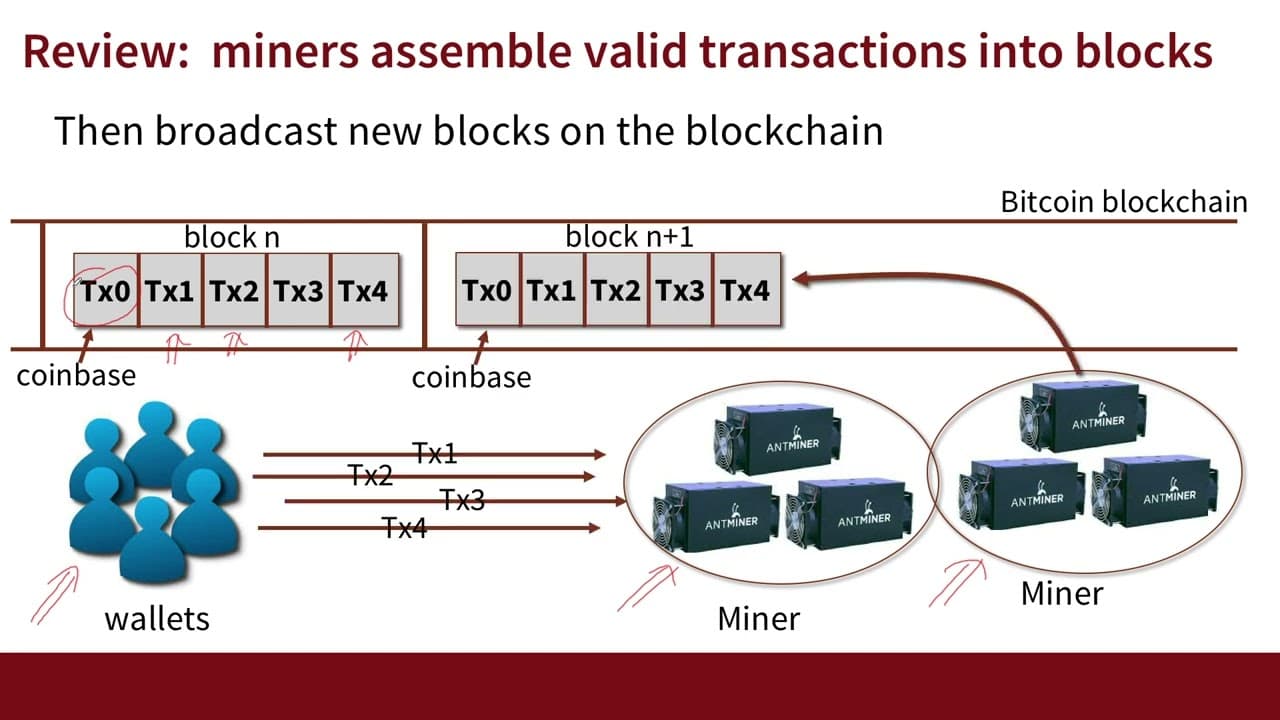
Miners collect transactions from users, assemble them into blocks, and write these blocks onto the blockchain. They get paid for their work and the miner that creates a block is chosen randomly to ensure fairness.

Transcript

okay welcome back everyone in this segment we're going to talk about how mining works so let's see what the miners actually do so this one picture is going to explain exactly what miners do in these blockchains so i'll use again one of our examples i'll use the bitcoin blockchain to illustrate it but it's actually quite similar in many blockchains ... Read More

Key Insights

  • 🚫 Miners in blockchains collect and assemble transactions into blocks before writing them onto the blockchain.
  • 💦 They are paid through a special transaction called "coinbase" for their work in creating blocks.
  • 👊 Random selection of miners ensures that anyone can participate in mining and prevents a Sybil attack.
  • 👊 Sybil attacks, where a single entity controls a majority of miners, can disrupt the fairness and persistence of blockchains.
  • 👻 Mining allows for liveness in the system as transactions can be posted even if some miners refuse to accept them.
  • 🖐️ Miners play a crucial role in maintaining the integrity and security of blockchains.
  • ❓ Different blockchains may have different mining mechanisms and reward structures.

Install to Summarize YouTube Videos and Get Transcripts

Explore YouTube Video Summarizer or Get YouTube Transcript Extractor

Questions & Answers

Q: How do miners collect transactions in blockchains?

Miners collect transactions from users who issue them into the network, such as the Bitcoin network. They receive these transactions and assemble them into blocks.

Q: How do miners get paid for their work?

Miners receive payment for their work through the "coinbase" transaction. This transaction is included in each block they create and it pays them for their mining efforts.

Q: How is the miner chosen to create a new block?

The miner that creates a new block is chosen randomly from the set of all miners. This ensures that anyone in the world can participate in mining and have a chance to earn rewards.

Q: What is a Sybil attack and how does it affect mining?

A Sybil attack occurs when a single entity controls a majority of the miners. This entity can block transactions and even revert some transactions, which goes against the principles of fairness and persistence in blockchains.

Summary & Key Takeaways

  • Miners in blockchains, like Bitcoin, collect transactions from users and write them onto the blockchain.

  • They assemble transactions into blocks and include a special transaction called "coinbase" that pays them for their work.

  • The miner that creates a block is chosen randomly to ensure that anyone can participate in mining.


Read in Other Languages (beta)

English

Share This Summary 📚

Summarize YouTube Videos and Get Video Transcripts with 1-Click

Download browser extensions on:

Try YouTube Summary with ChatGPT & Claude or YouTube Transcript Generator

Explore More Summaries from Stanford Online 📚
Stanford CS224N NLP with Deep Learning | Winter 2021 | Lecture 16 - Social & Ethical Considerations thumbnail
Stanford CS224N NLP with Deep Learning | Winter 2021 | Lecture 16 - Social & Ethical Considerations
Stanford Online
Stanford CS229: Machine Learning | Summer 2019 | Lecture 20 - Variational Autoencoder thumbnail
Stanford CS229: Machine Learning | Summer 2019 | Lecture 20 - Variational Autoencoder
Stanford Online
Stanford AA228/CS238 Decision Making Under Uncertainty I Policy Gradient Estimation and Optimization thumbnail
Stanford AA228/CS238 Decision Making Under Uncertainty I Policy Gradient Estimation and Optimization
Stanford Online
Bayesian Networks 4 - Probabilistic Inference | Stanford CS221: AI (Autumn 2021) thumbnail
Bayesian Networks 4 - Probabilistic Inference | Stanford CS221: AI (Autumn 2021)
Stanford Online
Stanford Webinar - GPT-3 & Beyond thumbnail
Stanford Webinar - GPT-3 & Beyond
Stanford Online

Summarize YouTube Videos and Get Video Transcripts with 1-Click

Download browser extensions on:

Try YouTube Summary with ChatGPT & Claude or YouTube Transcript Generator

Apps & Extensions

  • Chrome Extension
  • Safari Extension
  • Edge Add-ons
  • Firefox Add-ons
  • iOS App
  • Android App

Key Features

  • YouTube Video Summarizer
  • Web & PDF Summarizer
  • Web & PDF Highlighter
  • Chat with PDF
  • Ask AI Clone
  • Audio Transcriber
  • Glasp Reader
  • Kindle Highlight Export
  • Idea Hatch

Integrations

  • Obsidian Plugin
  • Notion Integration
  • Pocket Integration
  • Instapaper Integration
  • Medium Integration
  • Readwise Integration
  • Snipd Integration
  • Hypothesis Integration

More Features

  • APIs
  • MCP Connector
  • Blog & Post
  • Embed Links
  • Image Highlight
  • Personality Test
  • Quote Shots

Company

  • About us
  • Blog
  • Community
  • FAQs
  • Job Board
  • Newsletter
  • Pricing
Terms

•

Privacy

•

Guidelines

© 2026 Glasp Inc. All rights reserved.