Passive Transport | Biology
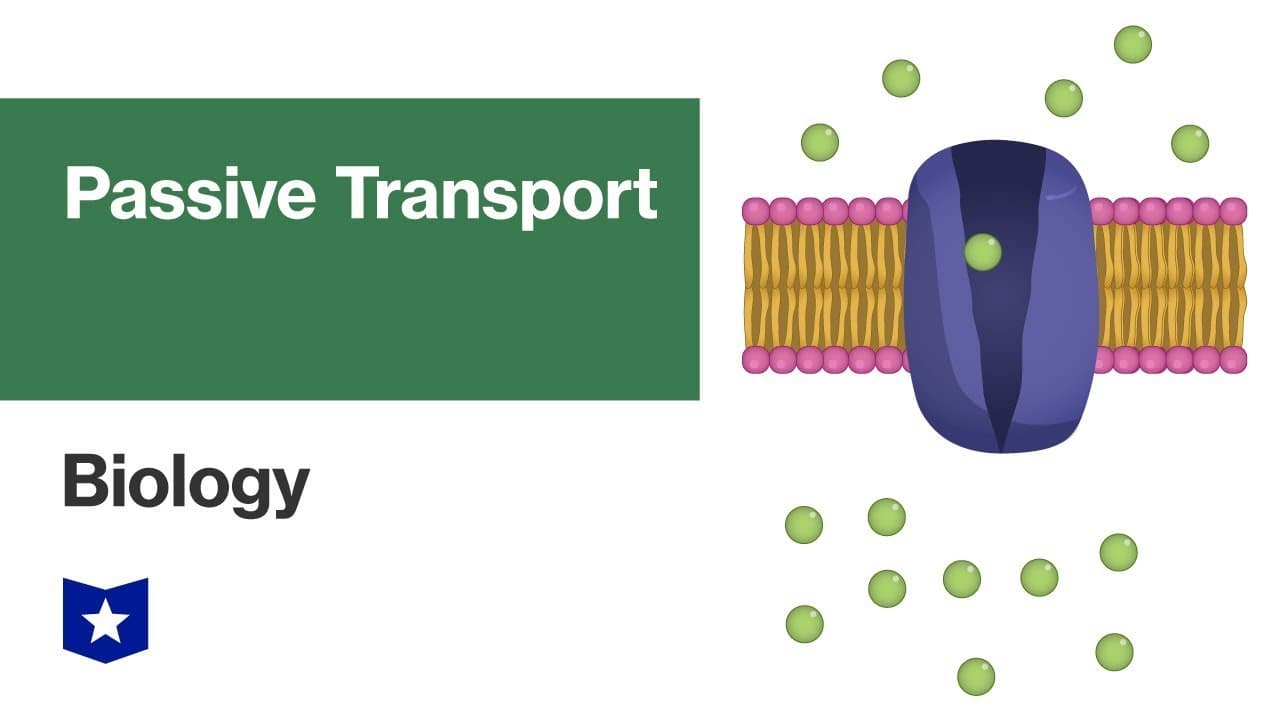
TL;DR
Cells use passive transport, like diffusion and facilitated diffusion, and active transport, like osmosis, to transport materials across membranes, maintaining homeostasis.
Transcript
the cell uses a number of mechanisms to transport material across the membrane some types of transport require the cell to expand energy and a cold active transport where other types of transport do not require the use of energy and a cold passive transport passive transfer is the most common way to transport material in and out of a cell and it oc... Read More
Key Insights
- 👻 Passive transport mechanisms like diffusion and facilitated diffusion allow cells to move molecules across membranes without expending energy.
- 💦 Osmosis, a type of passive transport, involves the movement of water molecules across semipermeable membranes based on solute concentration.
- 🤽 Tonicity plays a crucial role in regulating water movement in and out of cells, impacting cell size and function.
- ❓ Transport proteins, like channel and carrier proteins, facilitate the movement of specific molecules across cell membranes.
- ☠️ Factors like the nature of the diffusing substance, physical environment, and available transport proteins affect the rate of diffusion.
- 💦 In isotonic conditions, water movement in and out of cells is balanced, ideal for most animal cells.
- 💦 Hypertonic solutions cause water influx into cells, leading to cell swelling, while hypotonic solutions result in water efflux and cell shrinkage.
Install to Summarize YouTube Videos and Get Transcripts
Explore YouTube Video Summarizer or Get YouTube Transcript Extractor
Questions & Answers
Q: What are the main types of transport mechanisms used by cells?
Cells use passive transport mechanisms such as diffusion and facilitated diffusion, as well as active transport mechanisms like osmosis to transport materials across membranes.
Q: How does facilitated diffusion differ from simple diffusion?
Facilitated diffusion involves the aid of membrane proteins to assist the diffusion of specific molecules, overcoming the barrier posed by the cell membrane's hydrophobic region.
Q: What factors influence the rate of diffusion across cell membranes?
Factors like the specific transport proteins available, the nature of the diffusing substance, and the physical environment in which diffusion occurs, such as temperature and pressure, determine the rate of diffusion.
Q: How does tonicity impact cellular function?
Tonicity, determined by osmolarity and membrane permeability, influences the movement of water into or out of cells, affecting cell size, shape, and functionality.
Summary & Key Takeaways
-
Cells utilize passive transport mechanisms like diffusion and facilitated diffusion to move molecules across the cell membrane.
-
Osmosis, a type of diffusion, involves the movement of water molecules across semipermeable membranes.
-
Tonicity plays a vital role in determining the movement of water in and out of cells, impacting cell function and survival.
Read in Other Languages (beta)
Share This Summary 📚
Summarize YouTube Videos and Get Video Transcripts with 1-Click
Try YouTube Summary with ChatGPT & Claude or YouTube Transcript Generator
Explore More Summaries from Course Hero 📚




Summarize YouTube Videos and Get Video Transcripts with 1-Click
Try YouTube Summary with ChatGPT & Claude or YouTube Transcript Generator