Basic System Properties | Continuous and Discrete Time Systems | Signals and Systems
TL;DR
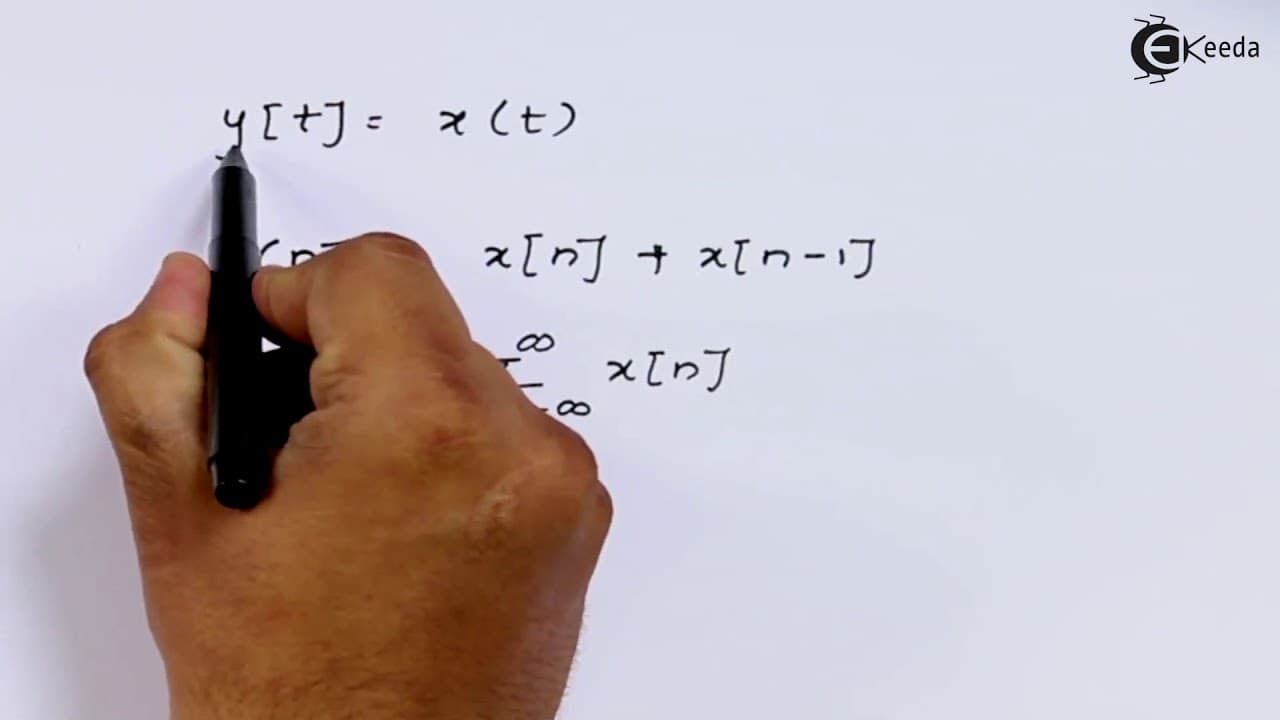
This video provides an analysis of the basic properties of systems, including static and dynamic, time invariant and variant, linearity and non-linearity, causality and non-causality, and stability and instability.
Transcript
click the bell icon to get latest videos from ekeeda hello friend and today is a new topic called basic system properties or you can say that the classification of system ah basically a classy system is classified into several types the most important types are like static and dynamic which is also known as memory or memberless second one is linear... Read More
Key Insights
- 🚱 System properties can be classified into static and dynamic, time invariant and variant, linearity and non-linearity, causality and non-causality, and stability and instability.
- 🔠 Static systems have output that depends only on the present input, while dynamic systems have output that depends on past and future inputs.
- ⌛ Time invariant systems produce the same output even with a delay, while time variant systems produce different outputs with a delay.
- 🚱 Linear systems follow the superposition principle, while non-linear systems do not.
- 🔠 Causal systems have output that depends only on present and past inputs, while non-causal systems also depend on future inputs.
Install to Summarize YouTube Videos and Get Transcripts
Explore YouTube Video Summarizer or Get YouTube Transcript Extractor
Questions & Answers
Q: What are the main types of system properties discussed in the video?
The main types of system properties discussed in the video are static and dynamic, time invariant and variant, linearity and non-linearity, causality and non-causality, and stability and instability.
Q: How can you determine if a system is static or dynamic?
A system is static if its output depends only on the present input, while a system is dynamic if its output depends on past and future inputs.
Q: What is the superposition principle?
The superposition principle states that in a linear system, the output is a combination of separate inputs. This principle is used to determine if a system is linear or non-linear.
Q: How can you identify if a system is causal or non-causal?
A system is causal if its output depends only on present and past inputs. If the system also depends on future inputs, it is non-causal.
Q: What does it mean for a system to be stable?
A stable system produces a finite output with a finite input. If the system produces an infinite output with an infinite input, it is unstable.
Summary & Key Takeaways
-
The video discusses the classification of system properties, including static and dynamic, time invariant and variant, linearity and non-linearity, causality and non-causality, and stability and instability.
-
Static systems have output that depends only on the present input, while dynamic systems have output that depends on past and future inputs.
-
Time invariant systems produce the same output even when the input is delayed, while time variant systems produce different outputs with a delay.
-
Linear systems follow the superposition principle, where the output is a combination of separate inputs, while non-linear systems do not.
-
Causal systems have output that depends only on present and past inputs, while non-causal systems also depend on future inputs.
-
Stable systems produce finite output with finite input, while unstable systems produce infinite output with infinite input.
Read in Other Languages (beta)
Share This Summary 📚
Summarize YouTube Videos and Get Video Transcripts with 1-Click
Try YouTube Summary with ChatGPT & Claude or YouTube Transcript Generator
Explore More Summaries from Ekeeda 📚


Summarize YouTube Videos and Get Video Transcripts with 1-Click
Try YouTube Summary with ChatGPT & Claude or YouTube Transcript Generator