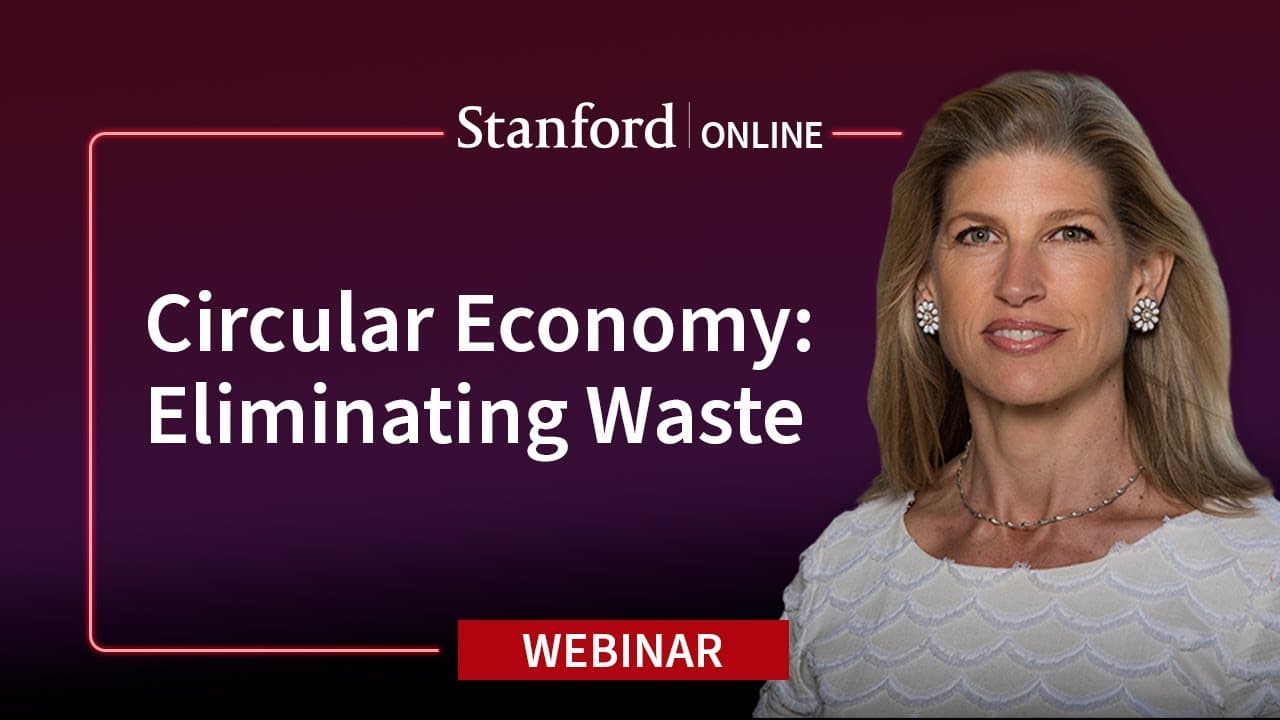
Stanford Webinar - Closing the Loop: The Circular Economy, Business & Sustainability
TL;DR
This webinar explores the concept of the circular economy and how businesses can integrate circularity into their strategies to achieve sustainability and economic growth.
Transcript
hello and welcome to today's webinar closing the loop the circular economy business and sustainability we appreciate you joining us today i'm anita wood and i manage the stanford energy innovation and emerging technologies program also known as the eiet program here at the stanford center for professional development it is my pleasure to introduce ... Read More
Key Insights
- 🪡 Sustainability is about securing the well-being of all people across generations by finding economic and social pathways that meet present needs without compromising the ability of future generations to meet their own needs.
- 😒 Circular economy principles align with the interdependence and complexity of the world, offering a more sustainable and efficient approach to resource use.
- 👨💼 Business models such as circular supply chain, recovery and recycling, product life extension, sharing platform, and product-as-service have shown significant impact in advancing circularity.
- 🥺 Circular economy practices can lead to increased competitiveness, profitability, and supply chain security, while also promoting environmental sustainability and social well-being.
Install to Summarize YouTube Videos and Get Transcripts
Explore YouTube Video Summarizer or Get YouTube Transcript Extractor
Questions & Answers
Q: How can businesses integrate circular economy principles into their core strategies?
Businesses can start by evaluating their supply chains, looking for opportunities to use renewable and recyclable materials. They can also explore product life extension through remanufacturing and establish sharing platforms for better resource utilization.
Q: What are some advantages of pursuing a circular economy approach?
Pursuing circular economy principles can lead to greater resource efficiency, reduced waste, and increased profitability. It also provides a competitive advantage by meeting customer demands for sustainable products and services.
Q: How can governments support the implementation of circular economy practices?
Governments can incentivize circularity through policies such as taxing resource use instead of labor, promoting recycling and remanufacturing, and encouraging collaboration between businesses and stakeholders.
Q: How can circular economy principles be applied in developing countries with limited resources?
Developing countries can benefit from circular economy practices by focusing on resource efficiency, waste reduction, and creating local job opportunities. They can explore partnerships with businesses and leverage innovative technologies to implement circularity.
Summary & Key Takeaways
-
The webinar discusses the interdependence and complexity of the world, emphasizing the need for a systems approach in business strategies.
-
Circular economy principles are presented as a way to decouple economic development from the use of scarce resources and reduce waste.
-
Five key business models of the circular economy, including circular supply chain, recovery and recycling, product life extension, sharing platform, and product-as-service, are outlined.
Read in Other Languages (beta)
Share This Summary 📚
Summarize YouTube Videos and Get Video Transcripts with 1-Click
Try YouTube Summary with ChatGPT & Claude or YouTube Transcript Generator
Explore More Summaries from Stanford Online 📚


Summarize YouTube Videos and Get Video Transcripts with 1-Click
Try YouTube Summary with ChatGPT & Claude or YouTube Transcript Generator