GMAT: Math 29 | Problem solving | GMAT | Khan Academy
TL;DR
The video consists of a math teacher solving a series of math problems involving primes, averages, expressions, discounts, and flowerbeds.
Transcript
We're on problem 148. What is the lowest integer that is the sum of three different primes, each greater than 20? So it's the lowest integer, so we essentially just have to find the three primes above 20. So let's see, 21 isn't a prime, 22 isn't a prime, 23 is a prime. 24, no, 25, no, 26, no, 27, 28, nope. 29, that's prime. 30 isn't, 31 is. 31 plus... Read More
Key Insights
- #️⃣ Primes are numbers greater than 1 with no positive divisors other than 1 and itself.
- #️⃣ The average of a set of numbers can be found by summing them and dividing by the count of numbers.
- 😑 Expressions can be simplified by combining like terms and evaluating any given variables or constants.
- 🈹 Discounts can be calculated by multiplying the original price by the discount percentage.
- ✖️ The area of a rectangle can be calculated by multiplying the length by the width.
Install to Summarize YouTube Videos and Get Transcripts
Explore YouTube Video Summarizer or Get YouTube Transcript Extractor
Questions & Answers
Q: How does the teacher find the lowest integer that is the sum of three different primes, each greater than 20 in problem 148?
The teacher searches for prime numbers greater than 20 and adds them until finding the lowest integer sum, which turns out to be 83.
Q: Can you explain the steps to find the value of x in problem 149?
By calculating the average of the numbers 6, 8, and 10, the teacher finds that it is equal to 8. By setting up an equation equating the average to 7 plus 9 plus x divided by 3, they solve for x and obtain the value 8.
Q: How is the expression in problem 150 simplified?
Using fractions, the teacher multiplies the original price by 3/5 (representing a 40% discount) and then by 3/4 (representing a 25% discount), resulting in a simplified expression of $7.20.
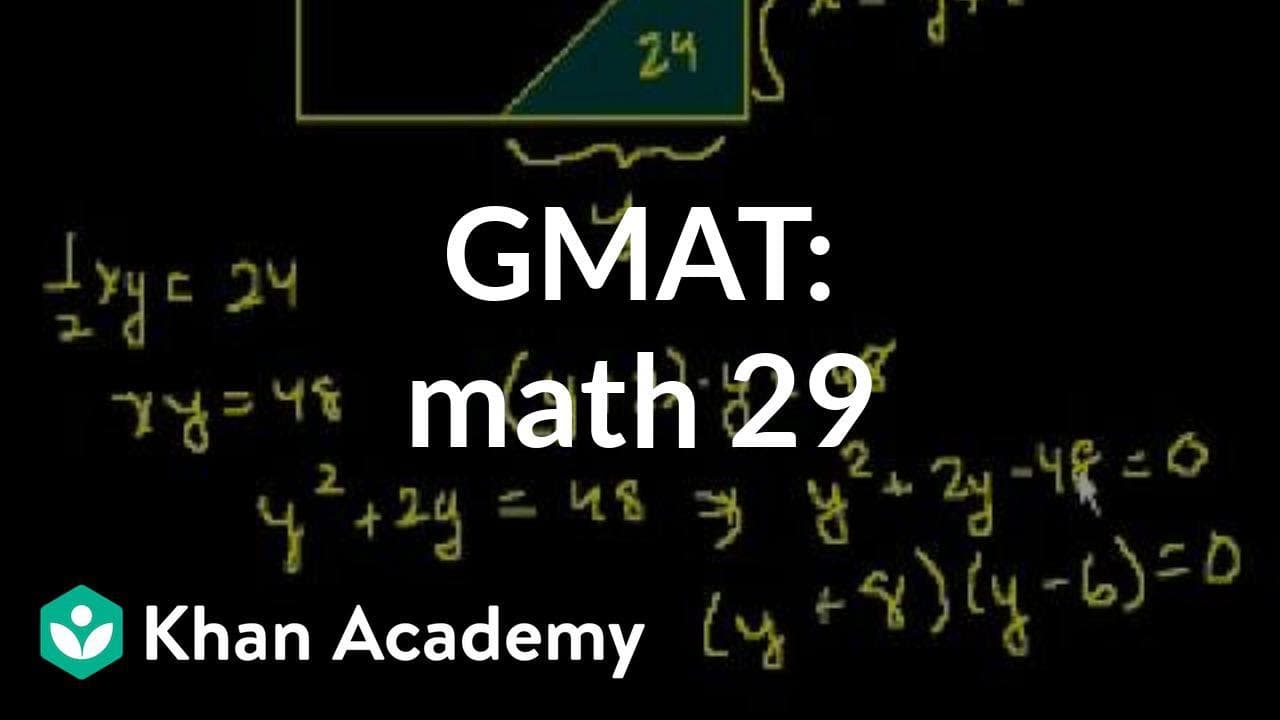
Q: What is the approach used to determine the length of side Z in problem 152?
By knowing the area of the flowerbed is 24 square yards and the relationship between the sides X, Y, and Z, the teacher sets up an equation using the area formula and solves for Z, finding the answer to be 10.
Q: How does the teacher solve problem 153 to find the age of Jack?
The teacher sets up an equation using the given relationship between Jack's and Bill's ages and solves for Jack's current age. The solution is 18, and adding 5 years to it gives Jack's age in 5 years, which is 23.
Summary & Key Takeaways
-
In problem 148, the lowest integer that is the sum of three different primes, each greater than 20, is found to be 83.
-
Problem 149 involves finding the value of a variable in an average equation, resulting in the answer being 8.
-
Problem 150 requires calculating an expression with a specific variable value, resulting in the answer being -3/2.
-
Problem 151 involves determining the lowest possible price of a discounted toy, which is found to be $7.20.
-
Problem 152 focuses on finding the length of the side of a shaded flowerbed, resulting in the answer being 10.
-
Lastly, in problem 153, the age of a person is determined based on given conditions, and the answer is found to be 23.
Read in Other Languages (beta)
Share This Summary 📚
Summarize YouTube Videos and Get Video Transcripts with 1-Click
Try YouTube Summary with ChatGPT & Claude or YouTube Transcript Generator
Explore More Summaries from Khan Academy 📚



Summarize YouTube Videos and Get Video Transcripts with 1-Click
Try YouTube Summary with ChatGPT & Claude or YouTube Transcript Generator