Washer method rotating around vertical line (not y-axis), part 1 | AP Calculus AB | Khan Academy
TL;DR
This video explains how to calculate the volume of a rotated shape using the disk method.
Transcript
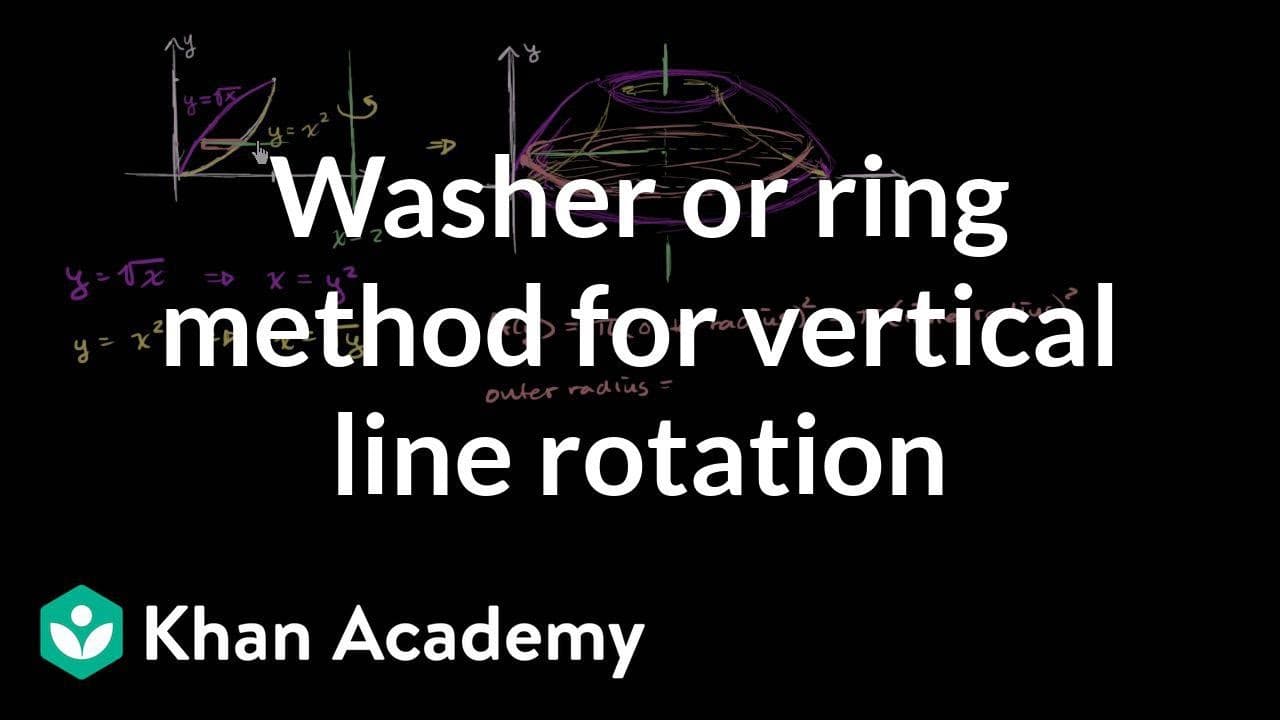
What we're going to do in this video is take the region between the two curves, y is equal to square root of x on top and y is equal to x squared on the bottom and rotate it around a vertical line that is not the y-axis. So we're going to rotate it around the vertical line x is equal to 2. We're going to rotate it right around like that. And if we ... Read More
Key Insights
- 🖕 Rotating a region between two curves can create a unique shape with a hollowed-out middle.
- 🔇 Calculating the volume of this shape can be done using the disk method or washer method.
- 😋 Each ring in the shape corresponds to a specific value of y and can be defined by its inner and outer radii.
- 😋 Integrating with respect to y allows us to calculate the volume by summing up the volumes of all the rings.
- 🔇 The choice of rotation axis greatly influences the shape and volume of the rotated figure.
- 😥 The intersection points of the two curves determine the limits of the integral for volume calculation.
- 😋 Expressing the functions in terms of y helps simplify the calculations for the area and volume of the rings.
Install to Summarize YouTube Videos and Get Transcripts
Explore YouTube Video Summarizer or Get YouTube Transcript Extractor
Questions & Answers
Q: What method is used to calculate the volume of the rotated shape?
The disk method, also known as the washer method, is used to calculate the volume of the rotated shape.
Q: What is the significance of the vertical line x = 2 in the rotation?
The shape is rotated around the vertical line x = 2, which creates the hollowed-out middle of the shape.
Q: How are the rings in the shape defined?
Each ring is defined by an inner radius (y = x^2) and an outer radius (y = sqrt(x)). The depth of the ring is represented by dy.
Q: What is the purpose of integrating in the y direction?
Integrating with respect to y allows us to stack up multiple rings and calculate the volume by summing up the volumes of all the rings.
Summary & Key Takeaways
-
The video discusses rotating a region between two curves, y = sqrt(x) and y = x^2, around a vertical line x = 2.
-
The shape formed is hollowed out in the middle, and the walls are created by the region in between the two curves.
-
To calculate the volume, the disk method (also known as the washer method) is used, where rings are stacked in the y direction and integrated.
Read in Other Languages (beta)
Share This Summary 📚
Summarize YouTube Videos and Get Video Transcripts with 1-Click
Try YouTube Summary with ChatGPT & Claude or YouTube Transcript Generator
Explore More Summaries from Khan Academy 📚



Summarize YouTube Videos and Get Video Transcripts with 1-Click
Try YouTube Summary with ChatGPT & Claude or YouTube Transcript Generator