Problem 2 Adaptive Filters - Adaptive Filters - Advanced Digital Signal Processing
TL;DR
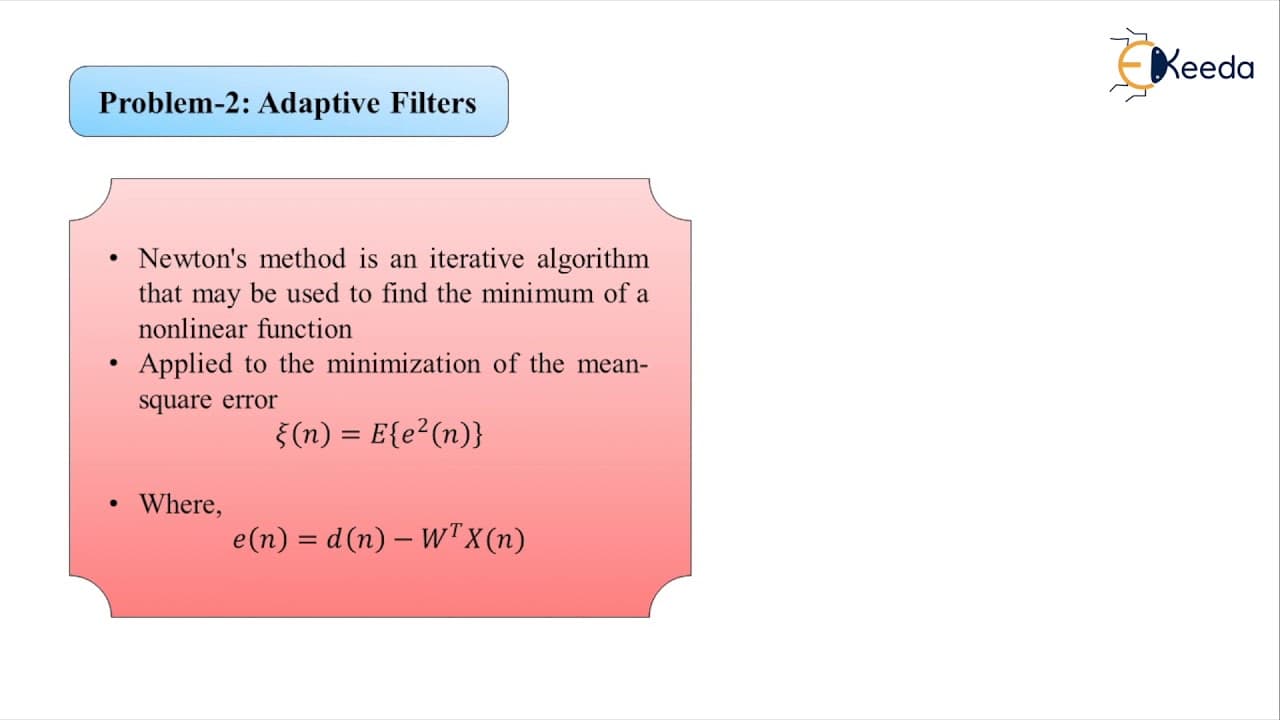
This video explains Newton's method, an iterative algorithm used for finding the minimum of a non-linear function, and its application in adaptive filters for minimizing mean square error.
Transcript
hello friends and welcome to this video we are with the adaptive filters to be the sixth chapter of the subject advanced digital signal processing the various concepts we have covered in this particular chapter for the design of adaptive filters to be either a fire type finite impulse response and ir type infinite impulse response the categorizatio... Read More
Key Insights
- ❎ Adaptive filters utilize different algorithms, such as Newton's method, for minimizing mean square error.
- 🚱 Newton's method is an iterative algorithm used for finding the minimum of a non-linear function.
- ❓ The stability of Newton's method in adaptive filters is dependent on the step size.
- 💨 The optimum step size value for the fastest convergence in Newton's method is 1.
- 💱 The LMS version of Newton's method replaces the gradient with a gradient estimate and changes the step direction.
Install to Summarize YouTube Videos and Get Transcripts
Explore YouTube Video Summarizer or Get YouTube Transcript Extractor
Questions & Answers
Q: What is Newton's method and how is it used in adaptive filters?
Newton's method is an iterative algorithm used to find the minimum of a non-linear function. In adaptive filters, it is used for minimizing mean square error by updating the weight vector based on the autocorrelation matrix and the gradient of the error.
Q: What is the stability condition for Newton's method in adaptive filters?
Newton's method is stable for step size values greater than 0 but less than 2. This range ensures convergence of the weight vector.
Q: What is the optimum value of the step size in Newton's method for the fastest convergence?
The optimum value of the step size in Newton's method for the fastest convergence is 1. This means that the algorithm converges to the desired minimum in a single step.
Q: How does the LMS version of Newton's method differ from the LMS algorithm?
In the LMS version of Newton's method, the gradient is replaced with a gradient estimate. The step direction is changed from the input signal to the inverse of the autocorrelation matrix multiplied by the input signal. This differs from the LMS algorithm, where the step direction is the input signal itself.
Summary & Key Takeaways
-
The video discusses the concepts of adaptive filters, including finite impulse response (FIR) and infinite impulse response (IIR) filters.
-
The problem statement focuses on applying Newton's method, a minimization algorithm, for finding the minimum of a non-linear function.
-
It explores the update equation and step size parameter in Newton's method, compares it to the steepest descent algorithm, and addresses different aspects of the problem statement.
Read in Other Languages (beta)
Share This Summary 📚
Summarize YouTube Videos and Get Video Transcripts with 1-Click
Try YouTube Summary with ChatGPT & Claude or YouTube Transcript Generator
Explore More Summaries from Ekeeda 📚





Summarize YouTube Videos and Get Video Transcripts with 1-Click
Try YouTube Summary with ChatGPT & Claude or YouTube Transcript Generator