Geometric sequence or progression
TL;DR
Geometric sequences are formed by repeatedly multiplying each term by a fixed non-zero number, called the common ratio.
Transcript
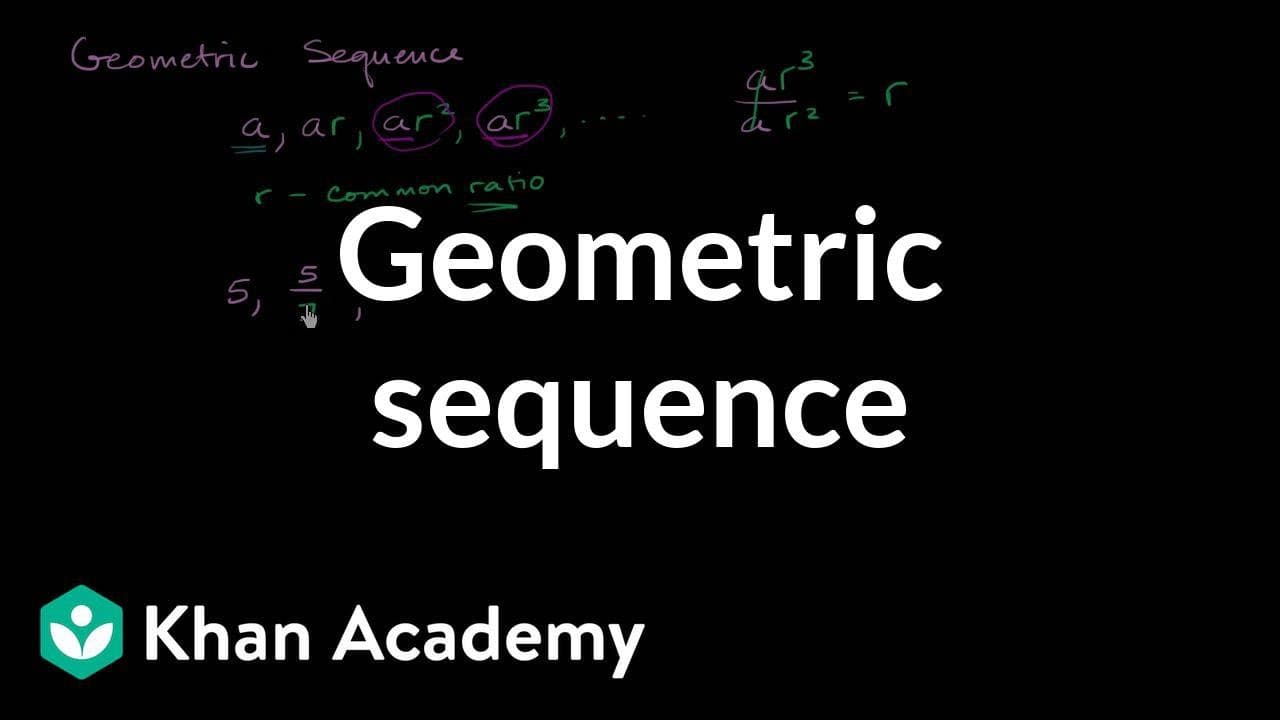
- [Instructor] I'm going to construct a sequence. We're going to start with some number. Let's say I start with the number, a. And then each successive term of the sequence, I'm going to multiply the, to get each successive term of the sequence, I'm going to muliply the previous term by some fixed non-zero number, and I'm going to call that r. So t... Read More
Key Insights
- 🥳 Geometric sequences are formed by multiplying each term by a fixed non-zero number, known as the common ratio.
- 🍉 The common ratio is consistent throughout the sequence and can be identified by dividing any term by the term before it.
- 🥳 Geometric sequences can have positive or negative common ratios.
- 🍉 If different numbers are multiplied to obtain each successive term, it is not a geometric sequence.
- 🥳 The common ratio is responsible for the growth or decay of the sequence.
- 🌍 Geometric sequences can be applied in various mathematical and real-world contexts.
- 👻 The structure of geometric sequences allows for the prediction of future terms.
Install to Summarize YouTube Videos and Get Transcripts
Explore YouTube Video Summarizer or Get YouTube Transcript Extractor
Questions & Answers
Q: What is a geometric sequence?
A geometric sequence is a type of progression where each term is obtained by multiplying the previous term by a fixed non-zero number, known as the common ratio.
Q: How can the common ratio be identified in a geometric sequence?
The common ratio can be found by dividing any term by the term before it. The result will always be the same value, regardless of which two terms are chosen.
Q: What happens if different numbers are multiplied to obtain each successive term?
If different numbers are multiplied to obtain each successive term, then it is not a geometric sequence. Geometric sequences require a constant common ratio.
Q: Can geometric sequences have negative common ratios?
Yes, geometric sequences can have negative common ratios. The sign of the common ratio does not affect the nature of the sequence.
Summary & Key Takeaways
-
A geometric sequence starts with a first value, and each successive term is obtained by multiplying the previous term by the common ratio.
-
The common ratio is found by dividing any term by the term before it, resulting in a consistent ratio.
-
Examples of geometric sequences are demonstrated, showing how the common ratio affects the progression of the sequence.
Read in Other Languages (beta)
Share This Summary 📚
Summarize YouTube Videos and Get Video Transcripts with 1-Click
Try YouTube Summary with ChatGPT & Claude or YouTube Transcript Generator
Explore More Summaries from Khan Academy 📚



Summarize YouTube Videos and Get Video Transcripts with 1-Click
Try YouTube Summary with ChatGPT & Claude or YouTube Transcript Generator