When an integral defined function is 0
TL;DR
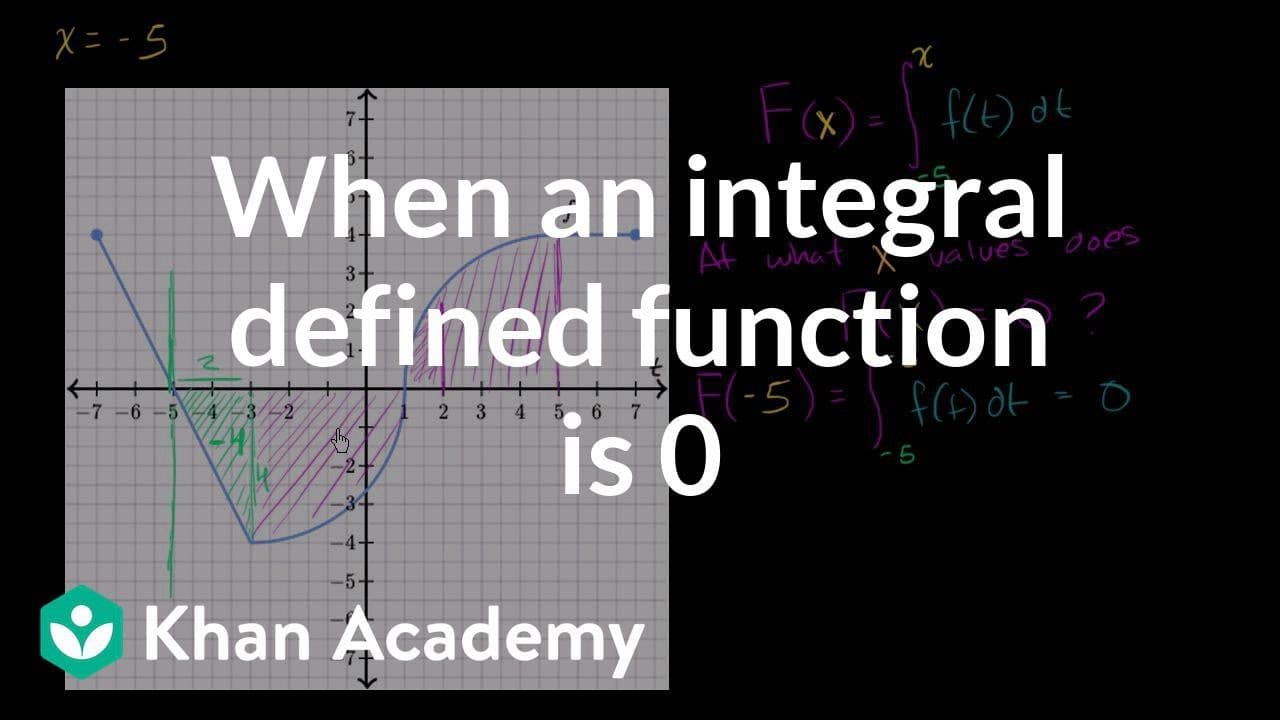
The video discusses the concept of the definite integral function and how to determine the x values in which the function is equal to 0.
Transcript
So right over here we have the graph of the function f. And we're assuming that f is a function of t, our horizontal axis. Here's the t-axis. So that is f of t, lowercase f of t. And now let's just, let's define another function. Let's call it capital F of, and it's not going to be a function of t. It's going to be a function of x. So capital F of ... Read More
Key Insights
- 😃 The definite integral function is represented by F(x) and calculates the area between a given function and the t-axis.
- ❎ Areas below the function and above the t-axis are negative, while areas above the function and below the t-axis are positive.
- ☺️ F(x) equals 0 at x = -5 and x = 6, where the areas calculated for different x values balance each other out.
Install to Summarize YouTube Videos and Get Transcripts
Explore YouTube Video Summarizer or Get YouTube Transcript Extractor
Questions & Answers
Q: How is the function F(x) defined?
F(x) is defined as the definite integral of f(t) from t = -5 to t = x. It represents the area between f(t), the t-axis, and the interval from -5 to x.
Q: At what x values does F(x) equal 0?
F(x) equals 0 at x = -5 and x = 6. At x = -5, there is no width for the area calculation, and at x = 6, the positive area offsets the negative area, resulting in a net value of 0.
Q: How are the areas calculated for different x values?
The areas are calculated by evaluating the definite integral of f(t) within specific intervals. The areas below f(t) and above the t-axis are negative, while the areas above f(t) and below the t-axis are positive.
Q: How does the function transition from negative to positive areas?
As x increases, the negative areas grow larger until a point of transition is reached. After the transition, positive areas start to offset the negative areas, resulting in a gradual shift towards positive values.
Summary & Key Takeaways
-
The video introduces the function f(t) and defines a new function, F(x), as the definite integral of f(t) from t = -5 to t = x.
-
The goal is to find the values of x for which F(x) equals 0 by analyzing the areas between f(t), the t-axis, and different x values.
-
The areas below f(t) and above the t-axis result in negative values, while the areas above f(t) and below the t-axis result in positive values.
-
By calculating the areas for different x values, it is determined that F(x) equals 0 at x = -5 and x = 6.
Read in Other Languages (beta)
Share This Summary 📚
Summarize YouTube Videos and Get Video Transcripts with 1-Click
Try YouTube Summary with ChatGPT & Claude or YouTube Transcript Generator
Explore More Summaries from Khan Academy 📚



Summarize YouTube Videos and Get Video Transcripts with 1-Click
Try YouTube Summary with ChatGPT & Claude or YouTube Transcript Generator