Stanford ENGR108: Introduction to Applied Linear Algebra | 2020 | Lecture 52-VMLS nonlin mdl fitting
TL;DR
Non-linear model fitting involves finding parameters that allow a model to fit a given dataset, and it has various applications such as curve fitting and classification.
Transcript
our next application of nonlinear least squares is non-linear model fitting and so we'll just look at what happens when the parameters enter the model in a non-affine way when they enter in an affine way you have just linear least squares and we already know how to do that so non-linear model fitting looks like this we have our predictor that's our... Read More
Key Insights
- 👻 Non-linear model fitting allows for more flexibility in capturing complex relationships between variables.
- 🚱 Curve fitting is an application of non-linear model fitting that can capture intricate shapes and patterns in the data.
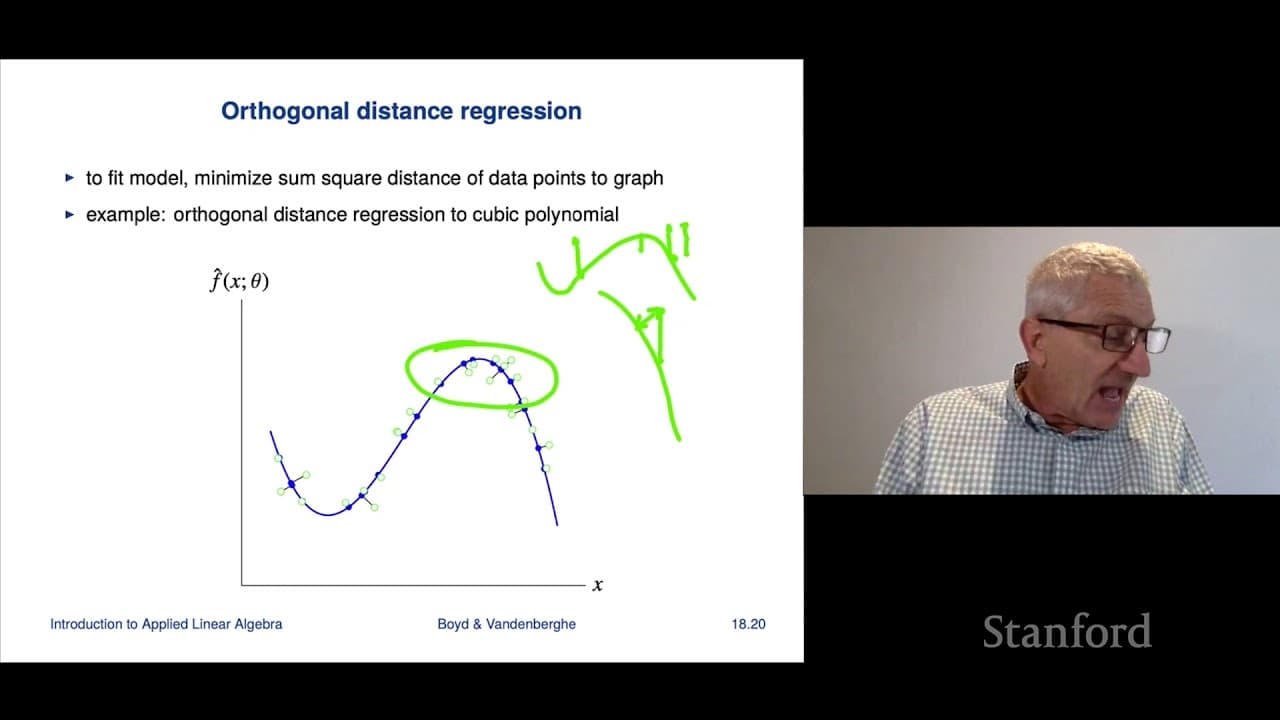
- 🚦 Orthogonal distance regression is a method that considers the distance to the curve instead of the vertical distance when fitting curves.
- ❎ Non-linear least squares classification replaces the sign function with a differentiable approximation and minimizes the squared differences between predicted and actual classes.
- 🚱 Non-linear model fitting can achieve performance comparable to human recognition in tasks such as digit classification.
- 🚱 Feature engineering, even with simple methods, can significantly improve the performance of non-linear model fitting.
- 🔨 Neural networks are another powerful tool for non-linear model fitting and can often achieve superhuman performance.
Install to Summarize YouTube Videos and Get Transcripts
Explore YouTube Video Summarizer or Get YouTube Transcript Extractor
Questions & Answers
Q: What is the main difference between linear and non-linear model fitting?
The main difference lies in the relationship between the predictor (model) and the parameters. In linear model fitting, the predictor is a linear function of the parameters, while in non-linear model fitting, the predictor can be a non-linear function of the parameters.
Q: How does non-linear model fitting improve interpretability?
Non-linear model fitting allows for more complex relationships between variables, which can lead to better interpretation of the underlying data patterns. For example, in curve fitting, a non-linear model can capture more intricate shapes and patterns compared to a linear model.
Q: What is orthogonal distance regression and how is it different from traditional model fitting?
Orthogonal distance regression is a method used for fitting curves when the distance to the curve (orthogonal distance) is considered instead of the vertical distance. This allows for fitting curves that are not necessarily functions and provides more flexibility in capturing the relationship between data points and the curve.
Q: How does non-linear least squares classification work?
In non-linear least squares classification, a non-linear model is used to classify data points by minimizing the sum of squared differences between the predicted and actual classes. A sigmoid function is typically used as a differentiable approximation of the sign function to enable optimization.
Summary & Key Takeaways
-
Non-linear model fitting involves finding parameters that make a model fit a dataset, allowing for non-linear relationships between the variables.
-
This method can be used for curve fitting, where a model is fitted to data points to find the best parameters that represent the underlying curve.
-
Non-linear least squares classification is another application, where a non-linear model is used to classify data points based on their features.
Read in Other Languages (beta)
Share This Summary 📚
Summarize YouTube Videos and Get Video Transcripts with 1-Click
Try YouTube Summary with ChatGPT & Claude or YouTube Transcript Generator
Explore More Summaries from Stanford Online 📚

Summarize YouTube Videos and Get Video Transcripts with 1-Click
Try YouTube Summary with ChatGPT & Claude or YouTube Transcript Generator