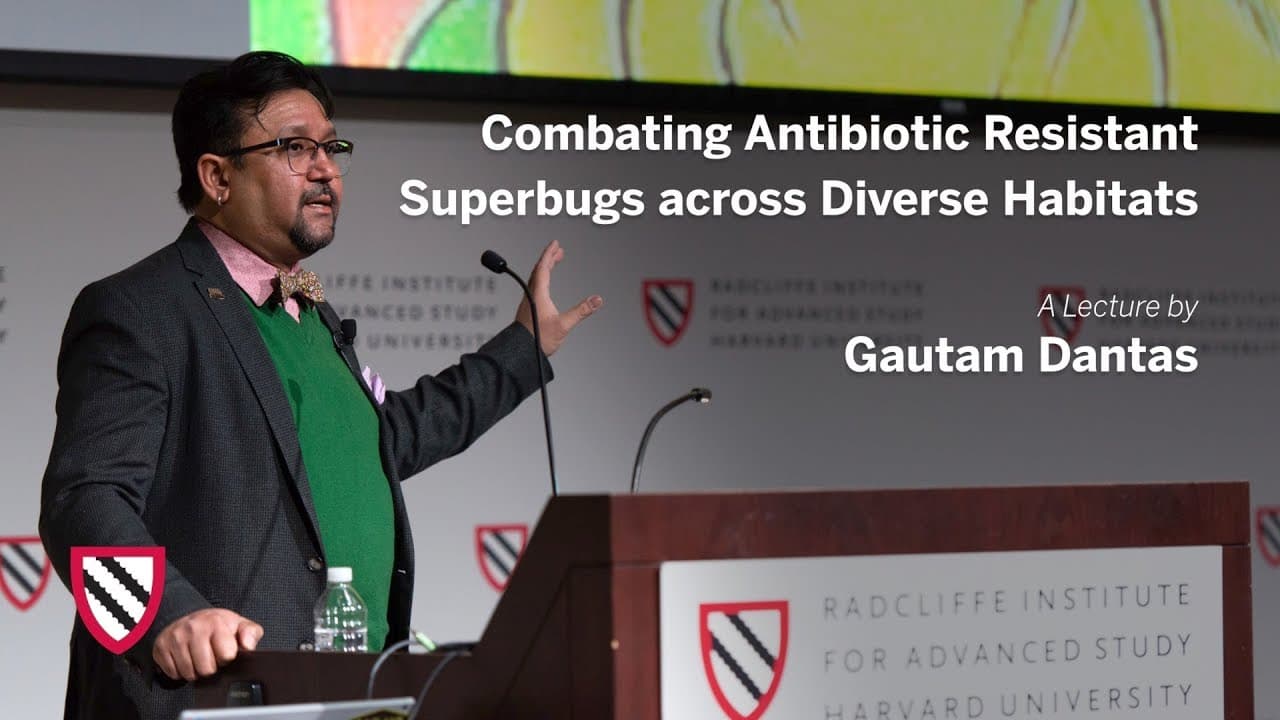
Combating Antibiotic Resistant Superbugs | Gautam Dantas || Radcliffe Institute
TL;DR
Antibiotic resistance is a growing concern and is a natural feature of microbes, with resistance genes existing before the discovery of antibiotics. The soil and human microbiome are hotspots for resistance genes, which can be transferred between bacteria. Researchers have identified antibiotic-eating bacteria in the soil and are exploring the use of selection inversion and synergy to combat resistance. A triple antibiotic combination has shown promise in animal models.
Transcript
[MUSIC PLAYING] - Hello, everyone, and welcome. I want to thank those intrepid souls who actually crossed over to Radcliffe today despite the weather. Winter is fully upon us. Thank you very much. I want to welcome you to our science lecture series. My name is Sean O'Donnell. I'm the associate director of academic ventures, and I help to oversee th... Read More
Key Insights
- 🦠 Antibiotic resistance is a natural feature of microbes and existed before the discovery of antibiotics.
- 🖐️ The soil and human microbiome are hotspots for resistance genes, and horizontal gene transfer plays a significant role in their spread.
- 😅 Antibiotic-eating bacteria have been found in the soil and can provide insights into resistance mechanisms.
- ❓ Researchers are exploring innovative strategies, such as selection inversion and synergy, to combat antibiotic resistance.
Install to Summarize YouTube Videos and Get Transcripts
Explore YouTube Video Summarizer or Get YouTube Transcript Extractor
Questions & Answers
Q: What are some potential risks associated with antibiotic use?
Overuse and misuse of antibiotics can lead to the development of antibiotic resistance. Antibiotics can also have side effects and disruptions to the microbiome.
Q: How are antibiotic resistance genes transferred between bacteria?
Antibiotic resistance genes can be transferred through horizontal gene transfer, where bacteria exchange genetic material, or through mutations that occur during replication.
Q: What strategies are researchers using to combat antibiotic resistance?
Researchers are exploring selection inversion, where susceptible bacteria are enabled to outcompete resistant bacteria, and synergy, where different antibiotics are used in combination to enhance effectiveness. Other approaches include repurposing existing drugs and developing new antibiotics.
Q: How are antibiotic-eating bacteria unique?
Antibiotic-eating bacteria have the ability to use antibiotics as their sole source of energy. They have naturally developed resistance mechanisms to protect themselves against antibiotics.
Summary & Key Takeaways
-
Antibiotic resistance is a natural feature of microbes, and resistance existed before the discovery of antibiotics.
-
Resistance genes are found in the soil and the human microbiome, with potential for transfer between bacteria.
-
Antibiotic-eating bacteria have been discovered in the soil, and researchers are exploring selection inversion and synergy as strategies to combat resistance.
-
A triple antibiotic combination has shown effectiveness in animal models, providing a potential solution to combat antibiotic resistance.
Read in Other Languages (beta)
Share This Summary 📚
Summarize YouTube Videos and Get Video Transcripts with 1-Click
Try YouTube Summary with ChatGPT & Claude or YouTube Transcript Generator
Explore More Summaries from Harvard University 📚





Summarize YouTube Videos and Get Video Transcripts with 1-Click
Try YouTube Summary with ChatGPT & Claude or YouTube Transcript Generator