Quadrilateral similarity by showing congruent angles | Similarity | Geometry | Khan Academy
TL;DR
Given the measures of angles in two quadrilaterals, we can determine their similarity through translations, rotations, reflections, and dilations.
Transcript
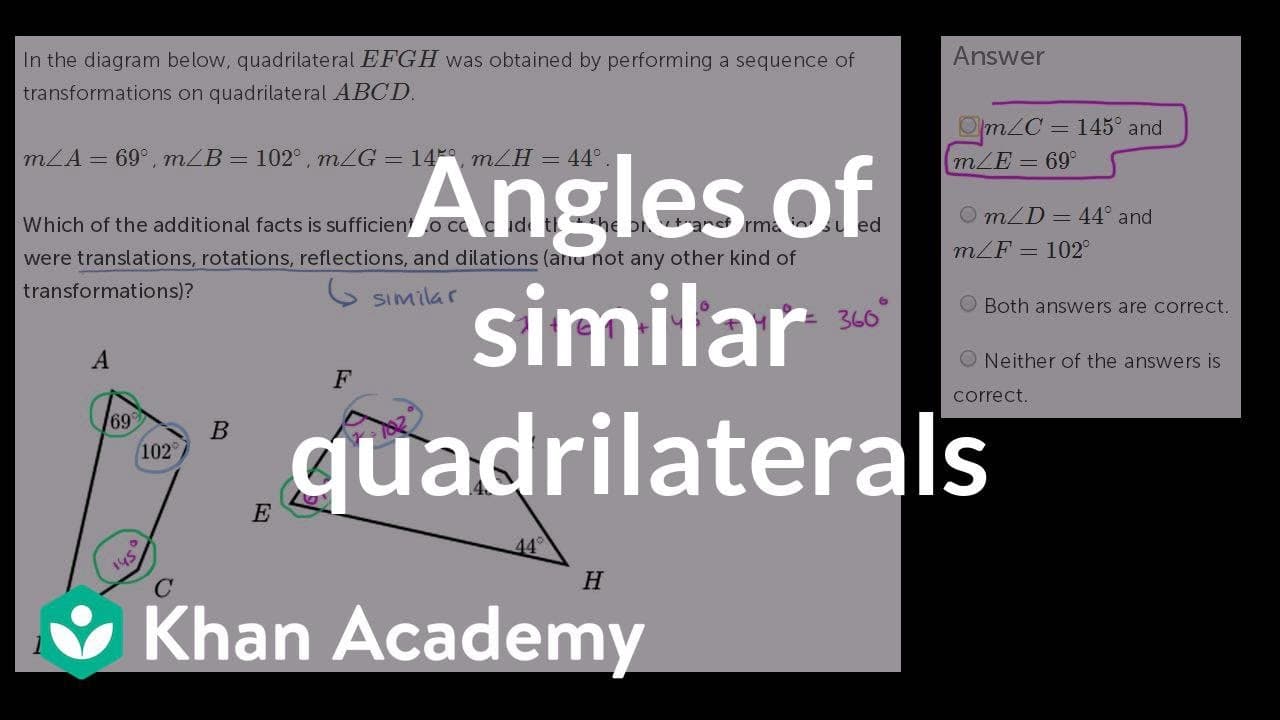
In the diagram below, quadrilateral EFGH-- so that's this one here-- was obtained by performing a sequence of transformations on quadrilateral ABCD. And then they tell us the information that's already written here. Measure of angle A is 69 degrees. Measure of angle B is 102 degrees. Measure of angle G is 145 degrees. And measure of angle H is 44 d... Read More
Key Insights
- ❓ The only transformations used in this context are translations, rotations, reflections, and dilations.
- 🔺 Similarity between quadrilaterals can be determined by comparing the measures of corresponding angles.
- 🔺 Calculating the sum of angles in a quadrilateral is essential for determining missing angle measures.
- 🔺 If all four corresponding angles between two quadrilaterals are congruent, they are similar.
- 🔺 Knowing the measures of three angles in a quadrilateral allows us to calculate the fourth angle using the angle sum property.
- ❓ Quadrilaterals can be transformed through a combination of translations, rotations, reflections, and dilations.
- 🔺 Having congruent corresponding angles in quadrilaterals means that all internal angles are congruent, indicating similarity.
Install to Summarize YouTube Videos and Get Transcripts
Explore YouTube Video Summarizer or Get YouTube Transcript Extractor
Questions & Answers
Q: How can we determine if two quadrilaterals are similar?
Two quadrilaterals are similar if their corresponding angles are congruent. This means that you can go from one quadrilateral to the other through translations, rotations, reflections, and dilations.
Q: What is the angle sum property in a quadrilateral?
In a quadrilateral, the sum of all four interior angles is always equal to 360 degrees. This property allows us to calculate missing angles based on the measures of the known angles.
Q: What is the significance of having congruent corresponding angles in two quadrilaterals?
When two quadrilaterals have corresponding angles that are congruent, it implies that all internal angles of the quadrilaterals are congruent. This indicates that the two quadrilaterals are similar.
Q: Are the measures of specific angles in the quadrilaterals sufficient to determine their similarity?
Yes, if we know the measures of three angles in each quadrilateral, we can calculate the missing angle using the angle sum property. If the four corresponding angles between the quadrilaterals are congruent, they are similar.
Summary & Key Takeaways
-
The task is to identify which facts are sufficient to conclude that two quadrilaterals can only be transformed through translations, rotations, reflections, and dilations.
-
The given facts are the measures of specific angles in the quadrilaterals.
-
By using the angle sum property and calculating the missing angle, we can determine that both sets of facts are sufficient to establish similarity.
Read in Other Languages (beta)
Share This Summary 📚
Summarize YouTube Videos and Get Video Transcripts with 1-Click
Try YouTube Summary with ChatGPT & Claude or YouTube Transcript Generator
Explore More Summaries from Khan Academy 📚



Summarize YouTube Videos and Get Video Transcripts with 1-Click
Try YouTube Summary with ChatGPT & Claude or YouTube Transcript Generator