Finding inverse functions: rational | Mathematics III | High School Math | Khan Academy
TL;DR
Learn how to find the inverse of a function by swapping the x and y variables and solving for the new y expression.
Transcript
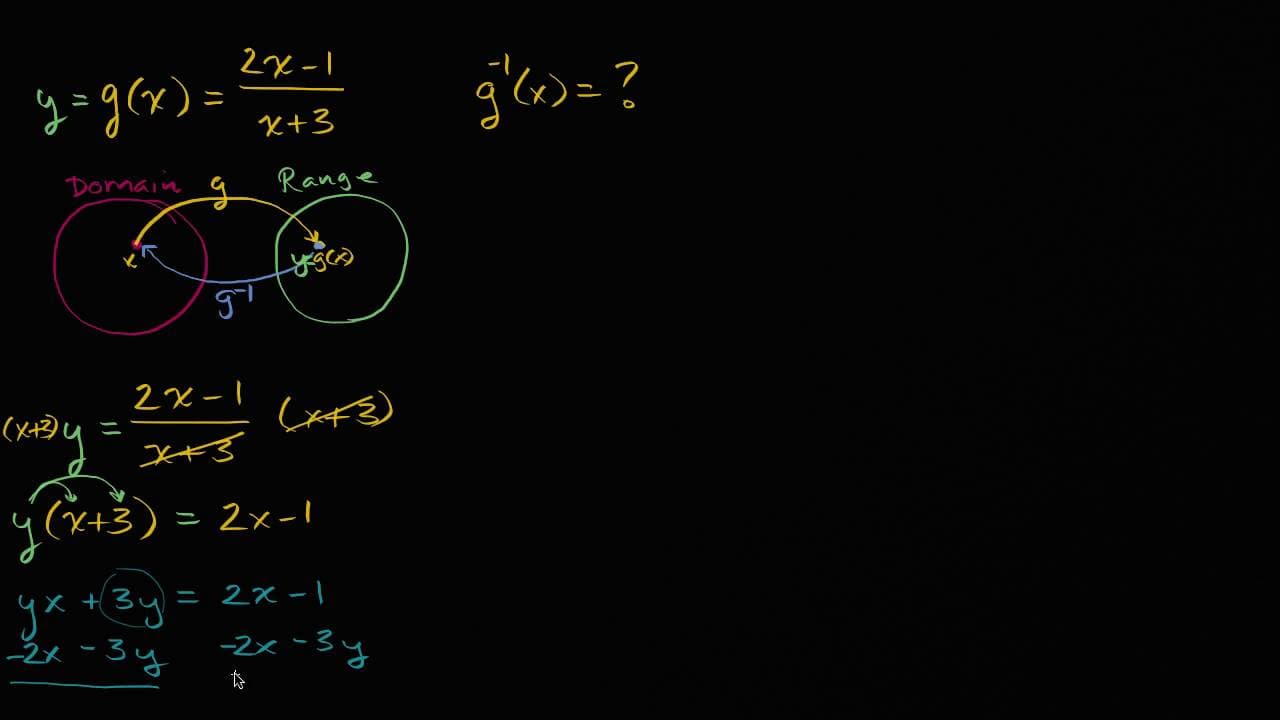
- [Voiceover] So we're told that g of x is equal to two x minus one over x plus three. Based on this, pause the video and see if you can figure out what the inverse of g is. g inverse of x. What is that going to be equal to? Alright, I'm assuming you've had a go at it, and just as a little bit of a reminder of what we're talking about when we're ta... Read More
Key Insights
- 🧡 The inverse of a function reverses the mapping of domain and range.
- ❣️ The process of finding the inverse involves setting y equal to the function and solving for x, then swapping the variables and rearranging the equation.
- 📤 The choice of variable names (x, y, a, b, etc.) in the inverse function is arbitrary and does not impact the functionality of the inverse.
- 🧡 Not all functions have inverses, as some may have repeated values in the domain or range that prevent a one-to-one correspondence.
- 👻 The inverse function allows us to work backwards from the range to determine the original domain values.
- ❣️ Swapping the x and y variables is equivalent to reflecting the function across the line y = x.
- 🆘 Finding the inverse of a function helps solve equations involving the original function.
Install to Summarize YouTube Videos and Get Transcripts
Explore YouTube Video Summarizer or Get YouTube Transcript Extractor
Questions & Answers
Q: How do you find the inverse of a function?
To find the inverse of a function, set y equal to the function and solve for x. Swap the x and y variables and rearrange the equation to express x in terms of y.
Q: What is the purpose of finding the inverse of a function?
Finding the inverse of a function allows us to work backwards from a range value to determine the corresponding domain value. It is useful in various mathematical applications, such as solving equations and analyzing relationships.
Q: Can the inverse of a function exist for any given function?
No, not all functions have an inverse. For an inverse to exist, each different input value (x) must correspond to a unique output value (y), and vice versa. If there are repeated values in the domain or range, the function will not have an inverse.
Q: Is it always necessary to swap the x and y variables when finding the inverse?
Yes, swapping the x and y variables is a crucial step in finding the inverse of a function. It allows us to switch the roles of the domain and range and find an expression that maps the range back to the domain.
Summary & Key Takeaways
-
The function g(x) is given as 2x - 1 / x + 3. The goal is to find the inverse of g, denoted as g inverse of x.
-
To find the inverse, first set y = g(x) and solve for x. This allows us to determine the corresponding x value for any given y value.
-
By manipulating the equation, collecting x terms on one side and non-x terms on the other, we arrive at an expression for x in terms of y.
-
The expression x = 1 - 3y / y - 2 represents the inverse function, where y can be any value in the range of g.
Read in Other Languages (beta)
Share This Summary 📚
Summarize YouTube Videos and Get Video Transcripts with 1-Click
Try YouTube Summary with ChatGPT & Claude or YouTube Transcript Generator
Explore More Summaries from Khan Academy 📚



Summarize YouTube Videos and Get Video Transcripts with 1-Click
Try YouTube Summary with ChatGPT & Claude or YouTube Transcript Generator