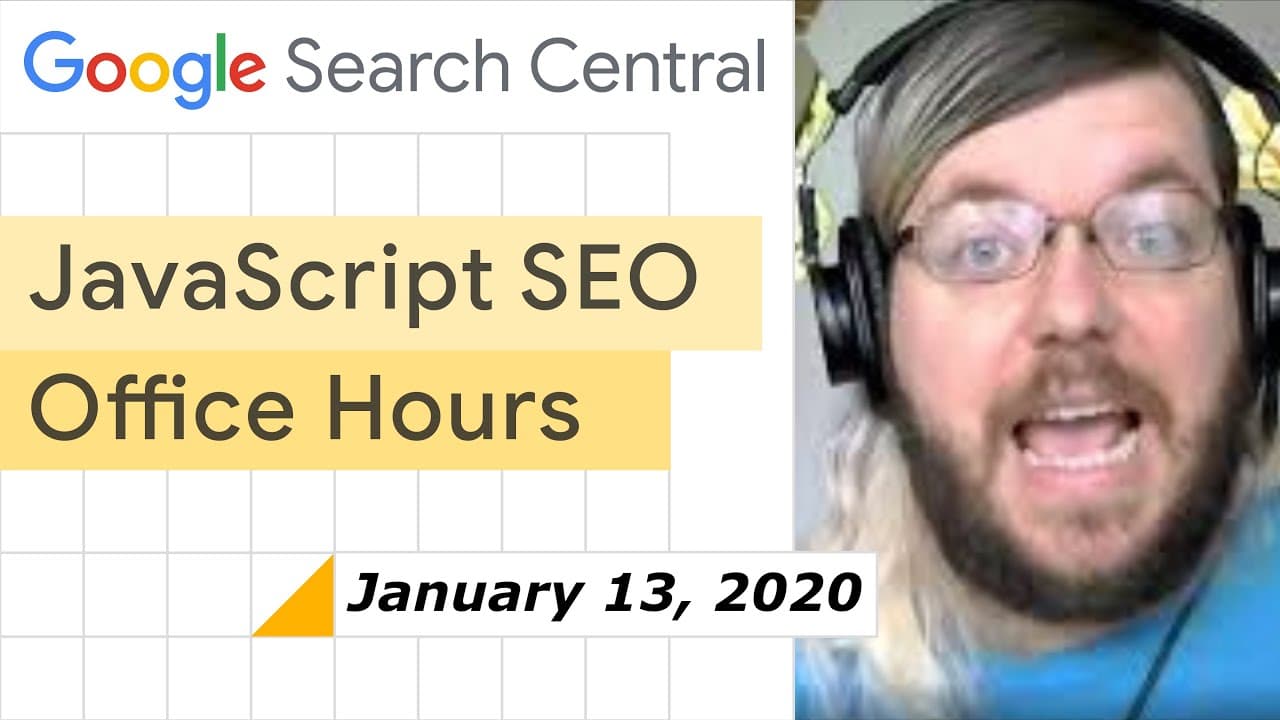
JavaScript SEO office hours January 13th, 2021
TL;DR
Martin Splitt answers various JavaScript SEO questions.
Transcript
MARTIN SPLITT: Hello. And welcome to the JavaScript SEO Office Hours in January 2021. Ooh. I hope that you all had a great turn of the years. I think that's what we say in German, but I'm not sure if that's an English thing that you can say as well. I hope you had a good start to the new year, that you're all safe and sound out there. I'm really ha... Read More
Key Insights
- Googlebot crawls and renders JavaScript similar to HTML, but rendering may occur more or less frequently depending on various factors such as infrastructure issues or changes in resources.
- Google My Business and Google Lens questions should be directed to their respective support forums as they are outside the expertise of Google Search.
- Google executes JavaScript similarly to a browser, rendering pages and indexing content injected into the DOM.
- Dynamic content that changes based on user actions or conditions like location is not interacted with by Googlebot, which does not click or scroll.
- Wix websites, which heavily use JavaScript, are rendered like any other site, and JavaScript's impact on crawl budget depends on the website's size and structure.
- Google does not partially index pages but evaluates content based on relevance, which might affect ranking for certain content sections.
- Ensuring Google accurately renders content can be verified through tools like the URL inspection tool and mobile-friendly test, focusing on rendered HTML.
- Changes in JavaScript links or navigation structure can affect the link graph and crawl budget, especially if links are removed or added via JavaScript.
Install to Summarize YouTube Videos and Get Transcripts
Explore YouTube Video Summarizer or Get YouTube Transcript Extractor
Questions & Answers
Q: How often does Googlebot crawl or render JavaScript for indexing?
Googlebot crawls and renders JavaScript as frequently as HTML, but the frequency can vary. Rendering might occur more often due to infrastructure issues or changes in resources. Generally, crawling and rendering happen in tandem, but there are exceptions where one might occur more frequently than the other.
Q: Does Google execute JavaScript, and how does it handle dynamic content?
Yes, Google executes JavaScript by rendering pages like a browser. It indexes content injected into the DOM by JavaScript. However, Googlebot does not interact with dynamic content that changes based on user actions, such as clicks or location-based content, as it doesn't perform user interactions.
Q: What should be done if Google is not indexing all pages of a large website?
If a large number of pages are not indexed, check the crawl statistics in Search Console for any server issues. Ensure important content is well linked and consider updating sitemaps. Use the URL inspection tool to verify if content is accessible and rendered correctly. Prioritize important pages for indexing requests.
Q: How does Google handle JavaScript-heavy websites like those on Wix?
Google renders JavaScript-heavy websites like any other site. The impact on crawl budget depends on the site's size and structure. JavaScript files and additional network requests count towards crawl budget, but unless the site is extremely large, it typically doesn't impact indexing significantly.
Q: How can I ensure Google accurately renders all content on my page?
Use tools like the URL inspection tool and mobile-friendly test to verify rendered HTML. If the content appears in the rendered HTML, it should be indexed. Screenshots are not used for indexing, so focus on rendered HTML for accuracy. Cached versions may not reflect JavaScript-rendered content.
Q: Is it beneficial to remove non-visible links from the DOM using JavaScript?
Removing non-visible links can be beneficial as Google may not value them highly if users can't access them. However, ensure that important pages remain linked to avoid orphaned pages. The decision should consider user experience and SEO strategy, as it can update the site's link graph.
Q: What is the impact of lazy loading on SEO for news articles?
Lazy loading does not impact SEO if articles are submitted via sitemaps or index API. Ensure important content is accessible for indexing. The Best Practices Guide for JavaScript provides more information on lazy loading. Lazy loading can affect a specific page's ranking but not the indexing of individual articles.
Q: How does Google handle links that load only after JavaScript actions?
Googlebot does not interact with pages, so links that load only after user actions like clicks are not seen. If links are hidden and then made visible, they are extracted before rendering. Google may choose not to follow them, but they will be visible in the HTML.
Summary & Key Takeaways
-
Martin Splitt answers questions on JavaScript SEO, covering topics such as Googlebot's crawling and rendering frequency, handling of dynamic content, and the impact of JavaScript on crawl budget. He emphasizes ensuring content is accessible and relevant for effective indexing.
-
Questions about Google My Business metadata and Google Lens are redirected to their respective support forums, highlighting the importance of addressing questions to the correct Google services for accurate assistance.
-
The session provides insights into handling JavaScript-heavy websites like those on Wix, explaining how Google processes JavaScript for indexing and the considerations for dynamic content and rendering consistency.
Read in Other Languages (beta)
Share This Summary 📚
Summarize YouTube Videos and Get Video Transcripts with 1-Click
Try YouTube Summary with ChatGPT & Claude or YouTube Transcript Generator
Explore More Summaries from Google Search Central 📚





Summarize YouTube Videos and Get Video Transcripts with 1-Click
Try YouTube Summary with ChatGPT & Claude or YouTube Transcript Generator