Isoperimetric Type 4 Problem 2 - Calculus of Variation - Engineering Mathematics - 4
TL;DR
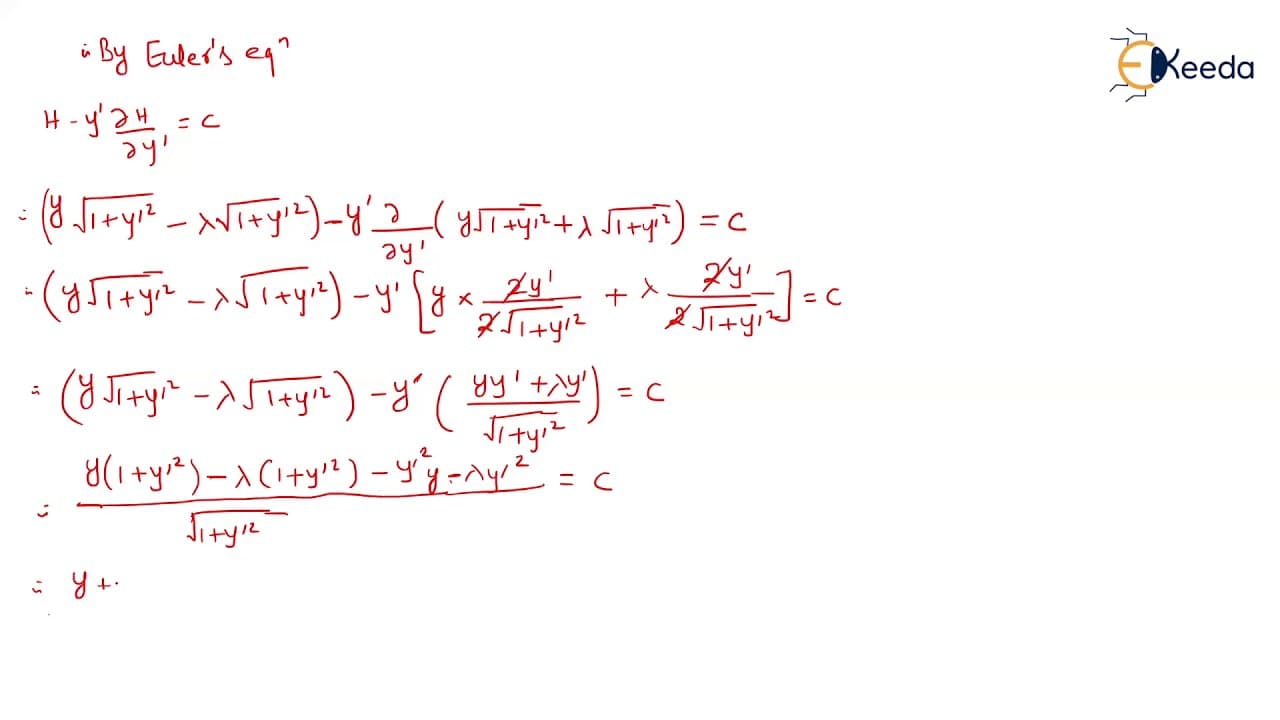
This video discusses how to solve problem 2 of iso-perimetric problems, which involves finding extremal values using Lagrange's function.
Transcript
hello friends in this video we'll be discussing type number four that is iso-perimetric problems problem number two welcome back friends let us start with the next problem problem number two here also a function is given that extremal values we need to find it out and here also a constraint is given so objective function with constraint that means ... Read More
Key Insights
- 💀 Problem 2 belongs to the iso-perimetric problem category, specifically utilizing Lagrange's function and Euler's equation.
- 💨 The objective function and constraint for problem 2 involve the root of 1 plus y dash square.
- 💨 The equation derived from Euler's equation is y plus y dash square minus lambda minus lambda y dash square.
Install to Summarize YouTube Videos and Get Transcripts
Explore YouTube Video Summarizer or Get YouTube Transcript Extractor
Questions & Answers
Q: What is the objective of problem 2 of iso-perimetric problems?
The objective is to find the shape of a flexible and inextensible homogeneous rod suspended at points A and B.
Q: What is Lagrange's function and how is it used in problem 2?
Lagrange's function, formed by combining the objective function and constraints, is used to find extremal values in problem 2.
Q: How is the special case of Euler's equation applied in problem 2?
In the special case where Lagrange's function is independent of x, Euler's equation is used to derive the equation for the problem.
Q: What is the importance of remembering the equation in this particular problem?
Remembering the equation is crucial for effectively solving problem 2, as it is commonly asked in exams and can be challenging without the equation.
Summary & Key Takeaways
-
Problem 2 involves finding the shape of a flexible and inextensible homogeneous rod suspended at points A and B.
-
Lagrange's function is used to form the objective function with constraints.
-
The special case of Euler's equation is applied to determine the equation for the problem.
Read in Other Languages (beta)
Share This Summary 📚
Summarize YouTube Videos and Get Video Transcripts with 1-Click
Try YouTube Summary with ChatGPT & Claude or YouTube Transcript Generator
Explore More Summaries from Ekeeda 📚

Summarize YouTube Videos and Get Video Transcripts with 1-Click
Try YouTube Summary with ChatGPT & Claude or YouTube Transcript Generator