Products
Features
YouTube Video Summarizer
Summarize YouTube videos
Web & PDF Highlighter
Highlight web pages & PDFs
Chat with PDF
Ask any PDF questions with AI
Ask AI Clone
Chat with your highlights & memories
Audio Transcriber
Transcribe audio files to text
Glasp Reader
Read and highlight articles
Kindle Highlight Export
Export your Kindle highlights
Idea Hatch
Hatch ideas from your highlights
Integrations
Obsidian Plugin
Notion Integration
Pocket Integration
Instapaper Integration
Medium Integration
Readwise Integration
Snipd Integration
Hypothesis Integration
Apps & Extensions
Chrome Extension
Safari Extension
Edge Add-ons
Firefox Add-ons
iOS App
Android App
Discover
Discover
Ideas
Discover new ideas and insights
Articles
Curated articles and insights
Books
Book recommendations by great minds
Posts
Essays and notes from readers
Quotes
Inspiring quotes collection
Videos
Curated videos and summaries
Explore Glasp
Glasp Newsletter
Weekly insights and updates
Glasp Talk
Interview series with great minds
Glasp Blog
Latest news and articles
Glasp Use Cases
Learn how others use Glasp
Build & Support
Glasp API
Access Glasp's API for developers
MCP Connector
Connect Glasp to Claude & ChatGPT
Community
Glasp Reddit Community
Students
Student discount and benefits
FAQs
Frequently Asked Questions
AboutPricing
DashboardLog inSign up

Numerical Type 3 Chapter 5 - Ground Water and Well Hydraulics - Water Resource Engineering 1
6.4K views
•
April 19, 2022
by
Ekeeda
YouTube video player
Numerical Type 3 Chapter 5 - Ground Water and Well Hydraulics - Water Resource Engineering 1

TL;DR

This video discusses numerical problems related to groundwater, specifically calculating specific yield, porosity, transmissibility, and drawdown in wells.

Transcript

hello everyone in this video we are going to discuss the third type of numerical based on the chapter of the groundwater so let's start now the first of the problem it says that in a certain alluvial basin of 100 square kilometer area 90 cubic millimeter of the ground water was pumped in a year and because of that the ground water table that has dr... Read More

Key Insights

  • 🔇 Specific yield is the volume of water pumped out divided by the total volume of the aquifer, while specific retention represents the volume of water retained.
  • 🔉 Porosity describes the total volume of voids in the medium and is calculated by summing specific yield and specific retention values.
  • ✖️ Transmissibility is determined by multiplying the coefficient of permeability by the width or depth of the aquifer.

Install to Summarize YouTube Videos and Get Transcripts

Explore YouTube Video Summarizer or Get YouTube Transcript Extractor

Questions & Answers

Q: How is the specific yield of the aquifer calculated?

The specific yield is calculated by dividing the volume of water pumped out by the total volume of the aquifer from which it was extracted.

Q: What is the formula for calculating porosity?

Porosity is calculated by summing the specific yield and specific retention values, which represent the volume of voids in the medium.

Q: How is the transmissibility of an aquifer determined?

The transmissibility is determined by multiplying the coefficient of permeability by the width or depth of the aquifer.

Q: How is the drawdown in the main well calculated?

The drawdown in the main well can be calculated using the same formula as for other observation wells, but with modified values for h1 and hw.

Summary & Key Takeaways

  • The first problem involves calculating the porosity of a soil based on specific yield and specific retention values.

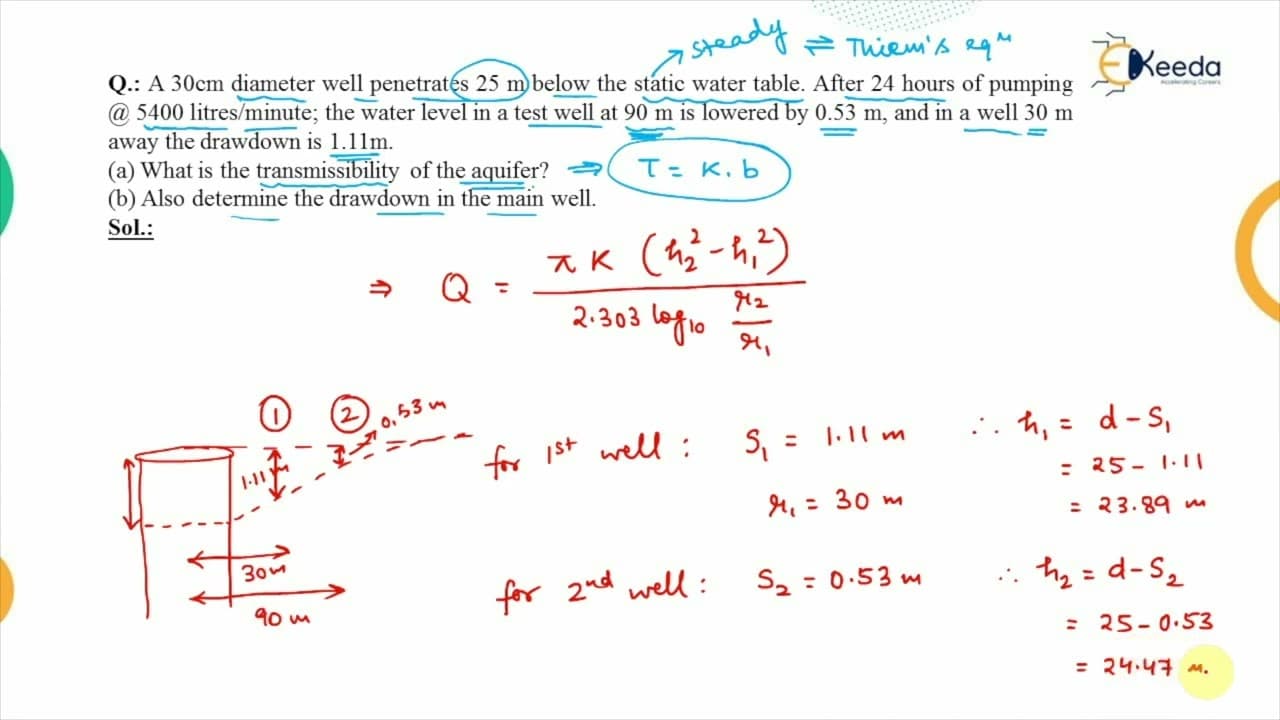
  • The second problem focuses on determining the transmissibility of an aquifer by using the Thiem's equation and given drawdown data.

  • The third problem involves calculating the drawdown in the main well by using the Thiem's equation with modified values.


Read in Other Languages (beta)

English

Share This Summary 📚

Summarize YouTube Videos and Get Video Transcripts with 1-Click

Download browser extensions on:

Try YouTube Summary with ChatGPT & Claude or YouTube Transcript Generator

Explore More Summaries from Ekeeda 📚

Program to generate the n Fibonacci numbers using recursion - Functions in C Programming thumbnail
Program to generate the n Fibonacci numbers using recursion - Functions in C Programming
Ekeeda
Anders Demonstrates His Hashing Technique In This Demo. thumbnail
Anders Demonstrates His Hashing Technique In This Demo.
Ekeeda
Electrostatic Focusing in Cathode Ray Oscilloscope CRO thumbnail
Electrostatic Focusing in Cathode Ray Oscilloscope CRO
Ekeeda
Problem 1 Parametric Amplifiers - Avalanche Transit Time Devices - Microwave Engineering thumbnail
Problem 1 Parametric Amplifiers - Avalanche Transit Time Devices - Microwave Engineering
Ekeeda
Structure For Realization of Discrete Time System In Z-Domain | Signals and Systems | Problem 1 thumbnail
Structure For Realization of Discrete Time System In Z-Domain | Signals and Systems | Problem 1
Ekeeda
Layout of SRAM thumbnail
Layout of SRAM
Ekeeda

Summarize YouTube Videos and Get Video Transcripts with 1-Click

Download browser extensions on:

Try YouTube Summary with ChatGPT & Claude or YouTube Transcript Generator

Apps & Extensions

  • Chrome Extension
  • Safari Extension
  • Edge Add-ons
  • Firefox Add-ons
  • iOS App
  • Android App

Key Features

  • YouTube Video Summarizer
  • Web & PDF Summarizer
  • Web & PDF Highlighter
  • Chat with PDF
  • Ask AI Clone
  • Audio Transcriber
  • Glasp Reader
  • Kindle Highlight Export
  • Idea Hatch

Integrations

  • Obsidian Plugin
  • Notion Integration
  • Pocket Integration
  • Instapaper Integration
  • Medium Integration
  • Readwise Integration
  • Snipd Integration
  • Hypothesis Integration

More Features

  • APIs
  • MCP Connector
  • Blog & Post
  • Embed Links
  • Image Highlight
  • Personality Test
  • Quote Shots

Company

  • About us
  • Blog
  • Community
  • FAQs
  • Job Board
  • Newsletter
  • Pricing
Terms

•

Privacy

•

Guidelines

© 2026 Glasp Inc. All rights reserved.