Products
Features
YouTube Video Summarizer
Summarize YouTube videos
Web & PDF Highlighter
Highlight web pages & PDFs
Chat with PDF
Ask any PDF questions with AI
Ask AI Clone
Chat with your highlights & memories
Audio Transcriber
Transcribe audio files to text
Glasp Reader
Read and highlight articles
Kindle Highlight Export
Export your Kindle highlights
Idea Hatch
Hatch ideas from your highlights
Integrations
Obsidian Plugin
Notion Integration
Pocket Integration
Instapaper Integration
Medium Integration
Readwise Integration
Snipd Integration
Hypothesis Integration
Apps & Extensions
Chrome Extension
Safari Extension
Edge Add-ons
Firefox Add-ons
iOS App
Android App
Discover
Discover
Ideas
Discover new ideas and insights
Articles
Curated articles and insights
Books
Book recommendations by great minds
Posts
Essays and notes from readers
Quotes
Inspiring quotes collection
Videos
Curated videos and summaries
Explore Glasp
Glasp Newsletter
Weekly insights and updates
Glasp Talk
Interview series with great minds
Glasp Blog
Latest news and articles
Glasp Use Cases
Learn how others use Glasp
Build & Support
Glasp API
Access Glasp's API for developers
MCP Connector
Connect Glasp to Claude & ChatGPT
Community
Glasp Reddit Community
Students
Student discount and benefits
FAQs
Frequently Asked Questions
AboutPricing
DashboardLog inSign up

Stanford EE259 I Lidar range and direction of arrival estimation I 2023 I Lecture 18
February 3, 2024
by
Stanford Online
YouTube video player
Stanford EE259 I Lidar range and direction of arrival estimation I 2023 I Lecture 18

TL;DR

Direct detection lidar measures the power of the incident light, while coherent lidar detects the full electromagnetic field, making it more versatile.

Transcript

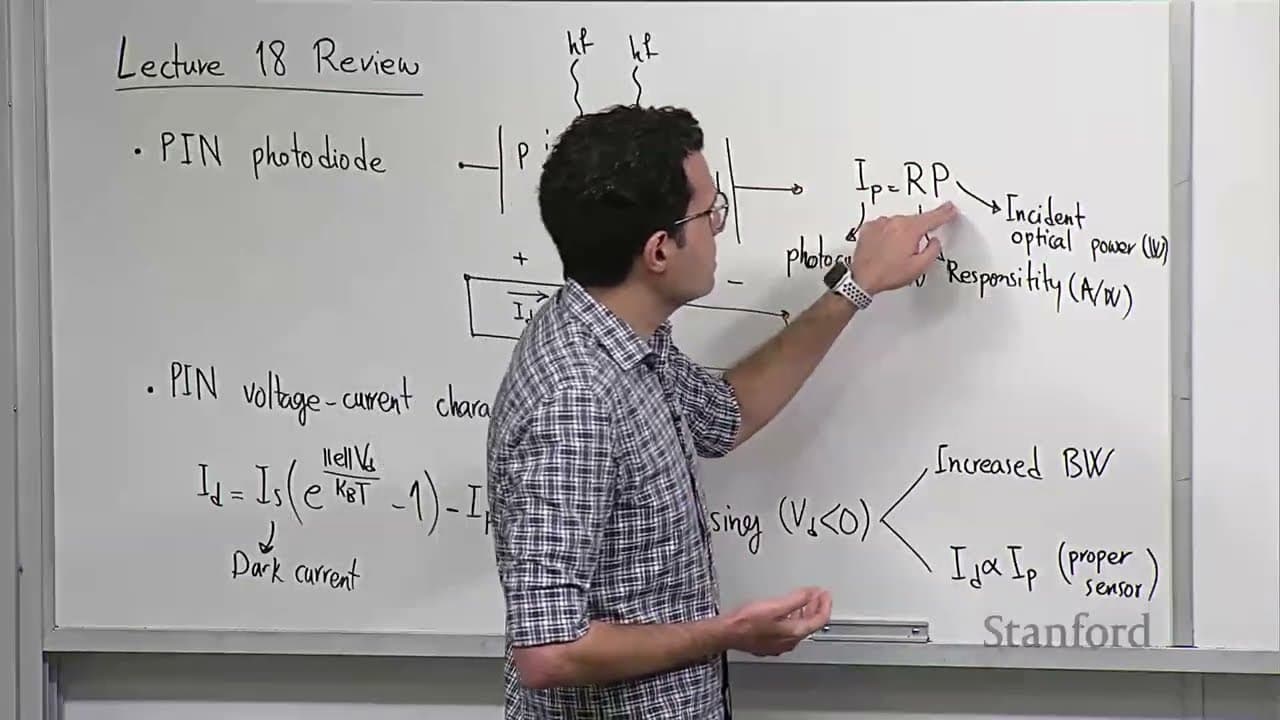
uh now let's do a quick review of uh previous lecture lecture 18. so we talked about uh pin photodiodes which are used to detect uh basically the light that is received by a lidar and we talked about the physics of it so the Pion photodiode it's like a regular diode which is a PN Junction except there is an extra material in between the p and the n... Read More

Key Insights

  • 🙂 Direct detection lidar measures the power of the incident light using a PIN photodiode, while coherent lidar detects the full complex electric field using a coherent receiver.
  • 📁 Direct detection lidar is simpler and more commonly used in the market, while coherent lidar offers additional capabilities like velocity estimation.
  • 🧡 Coherent lidar requires more complex hardware and algorithms but offers better range and SNR performance.
  • 😒 Both lidar systems can use different pulse shapes, but direct detection lidar typically uses short pulses, while coherent lidar can use FMCW or PMCW waveforms.
  • 💗 The range of a lidar system is determined by the pulse repetition interval (PRI) and pulse duration, with the maximum range being equal to (speed of light * PRI) / 2.

Install to Summarize YouTube Videos and Get Transcripts

Explore YouTube Video Summarizer or Get YouTube Transcript Extractor

Questions & Answers

Q: What are the two main types of lidar systems based on the detection method?

The two main types of lidar systems are direct detection lidar and coherent lidar.

Q: How does direct detection lidar measure the incident light?

Direct detection lidar uses a PIN photodiode to detect the incident light and measures the power of the light for ranging.

Q: What is the advantage of coherent lidar over direct detection lidar?

Coherent lidar can detect both the range and velocity of targets, while direct detection lidar can only measure the power of the incident light.

Q: How does coherent lidar recover the full electromagnetic field?

Coherent lidar uses a coherent receiver, which combines the received signal with a local oscillator signal to extract the real and imaginary parts of the electric field.

Summary & Key Takeaways

  • Direct detection lidar uses a PIN photodiode to detect the received light and measures the power of the incident light for time-of-flight estimation.

  • Coherent lidar continuously transmits waveforms using frequency modulation (FMCW) or pulse modulation (PMCW) and can detect both range and velocity by analyzing the complex electric field.


Read in Other Languages (beta)

English

Share This Summary 📚

Summarize YouTube Videos and Get Video Transcripts with 1-Click

Download browser extensions on:

Try YouTube Summary with ChatGPT & Claude or YouTube Transcript Generator

Explore More Summaries from Stanford Online 📚
Stanford CS224N NLP with Deep Learning | Winter 2021 | Lecture 16 - Social & Ethical Considerations thumbnail
Stanford CS224N NLP with Deep Learning | Winter 2021 | Lecture 16 - Social & Ethical Considerations
Stanford Online
Stanford CS229: Machine Learning | Summer 2019 | Lecture 20 - Variational Autoencoder thumbnail
Stanford CS229: Machine Learning | Summer 2019 | Lecture 20 - Variational Autoencoder
Stanford Online
Stanford AA228/CS238 Decision Making Under Uncertainty I Policy Gradient Estimation and Optimization thumbnail
Stanford AA228/CS238 Decision Making Under Uncertainty I Policy Gradient Estimation and Optimization
Stanford Online
Stanford Webinar - GPT-3 & Beyond thumbnail
Stanford Webinar - GPT-3 & Beyond
Stanford Online
Bayesian Networks 4 - Probabilistic Inference | Stanford CS221: AI (Autumn 2021) thumbnail
Bayesian Networks 4 - Probabilistic Inference | Stanford CS221: AI (Autumn 2021)
Stanford Online

Summarize YouTube Videos and Get Video Transcripts with 1-Click

Download browser extensions on:

Try YouTube Summary with ChatGPT & Claude or YouTube Transcript Generator

Apps & Extensions

  • Chrome Extension
  • Safari Extension
  • Edge Add-ons
  • Firefox Add-ons
  • iOS App
  • Android App

Key Features

  • YouTube Video Summarizer
  • Web & PDF Summarizer
  • Web & PDF Highlighter
  • Chat with PDF
  • Ask AI Clone
  • Audio Transcriber
  • Glasp Reader
  • Kindle Highlight Export
  • Idea Hatch

Integrations

  • Obsidian Plugin
  • Notion Integration
  • Pocket Integration
  • Instapaper Integration
  • Medium Integration
  • Readwise Integration
  • Snipd Integration
  • Hypothesis Integration

More Features

  • APIs
  • MCP Connector
  • Blog & Post
  • Embed Links
  • Image Highlight
  • Personality Test
  • Quote Shots

Company

  • About us
  • Blog
  • Community
  • FAQs
  • Job Board
  • Newsletter
  • Pricing
Terms

•

Privacy

•

Guidelines

© 2026 Glasp Inc. All rights reserved.