What Is the Newton-Raphson Method for Nonlinear Equations?
TL;DR
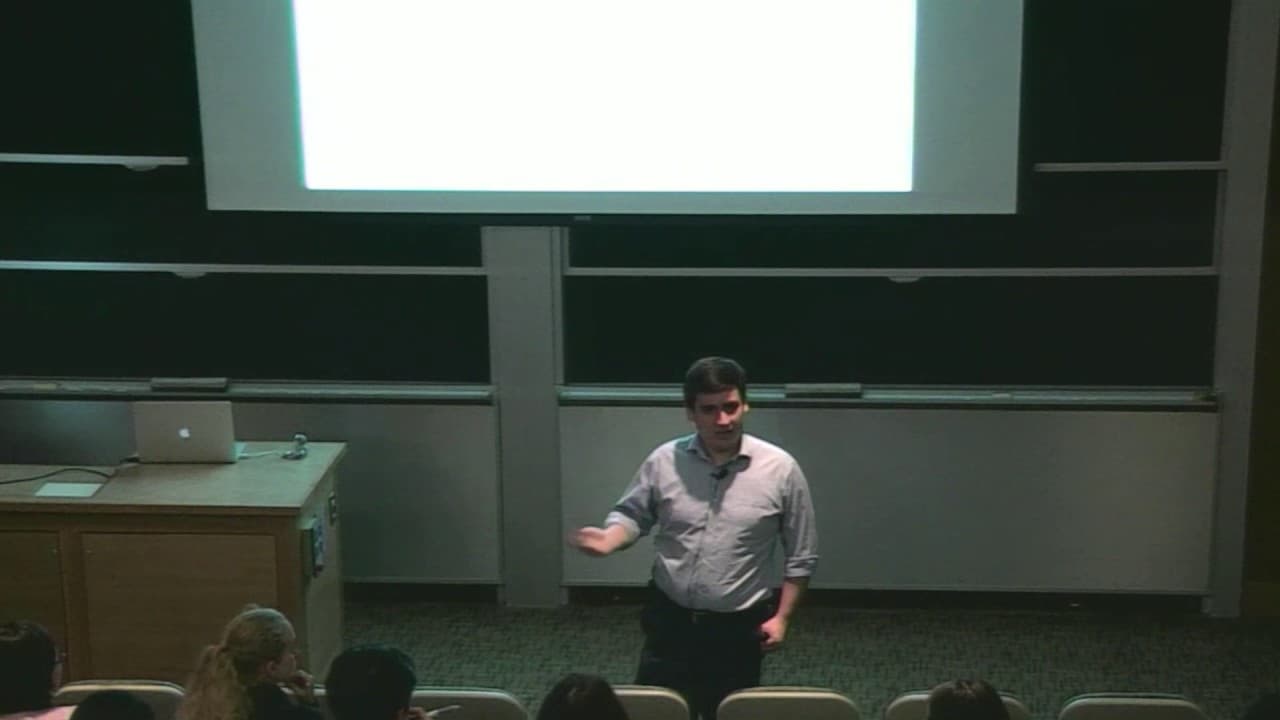
The Newton-Raphson method is an iterative technique used to solve systems of nonlinear equations by approximating their roots. It involves starting with an initial guess, calculating the Jacobian matrix to determine step size and direction, and iteratively refining the solution until convergence criteria are met. This method guarantees local convergence when the initial guess is sufficiently close to a locally unique solution.
Transcript
The following content is provided under a Creative Commons license. Your support will help MIT OpenCourseWare continue to offer high-quality educational resources for free. To make a donation, or to view additional materials from hundreds of MIT courses, visit MIT OpenCourseWare at ocw.mit.edu. OK, we're moving on. No more linear algebra. We're goi... Read More
Key Insights
- ❓ The Newton-Raphson method is an effective iterative technique for solving systems of nonlinear equations.
- 🖐️ The Jacobian matrix plays a crucial role in determining the step size and direction in each iteration.
- 😚 Convergence is guaranteed when the initial guess is sufficiently close to a locally unique solution.
- 💼 The Newton-Raphson method possesses local convergence properties, but may fail in cases of singular Jacobians or non-locally unique solutions.
Install to Summarize YouTube Videos and Get Transcripts
Explore YouTube Video Summarizer or Get YouTube Transcript Extractor
Questions & Answers
Q: What is the Newton-Raphson method?
The Newton-Raphson method is an iterative technique used to find the root of a nonlinear equation. It involves approximating the function as linear and using the Jacobian matrix to determine the step size and direction in each iteration.
Q: How does the Newton-Raphson method ensure convergence?
The Newton-Raphson method possesses a local convergence property, which means that if an initial guess is sufficiently close to a locally unique solution, the method will converge to that solution within a certain neighborhood.
Q: What is the role of the Jacobian matrix in the Newton-Raphson method?
The Jacobian matrix is used to approximate the derivative of the function and provides information about the direction and magnitude of the step in each iteration. It is also used to solve the system of linear equations to obtain the step size.
Q: What are the convergence criteria used in the Newton-Raphson method?
The convergence criteria include the function norm criterion and the step norm criterion. The function norm criterion checks if the function value is sufficiently close to zero, while the step norm criterion compares the step size with an absolute or relative tolerance.
Summary & Key Takeaways
-
The content introduces the concept of systems of nonlinear equations and their applications in various fields.
-
The Newton-Raphson method is presented as an iterative approach to solving nonlinear equations, where an initial guess is used to approximate the root of the equation.
-
The process of linearizing the function and finding the Jacobian matrix is explained, which is used to determine the direction and magnitude of the step in each iteration.
-
The convergence criteria for stopping the iterations are discussed, including the function norm and step norm criteria.
-
The concept of local convergence is introduced, where the Newton-Raphson method is guaranteed to converge to a locally unique solution within a certain neighborhood.
Read in Other Languages (beta)
Share This Summary 📚
Summarize YouTube Videos and Get Video Transcripts with 1-Click
Try YouTube Summary with ChatGPT & Claude or YouTube Transcript Generator
Explore More Summaries from MIT OpenCourseWare 📚

Summarize YouTube Videos and Get Video Transcripts with 1-Click
Try YouTube Summary with ChatGPT & Claude or YouTube Transcript Generator