What Are the Differences Between Fresnel and Fraunhofer Diffraction?
TL;DR
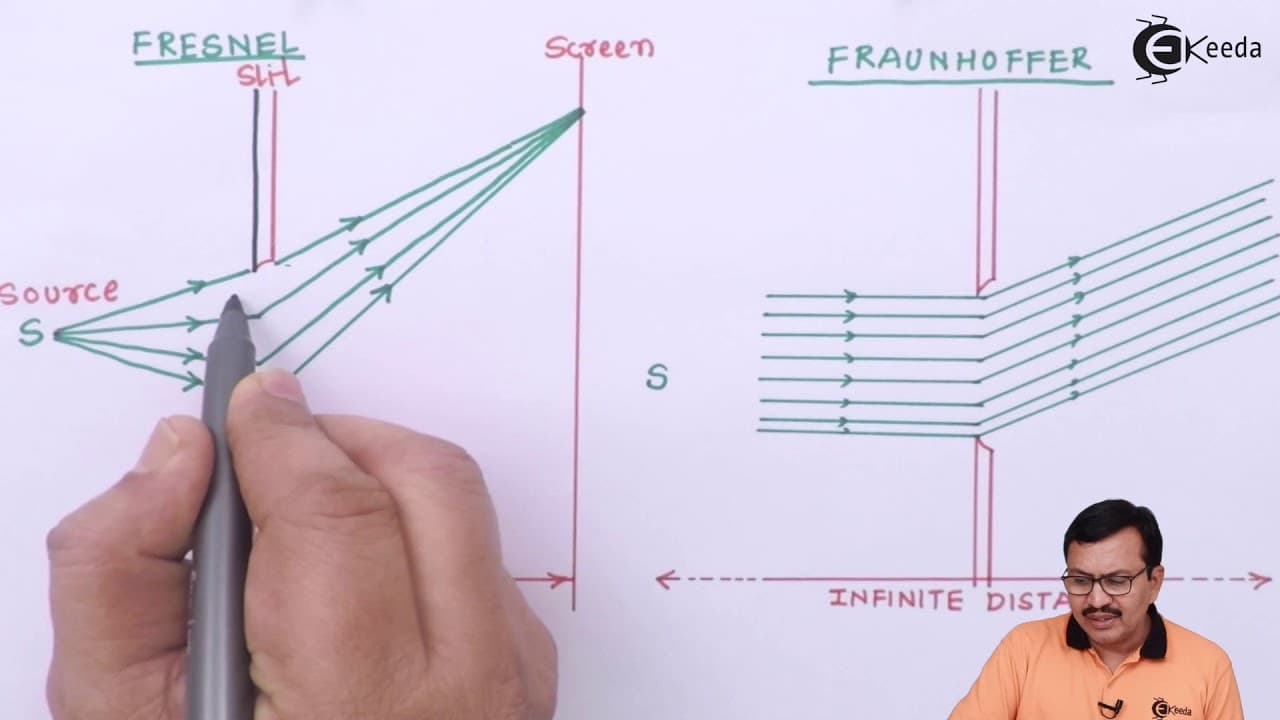
Fresnel diffraction occurs when a light source is at a finite distance from an obstacle, while Fraunhofer diffraction involves parallel light rays from an infinite distance. Key differences include the nature of wave fronts—cylindrical or spherical in Fresnel versus plane in Fraunhofer—and the use of lenses in Fraunhofer diffraction to focus light, unlike in Fresnel diffraction.
Transcript
click the bell icon to get latest videos from akira hello friends in this video we are going to learn the different types of diffraction namely frill and diffraction and front of a diffraction and also the differences between these two type of diffractions so what is the frontal type of diffraction in the foreigner type of diffraction you have a so... Read More
Key Insights
- 💻 Fresnel diffraction occurs when the source-screen distance is finite, while Fraunhofer diffraction occurs with an infinite source-screen distance.
- 👋 Fresnel diffraction has cylindrical/spherical wave fronts, while Fraunhofer diffraction has plane wave fronts.
- 👋 The phases of the waves in Fresnel diffraction are varying, while in Fraunhofer diffraction, they are constant.
- 😁 Lenses can be utilized in Fraunhofer diffraction for focusing the refracted beams.
- 😒 Fresnel diffraction does not involve the use of lenses.
- 🙂 Both types of diffraction involve the bending of light rays when they encounter an obstacle.
- 😥 Fresnel diffraction intensity is observed on a screen at a particular point, while Fraunhofer diffraction intensity can be calculated for any point on the screen.
Install to Summarize YouTube Videos and Get Transcripts
Explore YouTube Video Summarizer or Get YouTube Transcript Extractor
Questions & Answers
Q: What is the difference between Fresnel and Fraunhofer diffraction?
Fresnel diffraction occurs when the source and screen distances are finite, while Fraunhofer diffraction occurs with an infinite source-screen distance. Additionally, Fresnel diffraction involves cylindrical/spherical wave fronts, while Fraunhofer diffraction has plane wave fronts.
Q: How are the phases of the waves different in Fresnel and Fraunhofer diffraction?
In Fresnel diffraction, the phases of the incident wave in the plane of the obstacle are varying, while in Fraunhofer diffraction, the phases of the incident wave in the plane of the slit are constant.
Q: Can lenses be used in Fraunhofer diffraction?
Yes, lenses can be used in Fraunhofer diffraction. A bi-convex lens is placed near the source and another near the screen to develop a plane wave front and focus the refracted beams to a single point on the screen.
Q: What are the main criteria of Fresnel diffraction?
The main criteria of Fresnel diffraction include a finite source-screen distance, incident wave fronts that are cylindrical/spherical, varying phases of the waves in the plane of the obstacle, and the absence of lenses.
Summary & Key Takeaways
-
The Fresnel type of diffraction occurs when a source of light from a finite distance passes through an obstacle and is observed at a finite distance on a screen.
-
In contrast, Fraunhofer diffraction involves parallel rays of light that bend simultaneously when they reach an obstacle.
-
The main differences between Fresnel and Fraunhofer diffraction include the finite vs. infinite source-screen distance, cylindrical/spherical vs. plane wave fronts, constant vs. varying phases of the waves, and the use of lenses in Fraunhofer diffraction.
Read in Other Languages (beta)
Share This Summary 📚
Summarize YouTube Videos and Get Video Transcripts with 1-Click
Try YouTube Summary with ChatGPT & Claude or YouTube Transcript Generator
Explore More Summaries from Ekeeda 📚





Summarize YouTube Videos and Get Video Transcripts with 1-Click
Try YouTube Summary with ChatGPT & Claude or YouTube Transcript Generator