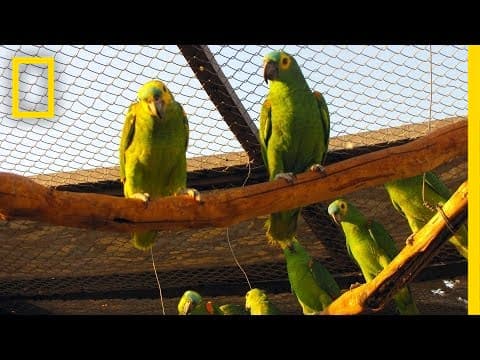
Juliana Machado Ferreira: The Stolen Birds of Brazil | Nat Geo Live
TL;DR
Exposing the consequences of illegal wildlife trade and advocating for conservation efforts to protect wild species.
Transcript
( intro music ) ( applause ) Juliana: Today I would like to invite you on a journey to show you not judgmentally but why we shouldn't keep wild animals from wild species as pets. Wildlife trafficking globally encompasses many ways of exploiting wildlife as it was very well shown here. From the production of souvenirs to the creation in food items, ... Read More
Key Insights
- 🐶 Cultural attitudes towards wildlife influence illegal pet trade.
- 😣 Illegal wildlife trade has severe consequences beyond animal welfare.
- 👨🔬 Conservation efforts involve research, rehabilitation, and advocacy.
- ❓ Commercial captive breeding may not be a sustainable solution.
- ❓ Genetic diversity is crucial for wild species' survival.
- 👮 Law enforcement and policy changes are essential in combating wildlife trafficking.
- 🤩 Education plays a key role in changing perceptions and behaviors.
Install to Summarize YouTube Videos and Get Transcripts
Explore YouTube Video Summarizer or Get YouTube Transcript Extractor
Questions & Answers
Q: What are the main reasons behind the illegal wildlife trade in Brazil?
The main reasons include a cultural acceptance of keeping wild pets, lack of awareness about the consequences, and a profitable black market for exotic animals.
Q: How does illegal wildlife trade impact the environment beyond animal welfare?
It disrupts ecosystems by altering plant growth, reducing seed dispersal, affecting predator-prey dynamics, and potentially leading to species extinction due to genetic homogenization.
Q: What are the challenges faced in rehabilitation and release of illegally seized animals?
Ensuring animals are healthy, exhibit wild behaviors, released in safe areas, and maintaining genetic diversity are key challenges to prevent recapture and support their survival in the wild.
Q: What are the proposed solutions to combat wildlife trafficking?
Education and awareness campaigns, research and mitigation efforts, responsible releases, capacity enhancement for law enforcement, and advocating for legislative changes are proposed solutions.
Summary & Key Takeaways
-
Illegal wildlife trade is a global issue, exploiting wild animals for various purposes.
-
Brazil has a cultural tendency to keep wild animals as pets, contributing to wildlife trafficking.
-
Solutions include education, research, responsible releases, and changing legislation.
Read in Other Languages (beta)
Share This Summary 📚
Summarize YouTube Videos and Get Video Transcripts with 1-Click
Try YouTube Summary with ChatGPT & Claude or YouTube Transcript Generator
Explore More Summaries from National Geographic 📚






Summarize YouTube Videos and Get Video Transcripts with 1-Click
Try YouTube Summary with ChatGPT & Claude or YouTube Transcript Generator