Finding Derivatives Using Logarithms - Differential Calculus
TL;DR
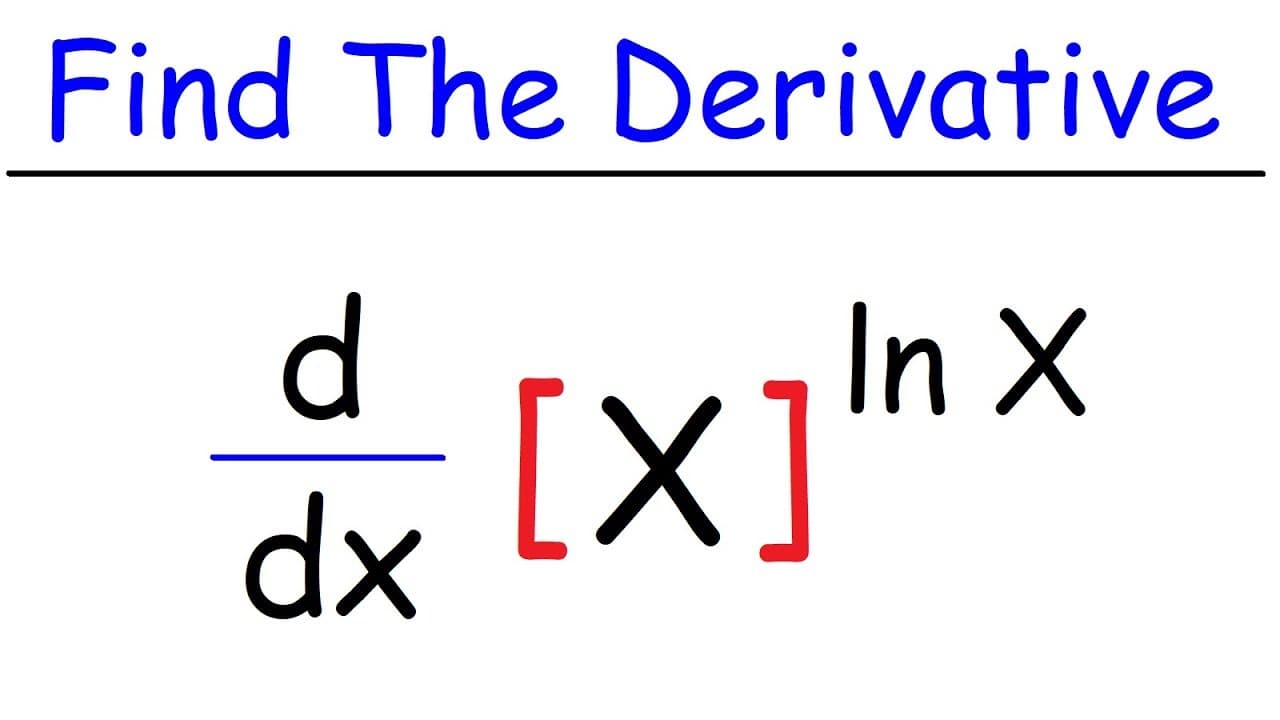
This video explains how to find the derivative of an expression with a variable raised to the natural logarithm of another variable using logarithmic differentiation.
Transcript
what is the derivative of x raised to the natural log of x how do we find the derivative of a variable raised to another variable in this video we're going to talk about how to do just that so we're going to need to use logarithms specifically a process called logarithmic differentiation so the first thing we're going to do is set this expression e... Read More
Key Insights
- 🤨 Logarithmic differentiation is a useful technique for finding the derivative of functions with variables raised to another variable.
- 🙃 Taking the natural log of both sides allows for simplification using logarithmic properties.
- 😀 Differentiating ln y requires applying the derivative of the variable within the natural log.
- ✊ Using the chain rule is necessary when differentiating ln x raised to a power.
- 😑 The final answer can be simplified by adjusting exponents and rearranging terms in the derivative expression.
- ❓ Logarithmic differentiation can be utilized for various exponential functions involving logarithms.
- 📏 Understanding the concept of composite functions and the chain rule is essential in applying logarithmic differentiation.
Install to Summarize YouTube Videos and Get Transcripts
Explore YouTube Video Summarizer or Get YouTube Transcript Extractor
Questions & Answers
Q: What is logarithmic differentiation used for in calculus?
Logarithmic differentiation is a technique used to find the derivative of functions with variables raised to another variable.
Q: Why do we take the natural log of both sides before finding the derivative?
Taking the natural log allows us to apply logarithmic properties and simplify the expression before finding the derivative.
Q: What is the derivative of ln(x)?
The derivative of ln(x) is 1/x.
Q: How do we handle composite functions in logarithmic differentiation?
Composite functions require using the chain rule to find the derivative, where we differentiate the outer function while keeping the inside function unchanged.
Summary & Key Takeaways
-
The video introduces logarithmic differentiation as a method to find the derivative of an expression with a variable raised to another variable.
-
The process starts by setting the expression equal to y and taking the natural log of both sides.
-
The derivative of the expression includes applying the derivative of ln y and using the chain rule for the derivative of ln x squared.
Read in Other Languages (beta)
Share This Summary 📚
Summarize YouTube Videos and Get Video Transcripts with 1-Click
Try YouTube Summary with ChatGPT & Claude or YouTube Transcript Generator
Explore More Summaries from The Organic Chemistry Tutor 📚

Summarize YouTube Videos and Get Video Transcripts with 1-Click
Try YouTube Summary with ChatGPT & Claude or YouTube Transcript Generator